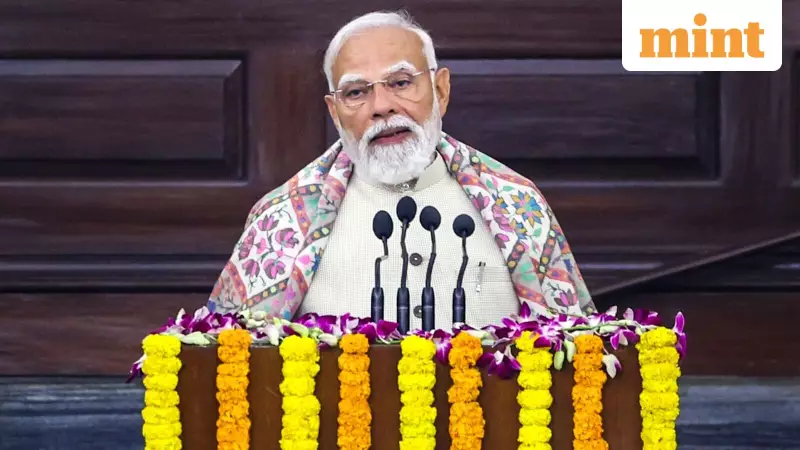
Prime Minister Narendra Modi delivered a powerful address at the 28th Conference of Speakers and Presiding Officers of the Commonwealth. He spoke at Parliament House, now known as Samvidhan Sadan. Modi strongly emphasized India's unwavering advocacy for the Global South on every international platform.
India's Commitment to the Global South
PM Modi noted India's dedicated efforts during its G20 presidency. He stated that the country placed the concerns of the Global South at the very heart of the global agenda. India is committed to ensuring that its innovations benefit the entire Global South and all Commonwealth nations.
"We are also creating open-source technology platforms," the Prime Minister explained. "This allows our partner countries in the Global South to develop systems similar to those in India." He highlighted that this approach fosters shared growth and technological advancement.

Showcasing India's Progress
Modi pointed to India's current status as the world's fastest-growing major economy. He cited specific achievements that demonstrate this progress. The Unified Payments Interface has emerged as the largest digital payment platform globally. India leads as the top producer of vaccines and ranks second worldwide in steel production.
The Inclusive Nature of Indian Democracy
Prime Minister Modi highlighted how Indian democracy operates with a spirit of public welfare. He stressed its inclusive nature, ensuring that benefits reach even the last mile. "We are working inclusively, ensuring that no one is left behind," Modi affirmed.
This commitment has yielded significant results. In recent years, India has lifted approximately 25 crore people out of poverty. "In India, democracy truly delivers," the Prime Minister stated. "In India, democracy means last-mile delivery."
Deep Democratic Roots
PM Modi reflected on India's rich democratic traditions. He described democracy in India as "like a large tree supported by deep roots." The Prime Minister referenced historical instances from ancient texts like the Vedas and the teachings of Buddha.
"We have a long tradition of debates, dialogue and collective decision-making," he noted. "India is called the mother of democracy. Our sacred text, the Vedas, is over 5000 years old. They refer to assemblies where people met to discuss issues, and decisions were taken after discussions and agreement."
Recalling the 2024 General Elections
Speaking on the immense scale of Indian democracy, PM Modi recalled the 2024 general elections. He described them as the largest democratic exercise in human history. Almost 980 million citizens were registered to vote in that election.
"This number is larger than the population of some continents," the PM observed. Over 8,000 candidates and more than 700 political parties participated. Modi also highlighted a record-breaking number of women voters. He emphasized that women now occupy prominent leadership roles, including the President of India and the Chief Minister of Delhi.
Addressing Doubts and Demonstrating Strength
PM Modi acknowledged that doubts have existed about India's progress despite its democratic framework. "Contrary to these doubts," he asserted, "India has demonstrated that democratic institutions and processes provide stability, scale, and speed to its development."
The Prime Minister asserted that India's democratic model successfully combines scale, inclusivity, and public welfare. India remains committed to both national progress and advancing the interests of developing countries globally.
Significance of Samvidhan Sadan
Modi spoke about the historical importance of the Central Hall, now called Samvidhan Sadan. This was the meeting place of the Constituent Assembly during India's fight for independence. For 75 years after independence, this building served as the Parliament of India.
"Many important decisions and discussions concerning India's future took place in this very hall," the Prime Minister noted. "Now, India has named this place, dedicated to democracy, as the Constitution House."

About the CSPOC Conference
The Conference of Speakers and Presiding Officers of the Commonwealth is a high-level gathering. It runs from January 14 to 16 and is led by Lok Sabha Speaker Om Birla. The event will see participation from 61 Speakers and Presiding Officers representing 42 Commonwealth nations. Representatives from four semi-autonomous parliaments will also attend.
CSPOC plans to discuss a range of contemporary parliamentary issues. The goal is to strengthen democratic institutions and modernize legislative practices. Major themes cover the evolving roles of Speakers and Presiding Officers.
Discussions will also focus on advances in technology for parliamentary work. Participants will explore methods to boost citizen participation in democracy beyond just voting.
Key Discussion Topics
The conference agenda includes several important sessions:
- "AI in Parliament: Balancing Innovation, Oversight, and Adaptation," led by Malaysia.
- "Social Media and Its Impact on Parliamentarians," presented by Sri Lanka.
- "Innovative Strategies to Enhance Public Understanding of Parliament and Citizen Participation Beyond Voting," with contributions from Nigeria and South Africa.
Other sessions will address the security, health, and well-being of Members of Parliament and parliamentary staff. A special plenary discussion will focus on the role of Speakers and Presiding Officers in safeguarding strong democratic institutions.