

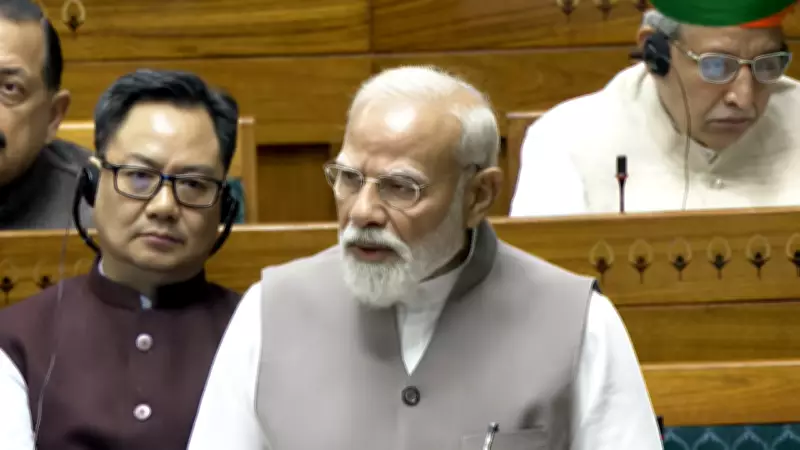
PM Modi Delivers Comprehensive Address on West Asia Crisis in Parliament
Prime Minister Narendra Modi on Monday delivered a detailed statement in the Lok Sabha regarding the escalating crisis in West Asia, which was triggered on February 28 following joint military actions by the United States and Israel against Iran. This development has plunged the strategically vital Gulf region into significant turmoil, with far-reaching implications.
Global Economic Ramifications and India's Strategic Concerns
The Prime Minister underscored that the continuous bombings and strikes across the oil-rich region have posed severe challenges to the global economy. He elaborated that India, with its extensive trade relations with countries embroiled in or affected by the conflict, faces unique vulnerabilities. The region is not only a crucial partner for trade but also serves as an essential maritime route, particularly for a substantial portion of India's crude oil, gas, and fertilizer imports via the Strait of Hormuz.
"The crisis in West Asia has negatively impacted the global economy and people," PM Modi stated, adding, "The West Asia war has created unprecedented challenges for India as well." He emphasized that the movement of commercial ships through the Strait of Hormuz has become exceptionally challenging since the conflict began, threatening energy security.

Safety and Support for the Indian Diaspora
A paramount concern highlighted by the Prime Minister is the safety and well-being of the large Indian community in the Gulf. Nearly 1 crore Indians live and work across the Gulf countries, with many serving as crew members on commercial vessels. PM Modi assured the House that the government is extending full support to all Indian nationals in the affected areas.
"Since this war began, every Indian in the affected countries has been provided assistance," he affirmed. Indian missions are maintaining constant communication with the diaspora, issuing regular advisories, and have established 24/7 emergency helplines and outreach rooms both in India and in the affected nations to provide the latest information and aid.
Remarkably, over 3,75,000 Indians have returned safely to India since the onset of the conflict. This includes nearly 1,000 individuals from Iran, of which more than 700 are medical students. The Prime Minister noted that he has engaged in two rounds of telephonic discussions with the heads of state of most West Asian countries, all of whom have assured the safety of Indian citizens.
Government Measures to Mitigate Domestic Impact
In response to the crisis, the Indian government has implemented several proactive measures to cushion the domestic economy and ensure public welfare. Despite the uncertainty in supply chains, efforts have been made to prevent severe disruptions in the availability of petrol, diesel, and gas. Given that India imports 60% of its LPG requirements, the government has prioritized domestic LPG consumers and is simultaneously working to increase domestic LPG production.
Furthermore, in an important step for education, the Central Board of Secondary Education (CBSE) has cancelled Class 10 and 12 examinations in schools located in Gulf countries. The board is taking necessary steps to ensure that students' education continues without significant disruption amidst the volatile situation.
Call for Parliamentary Consensus and Global Resolution
PM Modi stressed the necessity for a unified voice from the Indian Parliament on this international issue. "Therefore, it is essential that a unified voice and consensus reach the world regarding this crisis from the Parliament," he asserted. He described the situation as "worrisome" and noted that External Affairs Minister S. Jaishankar and Union Minister Hardeep Puri have previously briefed the House on developments over the past two to three weeks.
The Prime Minister concluded by highlighting that the conflict, ongoing for more than three weeks, is severely impacting the global economy and people's lives, which is why the international community is urging all sides for an early and peaceful resolution.






