

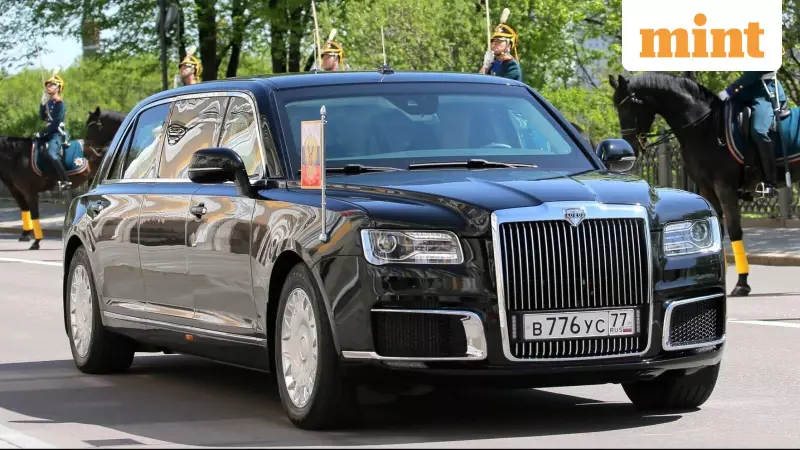
Russian President Vladimir Putin is scheduled to land in New Delhi this evening for a pivotal diplomatic engagement, arriving in his signature armored state car, the Aurus Senat Limousine. This visit underscores the strategic partnership between the two nations at a time of significant global trade realignments.
Putin's Fortress on Wheels: The Aurus Senat
The Russian leader's preferred mode of transport, the retro-styled, bulletproof Aurus Senat, accompanies him on all major foreign trips. First unveiled during his 2018 presidential inauguration, this full-size luxury vehicle is engineered by Moscow's NAMI and Aurus Motors. It is often described as a mobile fortress, designed to offer maximum security to its occupant.
Key specifications of the limousine highlight its formidable nature. Valued at approximately ₹5.5 crore (50 million rubles), it boasts a powerful 4.4-litre V8 engine generating 598 bhp, with an optional 850-bhp V12. The cabin features leather-lined interiors, ambient lighting, and premium wood trim. For challenging environments like Delhi's air, it is equipped with a sophisticated air filtration system, alongside critical safety features like a built-in fire suppression mechanism.

High-Powered Russian Delegation
President Putin will not be traveling alone. He is accompanied by a high-level Russian delegation comprising key ministers and heads of major state corporations. Notable members include Defence Minister Andrey Belousov and Dmitry Shugayev, Director of the Federal Service for Military-Technical Cooperation.
The delegation also features representatives from the Federal Customs Service, financial watchdog Rosfinmonitoring, and the top executives of Russia's flagship corporations: Roscosmos (space), Rosatom (nuclear energy), and VEB.RF (development bank). This composition signals a focus on deepening cooperation in defense, space, energy, and trade.
Strategic Talks Amid Global Tensions
This bilateral summit carries substantial weight given the current geopolitical climate. The talks are set against the backdrop of ongoing trade tensions between India and the United States. Former US President Donald Trump's administration had imposed tariffs of up to 50% on certain Indian imports, with penalties linked, in part, to India's energy and defense procurement from Russia.
The meeting in Delhi is therefore viewed as a crucial moment to reinforce the India-Russia strategic axis, exploring avenues to bolster trade and collaboration in sensitive sectors while navigating complex international pressures.






