Putin Signals Readiness to Deploy Frozen US Assets for Dual Purposes
In a significant diplomatic maneuver, Russian President Vladimir Putin has indicated Moscow's preparedness to utilize Russian state assets frozen in the United States for two distinct objectives: supporting post-war reconstruction efforts in Ukraine and contributing to US President Donald Trump's proposed "Board of Peace" initiative focused on Gaza. This strategic announcement comes as analysts interpret it as a calculated attempt to alleviate pressure from Washington while simultaneously reshaping negotiations concerning Europe's deadliest conflict since World War II.
Putin Floats Specific Allocation Plans for Frozen Funds
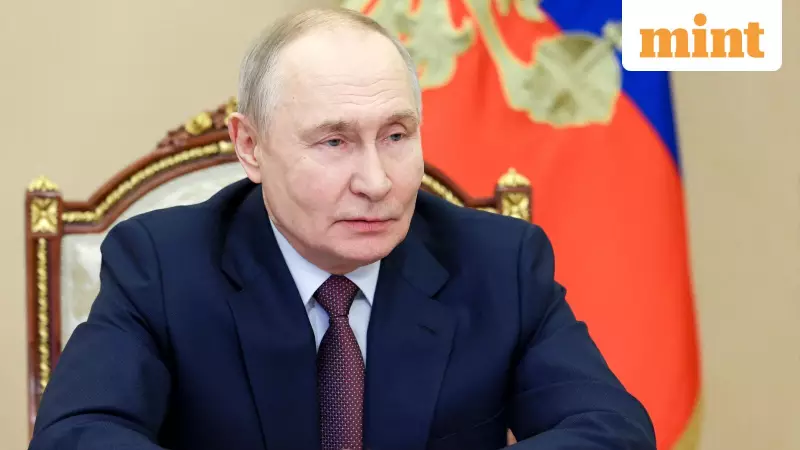
Speaking during a meeting of Russia's Security Council, Putin explicitly outlined Moscow's intentions regarding funds from Russian assets immobilized in the United States following Russia's 2022 invasion of Ukraine. He proposed that, after a peace treaty is formally concluded between Russia and Ukraine, the remaining financial resources could be directed toward rebuilding Ukrainian territories that have suffered extensive damage throughout the prolonged conflict.
"The remaining funds from our frozen assets in the US could also be used to rebuild territories damaged by the fighting after the conclusion of a peace treaty between Russia and Ukraine," Putin stated during his address.

Furthermore, Putin added that Russia could immediately allocate $1 billion from those same frozen assets specifically for Trump's proposed Board of Peace, even before Moscow's formal participation in the international body is finalized. "Even before we resolve the issue of participation in the Peace Council and its work, given Russia's special relationship with the Palestinian people, I believe we could direct one billion dollars to the Peace Council from Russian assets frozen under the previous US administration," Putin elaborated.
Upcoming Moscow Talks with Trump Envoys to Address Proposals
Putin revealed that this proposal has already been preliminarily discussed with US officials and will be revisited on Thursday during high-level meetings in Moscow with Trump's designated envoys, Steve Witkoff and Jared Kushner. These discussions are anticipated to comprehensively cover both the Ukrainian peace process and Trump's "Board of Peace" initiative for Gaza.
The Kremlin confirmed that the talks would "continue dialogue on the Ukrainian settlement" at a critical juncture when Trump has publicly suggested that an agreement to end the war may be within reach. "I think I can say that we're reasonably close," Trump remarked. "We have to get it stopped ... I believe they're at a point now where they can come together and get a deal done."
United States envoy Steve Witkoff confirmed his travel to Moscow later on Thursday to discuss ending the war in Ukraine, telling an audience at the World Economic Forum, "I think we've made a lot of progress," while noting negotiations were down to one final issue. "So if both sides want to solve this, we're going to get it solved," Witkoff told attendees in Davos. He additionally highlighted that establishing a tariff-free zone in Ukraine would prove "game-changing" for the nation's economy.
Modest Scale of Funds Contrasts with Vast Reconstruction Needs
Despite the headline-grabbing figures, the actual scale of Russia's financial offer remains relatively modest. Only approximately $4–5 billion of Russian assets are estimated to be held within the United States, representing merely a fraction of the roughly $300 billion in frozen Russian reserves worldwide—the majority of which are located across various European nations.
This limited amount presents a stark contrast when measured against Ukraine's immense reconstruction requirements. As of February 2025, the projected cost for reconstruction, alongside broader economic and social recovery, was estimated at around $524 billion over the forthcoming decade—a figure that continues escalating as the conflict persists without resolution.

Diplomatic Overture Aims to Avert Further US Pressure
Collectively, these proposals constitute a diplomatic overture strategically designed to appeal directly to Trump while forestalling additional economic penalties, utilizing funds that the Kremlin does not currently control. Russia has actively sought to prevent further US sanctions targeting itself and its trading partners, even as it demonstrates little indication of fundamentally altering the war it initiated nearly four years ago.
Trump, for his part, has alternated between blaming Putin and Ukrainian President Volodymyr Zelensky for obstructing peace, while simultaneously threatening tariffs and sanctions on Russian trading partners during moments of frustration. Substantial gaps persist within Trump's proposed peace framework, particularly regarding Russia's insistence that Ukraine cede territory it does not fully control.
Conflict Grinds On Despite Ongoing Peace Negotiations
Meanwhile, the devastating conflict continues exacting a heavy humanitarian and infrastructural toll. Both Ukraine and Russia have escalated attacks targeting energy infrastructure as the invasion approaches its fifth year. This winter witnessed Russia intensifying strikes on Ukraine's power grid, leaving millions without reliable heating and water during freezing conditions.
Putin noted he also plans to discuss the potential $1 billion contribution to the Board of Peace with Palestinian President Mahmoud Abbas, whom he is scheduled to meet in person. Trump has invited numerous world leaders to join the Board of Peace, a central pillar of his 20-point plan to end the Gaza war, with participation requiring a substantial financial commitment—Trump has demanded countries contribute at least $1 billion for permanent membership, thereby linking conflicts thousands of miles apart through this diplomatic initiative.