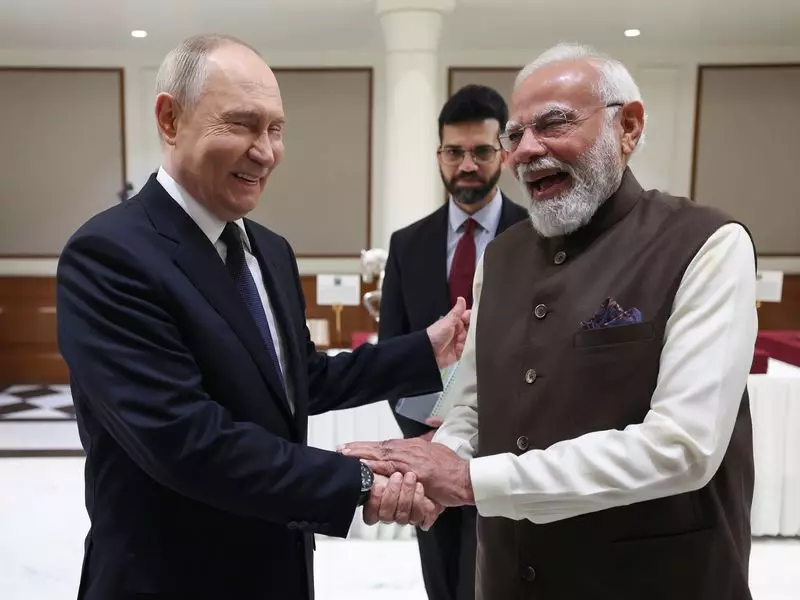
Russian President Vladimir Putin concluded a significant visit to India, laying out a comprehensive and ambitious plan to deepen the strategic partnership between the two nations across several critical domains. The high-level talks, centered on the 21st India-Russia Annual Summit, resulted in concrete agreements and a shared vision for future collaboration.
A Summit of Substantial Outcomes
The diplomatic engagement between President Putin and Prime Minister Narendra Modi was marked by the signing of 28 key agreements. These pacts spanned a wide spectrum of bilateral cooperation, with a pronounced focus on defence, trade, energy, and space exploration. The leaders emphasized that the special and privileged strategic partnership between India and Russia remains resilient and is poised for further growth.
In his statements, President Putin was explicit about the visit's purpose. He stated that a detailed roadmap had been established to enhance collaboration in vital sectors. This plan is designed not just to maintain existing ties but to aggressively expand them into new and emerging areas of mutual interest, ensuring the relationship evolves with the times.

Key Pillars of the New Roadmap
The ambitious collaboration plan hinges on several foundational pillars. In the realm of defence and military-technical cooperation, the two countries reaffirmed their commitment. Discussions progressed on the joint manufacturing of advanced military hardware, including the potential production of Russian weaponry within India. This aligns with India's 'Make in India' initiative and aims to bolster national defence capabilities while deepening industrial integration.
Energy security formed another crucial chapter of the talks. With global energy markets in flux, India and Russia are strengthening their partnership in this sector. The collaboration extends beyond the simple buyer-seller dynamic to include long-term contracts, joint exploration projects, and investments in energy infrastructure. This ensures a stable and predictable energy supply for India's growing economy.
Trade, Space, and Regional Stability
Addressing the economic dimension, both leaders set a target to increase annual bilateral trade to $30 billion by 2025. To achieve this, they agreed to work on removing trade barriers, simplifying customs procedures, and boosting investments. The use of national currencies, like the Russian Ruble and Indian Rupee, for settlements was also discussed to insulate trade from external financial volatility.
Space exploration, a traditional area of cooperation, received renewed impetus. The partnership between ISRO and Roscosmos is set to enter a new phase, with potential collaboration on satellite technology, lunar research, and manned space missions. Furthermore, the leaders exchanged views on pressing regional and global issues, including the situation in Afghanistan and the need for a united front against terrorism, underscoring their aligned perspectives on international security.
Strengthening an Enduring Partnership
The outcomes of this summit signal a deliberate and strategic effort to future-proof the India-Russia relationship. By moving beyond historical ties and crafting a forward-looking, action-oriented roadmap, both nations have demonstrated their commitment to a partnership that adapts to contemporary geopolitical and economic realities.
The visit successfully translated longstanding diplomatic warmth into tangible, executable agreements. The 28 signed MOUs and the clear political direction provide a robust framework for ministries and businesses in both countries to engage more deeply. As global dynamics shift, the reinforced India-Russia strategic axis is poised to play a stabilizing role, serving the national interests of both countries while contributing to a multipolar world order.