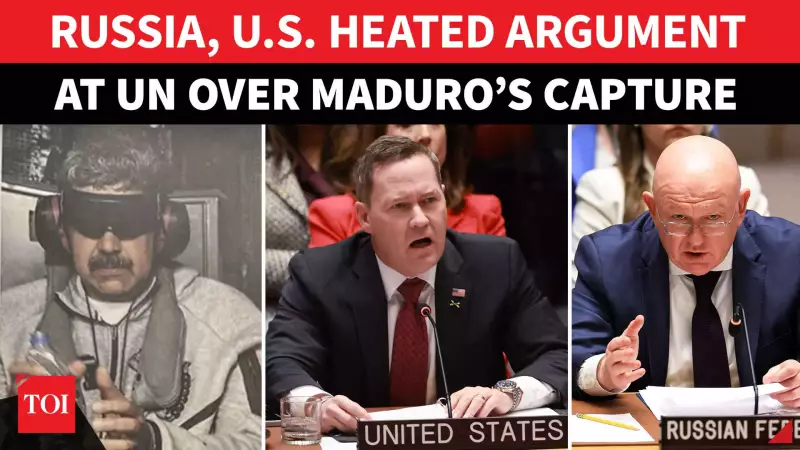
In a dramatic escalation of international tensions, Russia has launched a scathing diplomatic assault against the United States following the capture of Venezuelan President Nicolás Maduro and his wife by U.S. forces. The incident, which occurred recently, triggered a heated emergency session of the United Nations Security Council (UNSC) where Moscow accused Washington of committing a criminal act and recklessly abusing its power.
Diplomatic Fury at the United Nations
The UNSC meeting turned into a fierce confrontation as Russian diplomats unleashed a furious broadside against the American operation. Russia's envoy to the UN branded the capture of the Venezuelan leader a blatant violation of international law. Moscow's core accusation was that the United States, under the Trump administration, was shredding established global norms and imposing its will through brute force rather than adhering to rules-based order.
The Russian representative issued a stark warning, stating that President Trump's shock move to apprehend Maduro could trigger horrifying and unpredictable consequences. They labelled the seizure an irresponsible action that risks pushing already high global tensions into dangerous new territory, potentially destabilising international relations far beyond the Americas.

The US Operation and Immediate Aftermath
The operation, executed by U.S. forces, resulted in the capture of President Nicolás Maduro and his wife, Cilia Flores. While the exact location and tactical details of the capture were not fully disclosed in the UNSC debate, the political fallout was immediate and severe. The event, dated around January 6, 2026, represents one of the most direct military interventions by the U.S. in Latin America in recent decades, drawing immediate parallels to historical operations in the region.
Russia's reaction was not merely critical but framed in the language of impending crisis. By characterising the act as "criminal," Moscow positioned itself as the chief defender of state sovereignty against what it portrayed as American imperialism. This stance is expected to rally other nations wary of U.S. interventionism and could significantly reshape alliances within the UN.
Broader Implications and Global Reactions
The capture of Maduro and the subsequent Russian condemnation have thrust the Venezuela crisis back into the centre of global geopolitics. The move signals a highly aggressive phase in Trump's foreign policy, demonstrating a willingness to use direct military action to achieve political objectives against regimes labelled as adversarial.
The warnings from Russia about "dangerous new territory" suggest a potential for retaliatory measures, either in the form of escalated rhetoric, vetoes at the UNSC on matters crucial to the West, or increased support for U.S. adversaries elsewhere. The incident also raises profound questions about the future of international law regarding sovereignty and intervention, setting a precedent that other powerful nations might later cite for their own actions.
For India, a nation that maintains strategic relationships with both the United States and Russia, this development presents a delicate diplomatic challenge. New Delhi has traditionally advocated for dialogue and peaceful resolution in Venezuela. The unilateral U.S. action and the sharp polarisation at the UNSC will require careful navigation to balance these key partnerships while upholding principles of non-interference and stability.