

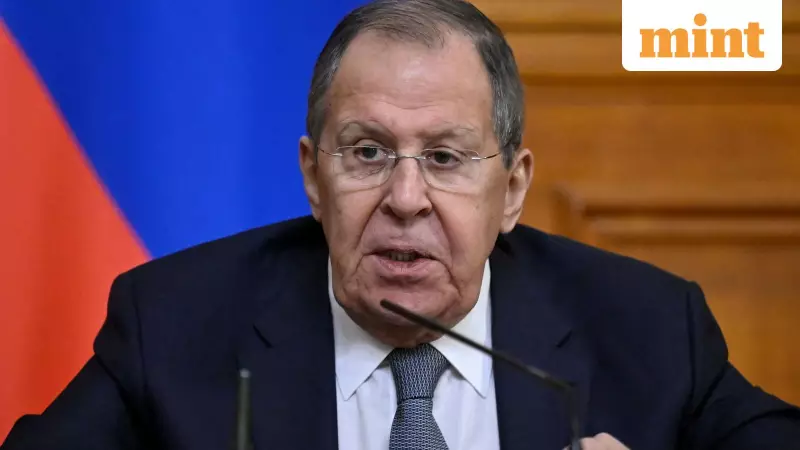
Russia has taken a firm stance against the revised American peace proposal for Ukraine, declaring it will not support any agreement that deviates from the original 28-point framework drafted during former President Trump's administration. The Kremlin's position emerged clearly through statements from top Russian officials this week.
Lavrov's Strong Warning Against Modified Plan
Russian Foreign Minister Sergei Lavrov reinforced Moscow's position on Tuesday, November 25, 2025, stating that Russia would not endorse any peace proposal that strays from the original 28-point plan. According to The Financial Times, Lavrov delivered a clear warning about the consequences of diluting the initial agreement.
"If the spirit and letter of Anchorage are erased from the key understandings we have documented, then the situation will be fundamentally different," Lavrov emphasized during his statement. He revealed that Moscow had received the latest version of the peace plan "through unofficial channels" and indicated that "a number of issues... need clarification."

Kremlin's Cautious Stance Amid Information Chaos
Kremlin spokesperson Dmitry Peskov adopted a more reserved approach on Tuesday, refusing to elaborate on Moscow's position regarding the ongoing US-Ukraine negotiations. Peskov characterized the surrounding discourse as an "information frenzy" that made meaningful commentary impossible.
"It is impossible to comment amid this information frenzy," Peskov told reporters. "A lot of contradictory information is being published, contradictory statements, and so on." Russian officials have largely avoided detailed public responses to the weekend talks in Geneva, where US, European, and Ukrainian officials discussed the revised American peace plan.
Original Trump Framework Remains Foundation
Despite refusing to discuss specifics, Peskov made it clear that the original US 28-point peace framework remains the only substantial document under consideration from Moscow's perspective. He explicitly referred to the plan as "Trump's framework" and stressed its continued relevance.
"The original U.S. proposal is currently the only substantive thing," Peskov stated. "We believe that it could be a very good basis for talks... this is what our president has stated."
The initial draft faced widespread criticism for aligning closely with long-standing Kremlin demands, including provisions that would require Ukraine to cede territory, reduce its armed forces by half, and accept limitations on long-range weapons.
Putin's Assessment and Ukrainian Resistance
Russian President Vladimir Putin confirmed on Friday that Moscow had received the 28-point proposal but noted it hadn't been discussed in detail with the United States. Putin expressed his belief that the document "could also form the basis for a final peace settlement" while highlighting Washington's challenges in securing Kyiv's approval.
"The reason is the same: the U.S. administration has not yet managed to secure the agreement of the Ukrainian side," Putin observed. He added that "Ukraine and its European allies are still under the illusion that they can inflict a strategic defeat on Russia."
The peace proposal has undergone significant revision since its initial presentation, with a Ukrainian official confirming that the original 28-point plan had been condensed to 19 points following negotiations. American officials have insisted that the revised version incorporates Kyiv's input and was shaped during meetings between top US and Ukrainian officials on Sunday.
The White House has acknowledged working to secure a deal after Special Presidential Envoy Steve Witkoff created the earlier version—a proposal widely perceived as highly favorable to Moscow's interests. The ongoing diplomatic maneuvering reflects the complex challenges in reaching a negotiated settlement to the conflict that began with Russia's full-scale invasion of Ukraine.






