Jeffrey Sachs: United States Not the Ultimate Priority for India
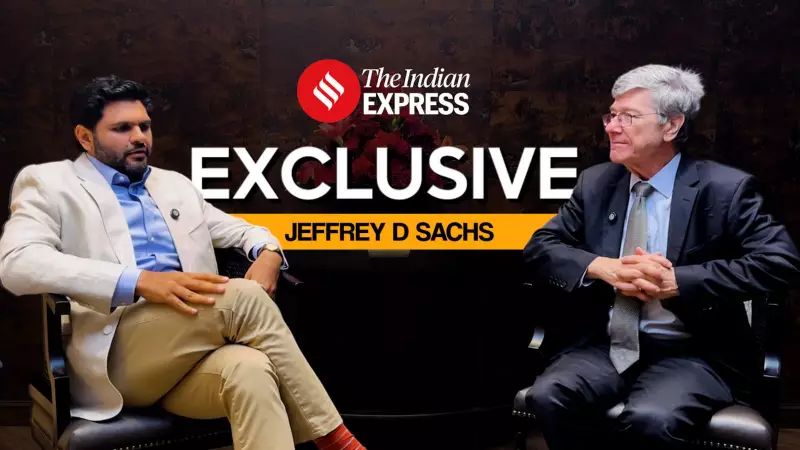
In a comprehensive interview, renowned American economist and Columbia University professor Jeffrey Sachs shared his insights on how India should navigate its relationship with the United States under the Trump administration. Speaking with Ananth Goena, Executive Director of The Indian Express Group, Sachs emphasized that India must not view the US as its sole strategic partner.
The Tech-Owned White House and Power Dynamics
Sachs highlighted the unprecedented influence of Silicon Valley billionaires in the current US administration. "This is a tech-owned White House," he stated, pointing to how figures like Elon Musk and Peter Thiel have become central to policy decisions. He described this group as "intoxicated with their wealth and power," controlling not just technology but also media and political discourse.
The economist criticized the casual approach to international relations, citing Commerce Secretary Howard Lutnick's remark about Prime Minister Modi not calling Trump. "To say relations between two giant economies fell apart because of a phone call is absurd," Sachs remarked, adding that it reflects the "collapse of systematic governance" in America.

Military-Industrial Digital Complex
Sachs introduced the concept of a "military-industrial digital complex," where traditional defense contractors have taken a backseat to tech giants like SpaceX and Palantir. He explained that the Pentagon now relies heavily on these companies for everything from space launches to facial recognition technology, creating an "unaccountable combination of forces."
This shift has given tech billionaires unprecedented surveillance capabilities and control over public discourse through platforms like X and Facebook, as well as traditional media outlets like the Washington Post.
Advice for Indian Negotiators
Regarding the India-US trade deal, Sachs advised New Delhi not to "chase that phantom" of constantly moving goalposts. "I would rather that a great power like India behave like a great power," he said, advocating for respectful, transparent negotiations. He stressed that India should not allow itself to be "abused" by arbitrary US actions.
Sachs particularly emphasized the need to reduce dollar dependency. "The US has weaponized the dollar," he noted, suggesting that India should support non-dollar settlements through BRICS mechanisms. He predicted the Chinese renminbi would account for 15-20% of global transactions within a decade.
India-China Relations and Multipolar World
The economist argued for improved India-China relations, stating "the real problem is not India versus China" but rather the end of Western imperial dominance. He suggested both countries should work together to counter US instability and protect international order.
Sachs proposed China should support India's bid for a permanent UN Security Council seat, calling India "the only absolutely indisputable claimant" based on its size, scope, and superpower status.
Three Pillars for Global Stability
Sachs outlined his vision for a stable multipolar world:
- Spheres of Security: Great powers should avoid military presence in each other's neighborhoods
- Good Neighbor Policy: Respect for sovereignty without military intervention
- Strengthened United Nations: Revitalizing international institutions for conflict resolution
He specifically recommended ending NATO, which he called "a dagger aimed at Russia," and establishing collective security arrangements between the European Union and Russia.
The American Dream and Current Reality
While acknowledging America's success as a land of opportunity, Sachs contrasted this with what he described as the country's "settler colonial" history and current divisions. "Trump is America at bringing out some of the White backlash," he observed, linking the current administration's rise to demographic changes and economic inequality.

He expressed hope that if the world can avoid major confrontation and India continues its growth trajectory, a multipolar world could emerge where the US "will not run the world" but contribute positively alongside other powers.
Cultural Diversity Over Hegemony
Sachs rejected the idea of any single model dominating global affairs. "We're all part of the same global technological systems," he acknowledged, but emphasized that political systems and cultures remain distinct. He praised Prime Minister Modi for "bringing about a new pride in India as a superpower" while appreciating Chinese statecraft's historical continuity.
The economist concluded with a call for calm: "China's not going to take over India. India is not going to take over China... We should all calm down and get on with issues that are really important for well-being."