

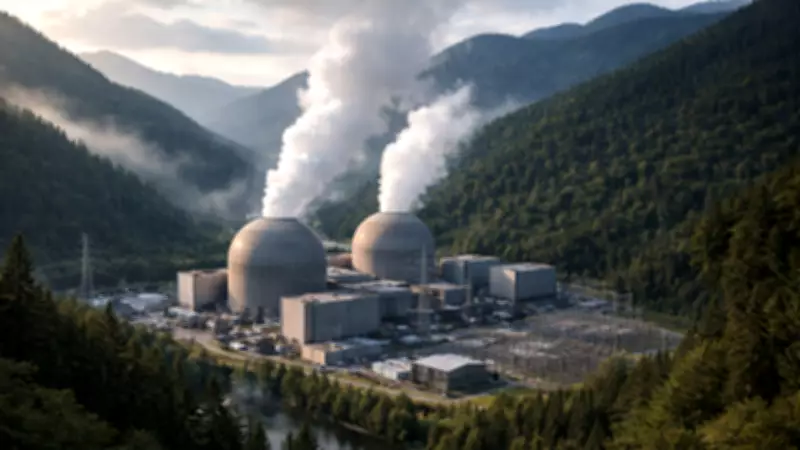
Satellite Imagery Uncovers Rapid Expansion of China's Nuclear Infrastructure in Sichuan
In the mist-covered valleys of southwest China's Sichuan Province, satellite imagery has unveiled a significant and rapid expansion of the country's nuclear weapons infrastructure. This development is part of what experts describe as a broader national effort to strengthen China's strategic position amid intensifying superpower rivalries. The secretive nuclear-related sites, including facilities near Zitong and Pingtong, have undergone substantial upgrades and expansions in recent years, signaling a push to modernize China's nuclear arsenal.
Modernization Efforts Complicate Global Arms Control
Analysts highlight that these changes align with China's wider push to modernize its nuclear capabilities, complicating international efforts to revive global arms control. This comes after the expiration of the last remaining US-Russia nuclear treaty. Washington argues that any future arms control agreement must include China, but Beijing has shown no interest in participating, raising concerns about unchecked nuclear proliferation.
According to the Pentagon's latest estimate, as reported by The New York Times, China possessed more than 600 nuclear warheads by the end of 2024 and could reach 1,000 by 2030. Although this total remains far below the stockpiles of the United States and Russia, the pace of growth is alarming to experts. Matthew Sharp, a former State Department official now at the Massachusetts Institute of Technology, emphasized the dangers of this trend, stating, "I think without a real dialogue on these topics, which we lack, it's really hard to say where it's going, and that, for me, is dangerous. Because now we're forced to react and plan around the worst-case interpretation of a concerning trend line."

Detailed Site Upgrades in Zitong and Pingtong
One valley near Zitong has seen engineers constructing new bunkers and ramparts, with a newly built complex featuring pipes that suggest it handles highly hazardous materials. Another valley houses the heavily secured Pingtong site, where specialists believe plutonium cores for nuclear warheads are produced. The main structure at Pingtong, marked by a 360-foot ventilation stack, has been refurbished with new vents and heat dispersers, and further construction is ongoing nearby. Above the entrance, large characters bearing leader Xi Jinping's slogan—"Stay true to the founding cause and always remember our mission"—are visible from space.
Experts note that Pingtong's layout resembles plutonium pit production plants in other countries, such as the Los Alamos National Laboratory in the United States. At Zitong, the new bunkers and fortified areas are likely used for testing high explosives, which are chemical charges that compress nuclear material to trigger a chain reaction. Hui Zhang, a physicist at Harvard University who reviewed the findings, explained, "You have a layer of high explosives and the shock wave at the same time implodes into the center. This needs blast tests to perfect them."
Uncertainties and Strategic Implications
The precise purpose and scale of these upgrades remain uncertain. Zhang added, "We don't know how many warheads have been produced, but we just see the plant expansion." Some changes could reflect safety improvements or preparations to adapt warhead designs for new weapons systems, such as submarine-launched missiles. Renny Babiarz, a geospatial intelligence expert who analyzed satellite images, stated, "The changes we see on the ground at these sites align with China's broader goals of becoming a global superpower. Nuclear weapons are an integral part of that. There's been evolution at all of these sites, but broadly speaking, that change accelerated starting from 2019."

US officials express worry that a larger and more advanced arsenal could influence China's actions in future crises, particularly over Taiwan. Michael S Chase, a former Pentagon official now at RAND, noted, "China seeks to ensure it is in the position where they believe they're largely immune from nuclear coercion by the United States. I think they probably judge that could come into play in a conventional conflict over Taiwan." This expansion underscores the growing tensions and strategic shifts in global nuclear dynamics, with implications for international security and diplomacy.





