

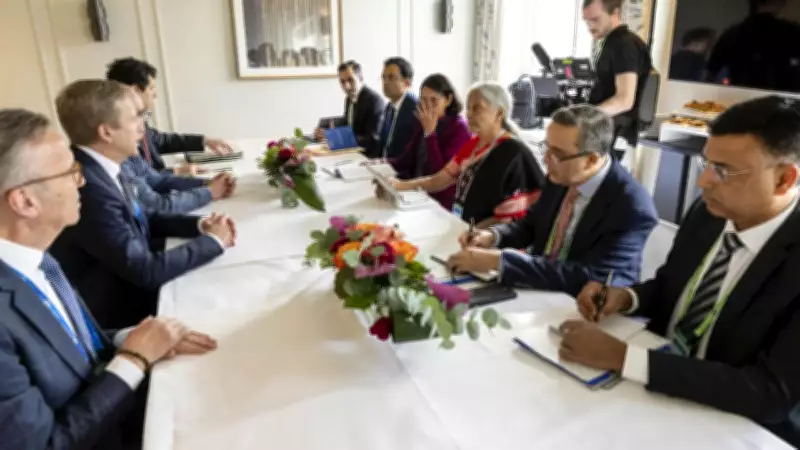
Finance Minister Nirmala Sitharaman Engages in High-Stakes Diplomacy at Munich Security Conference
Union Finance Minister Nirmala Sitharaman conducted a series of crucial diplomatic engagements during her ongoing visit to Munich, Germany, meeting with top global financial and political leaders to advance India's economic interests on the international stage.
Historic FTA Finalization with European Union
In a significant meeting with Christine Lagarde, President of the European Central Bank (ECB), both leaders expressed satisfaction at the finalization of the India-European Union Free Trade Agreement (FTA) in January 2026. Minister Sitharaman emphasized the pivotal financial role the ECB could play in facilitating trade under this landmark agreement.
The Finance Minister revealed concrete implementation plans, noting that through the Union Budgets for 2025-26 and 2026-27, India will permit European Union banks to establish up to 15 branches over a four-year period under the India-EU FTA framework, marking a substantial opening of India's banking sector to European financial institutions.

Strategic Meetings with Global Financial Leaders
Sitharaman engaged in substantive discussions with Vera Songwe, Chair and Founder of the Liquidity and Sustainability Facility, focusing on global capital markets and structural challenges facing emerging economies. The dialogue particularly addressed fiscal space concerns within the context of an increasingly volatile geopolitical environment.
The Finance Minister also met with Liechtenstein's leadership, including Prime Minister Brigitte Haas and Hereditary Prince Alois of Liechtenstein. These discussions centered on:
- Ongoing investments by Liechtenstein-based companies in India
- Expanding partnerships in manufacturing sectors
- Collaboration in environment-friendly technologies
- Agricultural equipment development
- Climate change mitigation initiatives
Sitharaman highlighted investment opportunities through India's National Investment and Infrastructure Fund (NIIF) and positioned the International Financial Services Centres Authority (IFSCA) as the primary financial gateway to India, while also outlining broader prospects within India's rapidly expanding manufacturing sector.
Strengthening Indo-German Economic Ties
In a meeting with Lars Klingbeil, Vice Chancellor and Federal Minister of Finance of Germany, both leaders discussed the strengthened bilateral relations following Prime Minister Narendra Modi's January meeting with Friedrich Merz in India. Klingbeil described the Free Trade Agreement as "a significant step forward for trade and investments in India," with particular emphasis on bilateral development cooperation and metro rail expansion projects.
The Finance Minister showcased India's digital payment achievements and expressed India's willingness to share best practices regarding its digital public infrastructure and digital stack with Germany, potentially paving the way for technological collaboration between the two nations.
Climate Finance and Sustainable Partnerships
During discussions with Eric Beisswenger, Bavarian Minister for European and International Affairs, both leaders acknowledged the deepening bilateral partnership following the German Chancellor's January 2026 visit to India. They explored:
- Avenues for climate finance through green and sustainable partnerships
- Exchange of best practices in recycling industries
- India's focus on skilling initiatives
- Healthcare sector announcements in the Union Budget 2026-27
Automotive Sector Engagement and Economic Reforms
In a separate corporate engagement, Sitharaman met with Oliver Zipse, Chairman of the Board of Management at BMW AG. Discussions focused on India's economic opening through recent reforms, with emphasis on policy continuity and stability.
The Finance Minister highlighted Prime Minister Narendra Modi's Viksit Bharat vision for 2047, supported by comprehensive reforms in GST, Customs procedures, manufacturing policies, and Production-Linked Incentive (PLI) schemes in sunrise sectors and the automobile industry. Special attention was given to energy efficiency initiatives, electric vehicle development, and battery infrastructure expansion.

Munich Security Conference Participation
During her Munich visit, the Union Finance Minister actively participated in the high-level Munich Security Conference Roundtable and key panel discussions. On the sidelines of the conference, she engaged in additional bilateral meetings with ministers, counterparts from various nations, and heads of multilateral organizations, further solidifying India's position in global economic and security dialogues.
These comprehensive engagements demonstrate India's proactive approach to international economic diplomacy, leveraging the finalized India-EU FTA as a foundation for expanded trade, investment, and technological cooperation with European partners while addressing global challenges like climate change and sustainable development.





