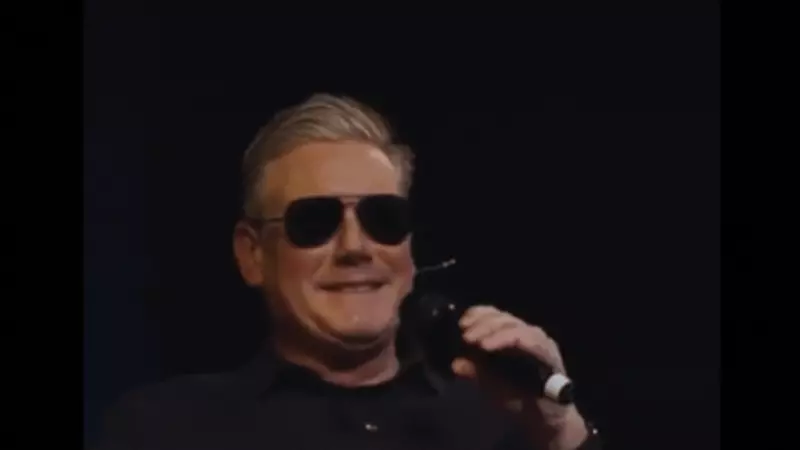
British Prime Minister Keir Starmer recently engaged in a lighthearted moment of international diplomacy through humor, making playful fun of French President Emmanuel Macron's distinctive appearance in aviator sunglasses during the World Economic Forum in Davos. The incident unfolded during a live comedy event, creating a viral social media exchange that blended politics with pop culture references.
Political Comedy Show Sparks International Banter
During his appearance at The Political Party Live event held at London's Duchess Theatre, Prime Minister Starmer participated in a live interview before an enthusiastic audience. The show took an unexpected turn when the British leader was handed a pair of sunglasses, which he promptly put on with theatrical flair. Demonstrating his comedic timing, Starmer looked through the tinted lenses and delivered a perfectly timed "Bonjour" to the delight of the crowd, clearly referencing his French counterpart's recent fashion statement.
Social Media Amplifies the Moment
The humorous exchange didn't remain confined to the theater. A clip capturing Starmer's sunglasses moment quickly made its way to TikTok, where it gained significant traction among viewers. The British prime minister further amplified the joke by adding a clever caption that referenced the iconic film Top Gun, writing "Talk to me, Goose" alongside the video. This pop culture nod created the perfect setup for international engagement.

President Macron himself entered the digital conversation, responding directly in the comments section with a simple but effective "For sure." This brief exchange demonstrated how modern political figures are increasingly using social media platforms for both serious diplomacy and lighthearted interaction, bridging formal international relations with more accessible public engagement.
The Original Sunglasses Incident at Davos
The entire exchange traced back to President Macron's appearance at the prestigious World Economic Forum in Davos just one week earlier. During his significant speech addressing complex geopolitical issues, the French leader made an unusual fashion choice by wearing dark, reflective aviator sunglasses throughout his indoor presentation. This distinctive accessory immediately captured public attention and generated considerable online discussion.
Substance Behind the Style
Macron's speech at Davos carried substantial political weight as he addressed critical international concerns. The French president specifically responded to former US President Donald Trump's threats regarding tariffs on European countries, particularly focusing on Trump's renewed interest in purchasing Greenland. In his address, Macron offered a robust defense of European sovereignty while criticizing what he characterized as Washington's problematic tone in international negotiations.
The French leader articulated Europe's position on the global stage with clarity, stating: "...having a place like Europe, which sometimes is too slow, for sure, and needs to be reformed for sure, but which is predictable, loyal, and where, well, you know that the rule of the game is just a rule of law, it's a good place. And I think this is a good place for today and for tomorrow." His remarks highlighted Europe's commitment to stability and rule-based international order during a period of global uncertainty.
Medical Explanation for the Fashion Statement
Following the considerable attention generated by Macron's indoor sunglasses use, the French president's office provided important context that shifted the narrative from fashion choice to medical necessity. Officials explained that Macron had suffered a burst blood vessel in his eye, requiring protective eyewear to shield his vision from harsh lighting conditions. This medical explanation transformed what initially appeared as a style statement into a practical health consideration.
The incident demonstrates how modern political communication operates across multiple layers—from formal diplomatic speeches to medical disclosures to social media banter. What began as a medical necessity evolved into a fashion talking point, then transformed into international humor, and ultimately became a case study in how political figures navigate their public personas in the digital age while addressing serious global concerns.