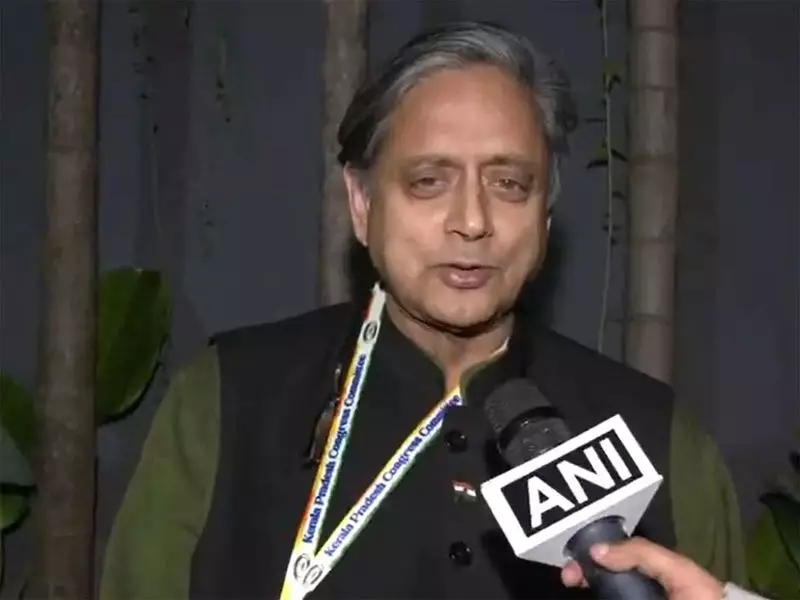
Senior Congress leader and Member of Parliament Shashi Tharoor has issued a sharp critique of recent international events, voicing deep concern over a growing trend where powerful nations unilaterally use force. His comments come in direct response to the recent military strikes conducted by the United States against targets in Venezuela.
Tharoor's Stern Warning on Global Power Dynamics
Speaking at an event in Kerala's capital, Thiruvananthapuram, on Sunday, Tharoor articulated his apprehension about the state of international relations. He expressed that the world is currently witnessing "many versions of 'might is right' in global affairs". The former Union Minister and diplomat emphasised that this shift away from established rules-based order carries "very serious implications" for the future of global stability and diplomacy.
The specific trigger for Tharoor's remarks was the decision by the United States to authorise military action within Venezuelan territory. According to reports, the US carried out strikes targeting facilities linked to drug trafficking. However, the action, undertaken without the explicit mandate of the United Nations Security Council or the consent of the Venezuelan government, has raised significant legal and ethical questions about sovereignty and the use of force.

The Venezuela Incident and its Broader Message
Tharoor contextualised the US strikes on Venezuela not as an isolated event, but as part of a disturbing pattern. He pointed out that such actions demonstrate how powerful states are increasingly willing to bypass multilateral institutions and international law to pursue their objectives. This, he argued, sets a dangerous precedent that could be emulated by other nations, leading to a more volatile and unpredictable world.
The core of Tharoor's argument rests on the principle that enduring peace and security require adherence to agreed-upon international norms. When major powers disregard these frameworks, it undermines the very foundation of the post-World War II global system, which was designed to prevent arbitrary aggression and protect smaller nations' sovereignty.
Implications for India and the Global South
As a prominent voice from India, a leading nation of the Global South, Tharoor's warning carries particular weight. He highlighted that a world governed by "might is right" disproportionately disadvantages smaller and developing countries. These nations rely on a rules-based system to ensure their security and fair treatment in international disputes.
The erosion of this system, as exemplified by the Venezuela strikes, could lead to a scenario where geopolitical and economic power alone dictate outcomes, marginalising diplomatic dialogue and legal recourse. For a country like India, which champions multilateralism and strategic autonomy, such a trend poses complex challenges to its foreign policy and its role on the world stage.
Tharoor's critique aligns with a broader debate within international circles about the need to reinforce, not weaken, multilateral institutions like the United Nations. His statement serves as a reminder of the responsibilities that come with power and the collective duty to uphold a just international order.