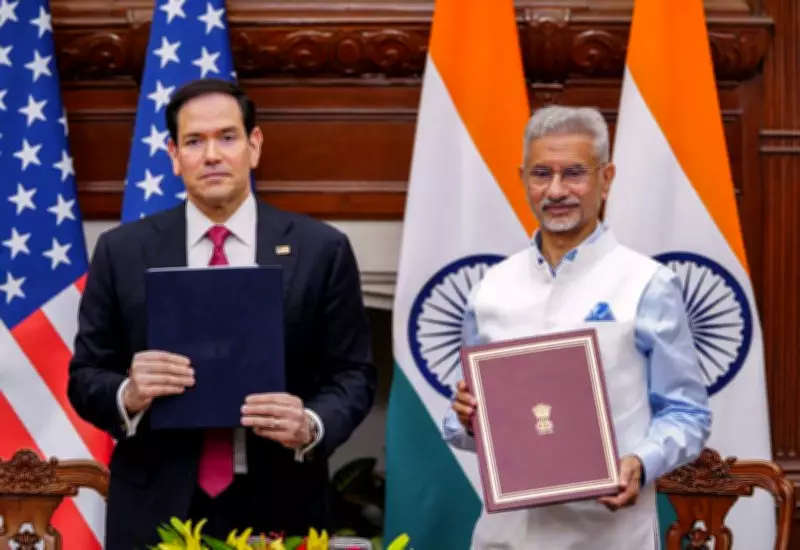
One certainty emerged from US Secretary of State Marco Rubio's four-day visit to four Indian cities: New Delhi is not yet convinced that Rubio will succeed Donald Trump as President three years from now or even as the Republican candidate for the top office in 2028.
In the latest Reuters/Ipsos poll conducted between May 15 and 18, Rubio and Vice President JD Vance are neck and neck in garnering a favourable view of the jobs they are doing. Trump is term-limited and cannot contest in another presidential election. He has not endorsed either Rubio or Vance. 'Both are very good men,' he said last month. Rubio, however, is rapidly gaining over Vance in opinion polls. The Vice President lost eight points from a similar poll conducted 16 months earlier.
Had India been convinced that Rubio will be a sure-shot presidential candidate in 2028, his reception in all four Indian cities would have been very different. It would not have been quite like the 'abki baar Trump Sarkar' slogan in Houston when Prime Minister Narendra Modi and Trump together took the floor at the 'Howdy Modi' event in 2019. But going beyond protocol, there would have been some trappings of a future head of state associated with Rubio during his stay in India. There were none. India treated the Secretary of State correctly and according to protocol, even though Rubio is institutionally the most powerful US Secretary of State since Henry Kissinger. Rubio is both National Security Adviser and Secretary of State. Kissinger was the only other American to concurrently hold both posts, although virtually no one in India seemed to take note of this during Rubio's visit.

India's Track Record in Identifying Future Leaders
Indian diplomacy is adept at identifying future foreign leaders, carefully cultivating them and ensuring continuity and goodwill for the day when they become heads of state or government. In 1981, Prime Minister Indira Gandhi invited Ayatollah Ali Khamenei to India. Since Khamenei held no official post in Iran then, he had to be invited as a Distinguished Visitor of the Indian Council for Cultural Relations.
Ten months after Narendra Modi became Prime Minister for the first time in May 2014, he had a meeting in Delhi with the current President of Cuba, Miguel Diaz-Canel, who was then the Vice President. Diaz-Canel missed a connecting commercial flight to India, Modi changed his itinerary for that day to ensure that he met the Cuban politician. India's then Ambassador in Havana, C Rajasekhar, had conveyed to Modi through a BJP leader that Diaz-Canel would succeed Raul Castro as President. The transition happened in 2018.
Retrospectively in today's circumstances, one such astute decision was to invite as Chief Guest for the 2017 Republic Day, the Crown Prince of Abu Dhabi, Sheikh Mohammed bin Zayed Al Nahyan although he was not the head of state or government. The decision was criticised for protocol reasons, but it has turned out to be an infinitely fruitful gesture. Sheikh Mohammed became President five years later.
Substance Over Gestures in US-India Ties
Without doubt, the US is the most important bilateral partner for India and will remain so in the foreseeable future. That is why it was important to pack Rubio's visit with substance instead of gestures which capture headlines merely for 24 hours. Repetitive and habitual prattle by the current occupant of the White House alone cannot advance India-US relations. The US Ambassador to India, Sergio Gor, got his 15 minutes of fame when Trump telephoned him two Sundays ago as Gor was preparing to introduce Rubio at an event to commemorate the semiquincentennial of American Independence.
Indians of consequence are tired of hearing Trump's periodic declarations that 'I love Prime Minister Modi' and that he is a big fan of Modi. Is there nothing more he can say about his country's ties with India, which people in both countries want to hear? About what this relationship means in today's turbulent world, for instance?

A Historical Perspective on US-India Relations
From my years as a foreign correspondent in Washington, one day remains etched in memory. That day, shortly after the catastrophic tsunami in the Indian Ocean in December 2004, then US President George W Bush and First Lady Laura Bush visited the Indian Embassy in Washington's Embassy Row. The First Couple did not come alone. They brought with them the former US Presidents then alive. Jimmy Carter could not join because he was taken ill that day and at 91, Gerald Ford was too frail to travel to Washington. Father Bush, George HW, praised his son for having carried forward the start of a new era in US relations with India, which George HW said he had set in motion. As always, Bill Clinton charmed everyone.
With such bipartisan consensus, a process which led to 'Asia-Pacific' being rechristened as 'Indo-Pacific' began on that occasion. India-US maritime cooperation, joint patrols, collaborative disaster management, naval interoperability — and much more grew out of that event. When the history of Quad is written — if it lives up to promise — the seeds of this quadrilateral initiative will be traced to the visit by incumbent and past US Presidents to the Embassy. They thanked India for being the first naval responder — even before the US Navy with its regional presence — to the tsunami in South Asia and parts of Southeast Asia. India's Ambassador in Washington, Ronen Sen, was beaming; he was understated but substantive, unlike Sen's present counterpart in New Delhi Sergio Gor.
George W Bush subsequently offered the nuclear deal which ended India's long nuclear winter. Bush did not proclaim that he was a fan of Manmohan Singh. He said it to the Prime Minister only in private. The India-US Strategic Dialogue was not an easy initiative to launch. There was considerable opposition to it within the US strategic community. One year, when this Dialogue was taking place in Washington, President Barack Obama walked into the State Department unannounced to a reception for the Dialogue interlocutors. In his typical style, Obama made a speech which was a blueprint for relations with India, out of which grew the ongoing 'Comprehensive Global Strategic Partnership.' That is the way to go, not tiresome proclamations of love for any leader in New Delhi.