US President Donald Trump has escalated the stakes in already delicate Middle East peace efforts by demanding several Muslim-majority countries join the Abraham Accords and recognize Israel as part of a potential deal with Iran, even as experts warn the proposal is unlikely to succeed under current regional conditions.
Trump's Proposal
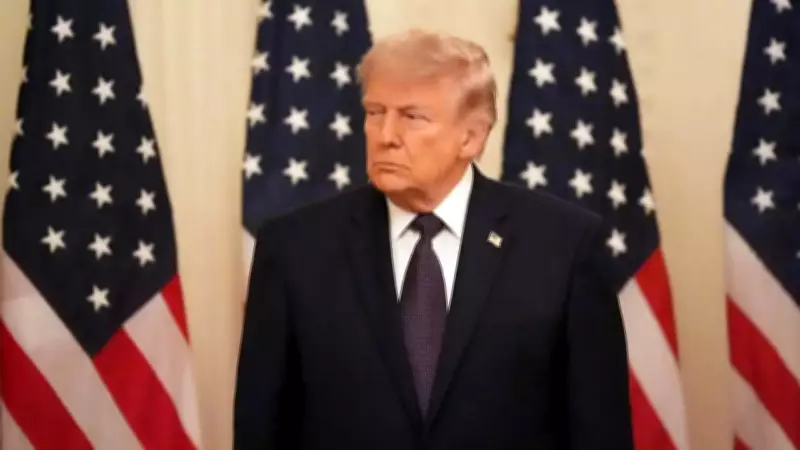
Trump recently called on countries including Saudi Arabia, Qatar, and Pakistan to formally recognize Israel once an agreement with Iran is reached. He even floated the possibility of Iran itself joining the framework. On Truth Social, Trump claimed the Abraham Accords had created a "Financial, Economic, and social boom" for participating nations, adding that they "will be even better for everybody, and bring true Power, Strength, and Peace to the Middle East."
According to reports, Trump raised the proposal during a conference call with leaders and senior officials from Saudi Arabia, the UAE, Qatar, Pakistan, Turkiye, Egypt, Jordan, and Bahrain. However, Axios reported that the proposal was met with silence from some leaders, particularly Saudi Arabia, Qatar, and Pakistan.

What Are the Abraham Accords?
The Abraham Accords are a set of US-brokered agreements launched during Trump's first term in 2020 to normalize diplomatic, economic, and security relations between Israel and Arab states. The accords were first signed on September 15, 2020, between Israel, the United Arab Emirates, and Bahrain, with Morocco and Sudan later joining. Kazakhstan formally became associated in 2025 despite already having ties with Israel. Before 2020, only Egypt and Jordan among Arab nations had officially recognized Israel. Unlike earlier Arab positions linking ties with Israel to Palestinian statehood, the accords focused on trade, investment, defense cooperation, and regional coordination against Iran's influence.
Current Members
The countries currently associated with the Abraham Accords are Israel, the United Arab Emirates, Bahrain, Morocco, Sudan, and Kazakhstan. The UAE, Bahrain, and Morocco formally signed the accords, establishing diplomatic, economic, and security ties with Israel. Sudan agreed to join but has not fully formalized relations. Kazakhstan, though not an Arab nation, joined the framework last year.
Why Experts Say the Plan Is Unrealistic
Analysts believe Trump is trying to combine several highly sensitive issues—Iran diplomacy, Gulf security, Arab-Israeli normalization, and Palestinian statehood—into one sweeping regional bargain. But the timing could hardly be worse. Public opinion across the Muslim world has hardened sharply against Israel during the Gaza war. Israel's military campaign following Hamas's October 7, 2023 attacks has left more than 70,000 Palestinians dead, according to Gaza health authorities.
"For most of the states named, the political cost of signing up under current conditions would be prohibitive," said H A Hellyer, senior fellow at the Royal United Services Institute and Center for American Progress. "Gaza is ongoing, annexation of the West Bank is accelerating, Israeli forces remain in southern Lebanon, the Golan is occupied."
Yossi Mekelberg, a Middle East expert at Chatham House, described Trump's proposal as "no more than a sweetener for Israel." He asked, "Why would these countries reward Netanyahu after so much destruction in the region and to their interests?"
Saudi Arabia remains one of the biggest obstacles. Riyadh has repeatedly maintained that it will not recognize Israel without a clear path towards an independent Palestinian state. "For Saudi Arabia there is no incentive to join the Abraham Accords, in the current circumstances," Mekelberg said. Former US diplomat Barbara Leaf also dismissed immediate progress: "I do not expect any of the Arab/Muslim states whose leaders spoke to President Trump on May 23 to move towards normalisation with Israel right now."

Pakistan Publicly Rejects Proposal
Pakistan became the first country mentioned by Trump to openly reject the idea. Defence Minister Khawaja Muhammad Asif said Islamabad would not support any arrangement conflicting with its position on Palestine. "Personally, I don't think we should join any such accord that clashes with our fundamental ideologies," Asif told Samaa TV. "How will you sit down with those people whose word cannot be trusted even for a single day?" He reiterated Pakistan's long-standing policy of recognizing Israel only after an independent Palestinian state based on pre-1967 borders with East Jerusalem as its capital. Islamabad also faces strong domestic pressure from religious groups and public opinion against recognizing Israel.
Is Trump Chasing a Political Win?
Some analysts believe Trump's proposal may be aimed more at domestic politics and reassuring Israel than at achieving a realistic diplomatic breakthrough. Abdulla Banndar Al-Etaibi, assistant professor of International Relations at Qatar University, suggested the announcement was intended to show that military escalation against Iran had produced political gains. "The US administration needs a narrative showing that escalation was not meaningless, and that the end result has reshaped the regional environment," he posted on X. Others believe Trump is attempting to craft a legacy-defining diplomatic deal that could strengthen his image as a global dealmaker, potentially earning him the Nobel Peace Prize he covets.