

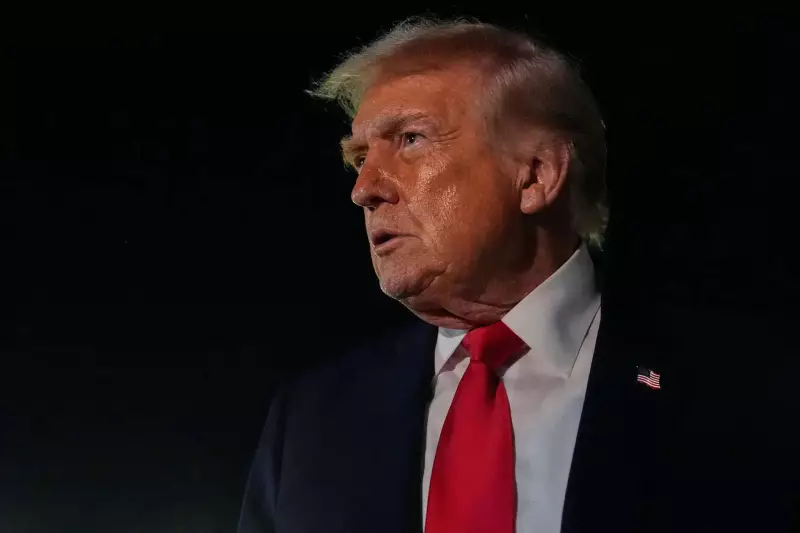
US President Donald Trump extended a formal invitation to India on Monday. He asked New Delhi to join the newly created Gaza Peace Board. This American-led initiative places India in a delicate strategic position. The country must now decide whether to participate fully or stay out completely.
Timing of the Invitation
The invitation arrives at a critical moment. The Gaza war has now entered its third year. This prolonged conflict amplifies diplomatic sensitivities for many nations. Countries are carefully weighing their involvement in various post-war reconstruction frameworks.
GTRI Report Sounds Alarm
A recent report from the Global Trade Research Initiative (GTRI) provides a stark analysis. While Washington frames the initiative as expanding international involvement in Gaza's stabilization, critics see it differently. The GTRI argues the framework is politically imbalanced. It bypasses established multilateral norms. Most importantly for India, the report highlights significant strategic and reputational risks.

Why India Should Stay Out: Key Reasons
The GTRI report outlines multiple compelling reasons for India to avoid formal participation.
Trump's Real Estate Rhetoric: The report notes President Trump has repeatedly promoted Gaza as a real estate opportunity. He famously called it a failed "Riviera of the Middle East." In February 2025, during a White House meeting with Israeli Prime Minister Benjamin Netanyahu, Trump described the territory as a "demolition site" with high redevelopment potential. He suggested the US should "take over" and "own" Gaza. Days later, he reiterated this idea online, referring to Gaza as a "big real estate site."
Absence of Palestinian Ownership: A major concern is the lack of Palestinian political ownership. The GTRI warns this makes any outcome appear externally imposed. Such outcomes would inherently lack legitimacy. "The most important is the absence of Palestinian political ownership," the report stated. "This makes any outcome look externally imposed and weak on legitimacy."
Israeli Veto Power and Structural Imbalance: Another critical issue is power dynamics. Israel holds de facto veto power over security and implementation matters. This is despite Israel not being a formal member of the board. The think tank added this creates a serious imbalance without any real accountability.
Bypassing UN Frameworks: The Board also operates outside United Nations-led frameworks. The report argues this undermines international law and norms. India has consistently upheld these multilateral principles.
Unclear Future Governance: The US-dominated structure offers little clarity. There is no clear plan for Gaza's future governance, borders, or sovereignty.
Humanitarian and Financial Risks: From a humanitarian perspective, the report raises alarms. Linking reconstruction funds to security conditions could delay urgently needed relief. The proposed $1 billion package might simply shift costs onto partner countries. It fails to address the conflict's deep political roots.
Commercialization Concerns: Finally, the report highlights fears of commercialization. Trump's earlier real-estate rhetoric, combined with the presence of financiers on the board, is troubling. There is a genuine concern that reconstruction could prioritize commercial projects and land use. Palestinian rights, consent, and the right of return might be sidelined.
The $1 Billion 'Board of Peace'
The concept was formally laid out on September 29, 2025. A 20-point redevelopment plan proposed reconstruction under a US-chaired Board of Peace. This board would operate outside UN frameworks. The idea took concrete form on January 15, 2026, when Trump unveiled the Gaza Peace Board.
The $1 billion reconstruction plan focuses on key areas: housing, power, water, sanitation, and job creation. Crucially, funding is linked to security conditions and regional cooperation.
Who is on the Executive Board?
The Executive Board was announced on January 17, 2026. It brings together a diverse group of diplomats, politicians, and financiers:

- Nickolay Mladenov as High Representative for Gaza
- US Secretary of State Marco Rubio
- Middle East envoy Steve Witkoff
- Jared Kushner
- Former UK Prime Minister Tony Blair
- Apollo Global Management chief Marc Rowan
- World Bank President Ajay Banga
- Political adviser Robert Gabriel Jr.
Invitations for Founding Membership
Invitations for founding membership have been sent to nations across multiple regions:
- Middle East & North Africa: Egypt, Jordan, Turkey, Qatar, the UAE, and Morocco.
- Americas: Argentina, Canada, Brazil, and Paraguay.
- Asia-Pacific: India, Pakistan, Vietnam, Australia, and Indonesia.
- Europe: France, Germany, and the UK.
Final Warning from GTRI
The GTRI report concludes with a strong warning for India. Joining the board could seriously undermine the country's credibility. It risks India's longstanding position on multilateralism and Palestinian self-determination. The report emphasizes that India can extend humanitarian assistance to Gaza without needing formal membership in this controversial board. The strategic choice for New Delhi is now clear and fraught with consequence.





