Trump's Mixed Signals on Iran Conflict Fuel Global Economic Uncertainty
In a recent address, US President Donald Trump declared that the month-long conflict with Iran is nearing its conclusion, asserting that the United States has "nearly achieved its military goals" and portraying the situation as a military success. He previously suggested that US forces could withdraw from Iran within a two- to three-week timeframe, raising hopes for a potential end to hostilities.
Threats of Escalation and Contradictory Claims
However, Trump's remarks also carried a stark warning of potential escalation. He stated that the US would hit Iran "extremely hard" over the next two to three weeks and claimed the country could be "brought back to the stone ages where they belong." The absence of a clear timeline or exit strategy has left observers uncertain whether the conflict is winding down or intensifying.
Trump further addressed the near-closure of the Strait of Hormuz, a critical waterway for global oil shipments, urging allies dependent on Middle Eastern oil to assist in resolving the situation. He predicted the passage would reopen "naturally" once hostilities subside. Additionally, Trump claimed that Iran had requested a ceasefire, a statement Tehran promptly denied as "false and baseless."

Indian Stock Market Sees Dramatic Swings
The uncertainty fueled investor concerns worldwide, with the Indian stock market experiencing significant volatility. The BSE Sensex plummeted as much as 1,588.51 points in early trade to hit 71,545.81, while the NSE Nifty slid 496.85 points to 22,182.55. However, both indices staged a remarkable recovery later in the session.
The Sensex closed higher by 185.23 points at 73,319.55, and the Nifty gained 33.70 points to settle at 22,713.10. This turnaround was largely driven by renewed interest in blue-chip IT stocks, with notable gains in:
- HCL Technologies
- Tech Mahindra
- Tata Consultancy Services
- Infosys
These stocks climbed up to 3% as investors stepped in at lower levels. Gains were also seen in Maruti Suzuki India, Trent, Bharat Electronics Ltd, Bajaj Finance, HDFC Bank, and ITC. In contrast, several heavyweights remained under pressure, including:
- Asian Paints
- Sun Pharmaceuticals
- NTPC
- PowerGrid
- State Bank of India
- Reliance Industries
- IndiGo
- UltraTech Cement
- Adani Ports
- Eternal
Sectorally, the IT space stood out, with IT and Focused IT indices rising up to 2%, even as the broader market remained volatile for most of the trading session.
Oil Prices Surge on Supply Fears
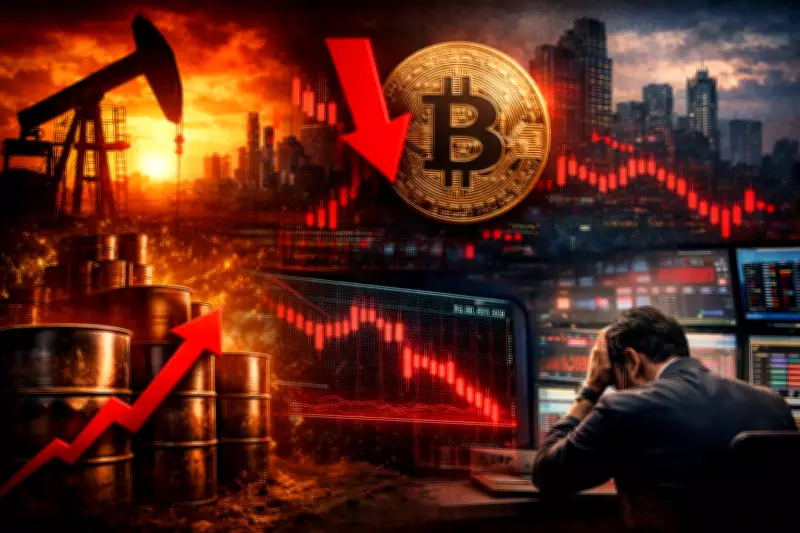
Oil prices surged sharply as Trump's remarks heightened fears of prolonged disruption to global energy supplies. Brent crude jumped 6.6% to near $108 a barrel, with intraday gains exceeding 5% to above $106 a barrel. The gains were driven by continued concerns over the Strait of Hormuz, which handled about a fifth of the world's oil and liquefied natural gas supply before the conflict.
With the waterway effectively shut, markets reacted to tightening supply and the risk of sustained high crude prices. The lack of a clear reopening timeline added to uncertainty, fueling volatility and reinforcing inflation concerns linked to elevated energy costs.
Regional Impact on Nepal and Bhutan
As oil prices continue to surge amid the Middle East war, countries like Nepal and Bhutan are feeling significant strain. Nepal has nearly doubled aviation fuel prices as global energy costs climb, sparking fears of a fresh blow to its tourism-dependent economy. The landlocked nation of 30 million relies almost entirely on India for fossil fuel supplies, leaving it highly exposed to global price shocks.
Bhutan is also facing pressure, with the government citing "external conditions beyond our control" for a hike in fuel prices. Despite its carbon-negative status and strong hydropower exports to India, the country depends on fuel imports via its neighbor. Shortages have already led to long queues at filling stations in the capital, Thimphu.

Precious Metals and Cryptocurrencies Decline
Precious metals came under heavy selling pressure following Trump's speech, as investors moved to liquidate positions amid rising uncertainty and broader market stress. Spot gold tumbled as much as 4.3%, snapping a four-day winning streak, and was down 4.1% at $4,562.88 an ounce. Silver saw even sharper losses, dropping 7% to $69.86, with additional reports noting a fall of around 5.7% during trading. Platinum and palladium also declined in line with the broader sell-off.
The fall in precious metals was accompanied by a 0.4% rise in the Bloomberg Dollar Spot Index, adding pressure on bullion. Gold's traditional safe-haven appeal was weakened as investors prioritized liquidity and responded to inflation risks stemming from higher oil prices.
Cryptocurrencies declined across the board as investors pulled back from risk assets. Bitcoin fell as much as 2.5% to roughly $66,500 in Asia trading, with smaller tokens recording steeper losses. Ether fell as much as 4.5%, and Solana dropped up to 5.1%. The decline mirrored weakness in equities and other risk-sensitive assets, as market sentiment deteriorated amid uncertainty over the conflict's trajectory.
Global Stock Markets Under Pressure
Stock markets worldwide remained under pressure, dragged down by weak investor sentiment. European markets opened on a weaker note, with Britain's FTSE 100 slipping 0.2% to 10,342.28. France's CAC 40 declined 0.8% to 7,917.81, while Germany's DAX saw sharper losses, falling 1.6% to 22,935.01.
Asian markets also ended in the red:
- Japan's Nikkei 225 dropped 2.4% to 52,463.27
- South Korea's Kospi plunged 4.5% to 5,234.05
- Hong Kong's Hang Seng fell 0.7% to 25,116.53
- Shanghai Composite slipped 0.7% to 3,919.29
- Australia's S&P/ASX 200 declined 1.1%
- Taiwan's Taiex was down 1.8%
US futures also pointed lower, with S&P 500 futures falling 1.1% and Dow Jones Industrial Average futures down 0.9%, indicating continued global market unease.