

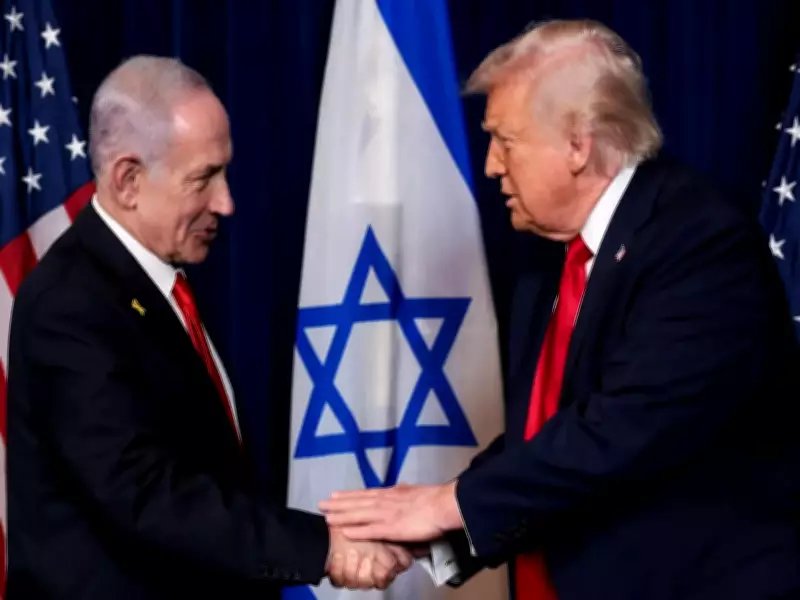
Trump's Public Rebuke of Netanyahu Exposes Strategic Divide in Iran Conflict
While world leader summits often produce carefully curated content for social media, Donald Trump continues to generate unfiltered moments that reveal genuine geopolitical tensions. His recent Oval Office remarks about Israel's Prime Minister Benjamin Netanyahu have exposed a significant strategic divergence in the ongoing conflict with Iran, centered on an unexpected flashpoint: Qatar's critical energy infrastructure.
The South Pars Strike That Changed Everything
Trump's frustration became public when discussing Israel's military strike on Iran's South Pars natural gas field. "I told him, 'Don't do that'," Trump revealed about his conversation with Netanyahu. The US president went further, warning that if Netanyahu "does something he does not like, 'we're not doing that anymore.'" This unusually sharp language from a traditional ally signals more than temporary disagreement.
The significance of South Pars extends far beyond Iranian territory. This massive natural gas field is shared with Qatar, whose liquefied natural gas exports form the backbone of energy supply chains across Europe and Asia. When Israeli forces targeted this facility, they weren't merely striking Iranian revenue sources—they were destabilizing infrastructure tied to a crucial Gulf partner that maintains deep strategic importance for Washington.

Qatar's Critical Role in the Conflict Calculus
The immediate consequences demonstrated why Trump viewed this escalation so negatively. Iran retaliated by striking Qatar's Ras Laffan industrial complex, one of the region's most vital energy hubs. What had been primarily a military conflict against Iran's capabilities suddenly began threatening Gulf infrastructure and, by extension, global energy flows.
For the Trump administration, this represented a dangerous threshold crossing. A campaign focused on Iran's military assets can be managed through calibrated responses, but conflict spilling into Qatar creates systemic risks. Qatar hosts the massive Al Udeid Air Base, serves as a central diplomatic player in Middle Eastern affairs, and occupies a pivotal position in global gas markets. Once Qatar becomes entangled in hostilities, containment becomes exponentially more difficult.
Diverging War Objectives: Management Versus Transformation
The reporting reveals fundamentally different approaches between Washington and Jerusalem. Trump's administration has concentrated on degrading Iran's missile programs, nuclear infrastructure, and naval capabilities. Israel, however, has expanded targeting to include leadership figures and, with South Pars, economic infrastructure directly tied to Iranian revenue generation.
This distinction reflects deeper strategic divergence. Trump seeks to maintain the conflict within manageable parameters, concerned that attacks on energy infrastructure will spike oil and gas prices, destabilize shipping through the Strait of Hormuz, and create economic ripple effects far harder to control than military outcomes. As one former State Department official noted, "Trump can manage missiles. He cannot easily manage markets."
Netanyahu's strategy operates on a broader horizon. European officials interpret Israeli actions as part of a comprehensive approach aimed at dismantling Iran's revenue sources and potentially triggering what Israeli planners describe as "state collapse." The Israeli prime minister has framed this moment as an opportunity to reshape the Middle East, speaking of ushering in "a new era in the region."
The Personal and Political Dimensions
Beyond strategic calculations, personal and political factors cannot be ignored in understanding Trump's reaction. Qatar has cultivated extensive relationships across Washington, including with figures in Trump's orbit, and engages in the high-visibility diplomacy that resonates with his transactional approach. In this context, gestures from Gulf monarchies represent more than formalities—they signal alignment and access.
When Israeli actions trigger retaliation threatening Qatar, they don't merely create strategic complications. They potentially undermine networks of relationships that Trump values both politically and personally. This adds layers of complexity to what might otherwise appear as straightforward military calculations.

Explicit Divergence in Stated Objectives
The gap between American and Israeli goals has become increasingly explicit. Trump has consistently stated his objective is ensuring Iran "never has a nuclear weapon." His own intelligence chief acknowledged that "the objectives that have been laid out by the president are different from the objectives that have been laid out by the Israeli government."
Trump has grown notably cautious about regime change prospects, telling media outlets that overthrowing Iran's leadership would represent "a very big hurdle" given the strength of Tehran's internal security apparatus. Experts observing the situation note that while current differences remain manageable, the true challenge will emerge when both sides must determine "when it's time to end the military operation."
The Core Fault Line Revealed
The fundamental disagreement now stands exposed. Trump isn't angry because Israel struck Iran—he's furious because Netanyahu struck a component of the conflict that involves Qatar, rattles global energy markets, and pulls hostilities into domains where American control diminishes.
Trump desires a conflict he can manage, calibrate, and eventually conclude with clear parameters. Netanyahu appears willing to push toward deeper transformation of Iran, even if this means accepting broader regional instability. While both leaders continue employing the language of coordination and the alliance remains formally intact, the South Pars episode has revealed differences that cannot be easily reconciled.
Somewhere between Trump's characteristic quip about Pearl Harbor warnings and the flames rising from a critical gas field, this war stopped being exclusively about Iran. It became about limits, escalation thresholds, and competing visions for the conflict's ultimate objectives. For the first time in this prolonged confrontation, those limits are not being determined solely in Washington.





