

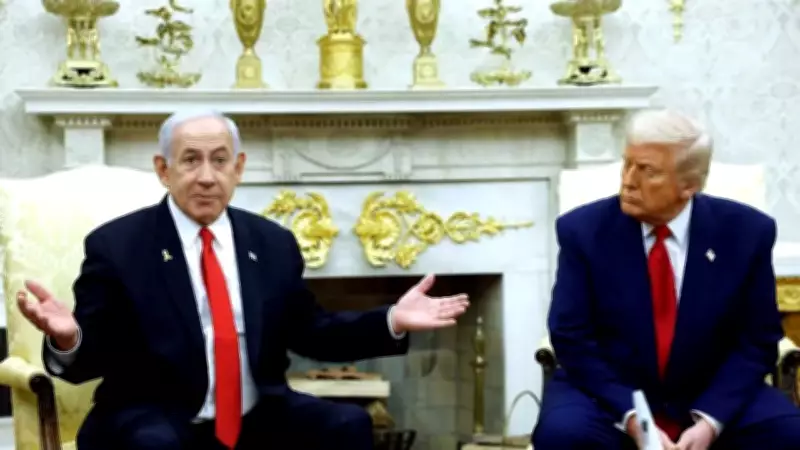
Trump's Surprise Declaration Prohibits Israeli Airstrikes in Lebanon, Stuns Netanyahu
In a dramatic development that sent shockwaves through diplomatic circles, US President Donald Trump stunned Israeli Prime Minister Benjamin Netanyahu by declaring Israel was "prohibited" from carrying out further airstrikes in Lebanon. This announcement came even as Iran revealed it was reopening the strategically vital Strait of Hormuz to commercial shipping during a fragile regional ceasefire that had been in effect for ten days.
Immediate Confusion and Policy Questions Emerge
President Trump's remarks created immediate and profound confusion within Israeli government circles, raising urgent new questions about the consistency and direction of United States policy toward the delicate ceasefire between Israel and Lebanon. The timing was particularly significant, as Tehran's parallel decision to reopen one of the world's most critical oil shipping lanes signaled potential movement in the broader, often tense, diplomacy between the United States and Iran.
"Israel will not be bombing Lebanon any longer. They are PROHIBITED from doing so by the U.S.A. Enough is enough!!!" President Trump declared emphatically on Friday, according to reports from Axios. The news outlet detailed that Netanyahu and his closest advisers were visibly shocked by the statement. This surprise was compounded by the fact that the official ceasefire terms, released just the previous day by the US State Department, had explicitly preserved Israel's long-standing right to self-defense against what it described as "planned, imminent, or ongoing attacks."

Israeli Officials Scramble for Clarification
In the wake of Trump's declaration, Israeli officials reportedly contacted the White House seeking urgent clarification, having first learned of the President's comments through media reports. Senior aides, including Israeli Ambassador to Washington Yechiel Leiter, scrambled to determine whether the United States had unilaterally and fundamentally changed its diplomatic position regarding the ceasefire agreement.
After Axios sought official comment, a US official provided a statement that appeared to attempt clarification: "The President's ceasefire agreement between Lebanon and Israel clearly states that Israel will not carry out any offensive military operations against Lebanese targets but preserves its right to self-defense against planned, imminent or ongoing attacks."
President Trump later doubled down on his position in an interview with Axios, stating firmly: "Israel has to stop. They can't continue to blow buildings up. I am not gonna allow it."
Ceasefire Violations and Military Activity Continue
Despite the declared ceasefire, military activity in the region did not fully cease. Lebanese state media reported that an Israeli drone strike killed a motorcyclist in the southern town of Kunin shortly after President Trump made his statement. In a separate incident, an Israeli source claimed that the militant group Hezbollah had violated the truce by attacking Israeli forces.
"Our forces acted in self-defense to remove the threat in accordance with the ceasefire agreement reached with the United States and Lebanon," the Israeli source asserted, highlighting the ongoing tension and differing interpretations of the agreement's terms on the ground.
Iran Reopens Strait of Hormuz, Trump Responds
Simultaneously, Iran's Foreign Minister Abbas Araghchi announced a significant geopolitical move: commercial shipping through the strategically crucial Strait of Hormuz would resume for the duration of the Lebanon ceasefire. "In line with the ceasefire in Lebanon, the passage for all commercial vessels through Strait of Hormuz is declared completely open for the remaining period of ceasefire," Araghchi stated publicly.
However, a senior Iranian military official clarified that military vessels would remain barred from using the waterway, maintaining a distinction in the reopening policy. President Trump welcomed Iran's announcement but was quick to emphasize that US pressure on Tehran would continue unabated.

"THANK YOU!" Trump posted on social media, later adding: "The naval blockade will remain in full force and effect as it pertains to Iran, only, until such time as our transaction with Iran is 100% complete." He also wrote: "A GREAT AND BRILLIANT DAY FOR THE WORLD!" and claimed that Iran had agreed the strait "will no longer be used as a weapon against the World."
Global Economic and Regional Security Implications
The Strait of Hormuz is a linchpin of global energy markets, carrying approximately one-fifth of all global oil shipments. Following Iran's announcement, oil prices reportedly fell further, reflecting market hopes for a genuine easing of regional tensions and a more stable supply route.
In Israel, the military announced that wartime restrictions were being gradually lifted to allow civilian movement and economic activity to resume. However, Prime Minister Netanyahu issued a stern warning, indicating that military operations against Hezbollah were far from concluded. "We have not yet finished the job. There are things we plan to do to address the remaining rocket threat and the drone threat," Netanyahu stated, underscoring the fragile and potentially temporary nature of the current calm.
This series of rapid-fire announcements from Washington, Jerusalem, and Tehran has created a complex and volatile diplomatic landscape. The apparent contradiction between President Trump's public prohibition and the previously agreed ceasefire terms, combined with Iran's strategic reopening of a key maritime chokepoint, sets the stage for continued uncertainty in US foreign policy and Middle Eastern stability in the days ahead.





