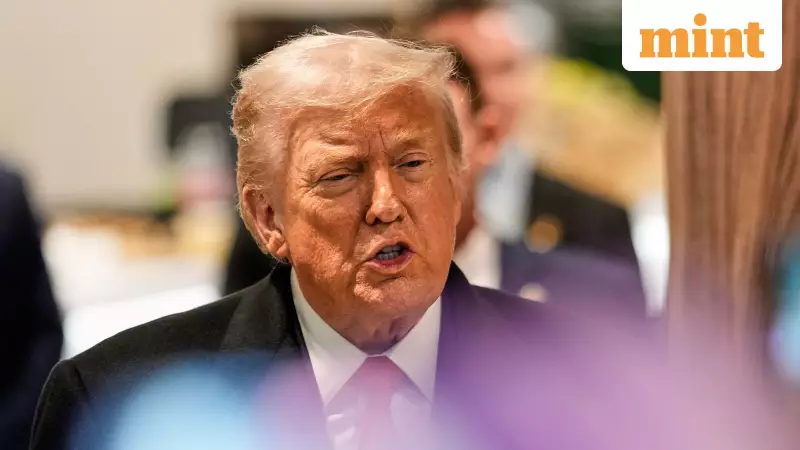
President Donald Trump's decision to rule out military force and withdraw tariff threats linked to acquiring Greenland marked the culmination of weeks of internal discord, diplomatic anxiety, and market unease, according to sources familiar with White House deliberations. The reversal, announced on the sidelines of the World Economic Forum in Davos, followed sustained pushback from senior aides concerned about the fallout among US allies and the risks of escalation, as reported by Reuters.
A Climbdown from Trump After Weeks of Ambiguity
Speaking in Davos on Wednesday, US President Donald Trump said he would not use force to secure Greenland, after weeks of refusing to rule out that option. He also stated that the United States would not proceed with tariffs he had threatened to impose on European nations from February 1. In a social media post, Trump noted that he and NATO's Mark Rutte had "formed the framework of a future deal with respect to Greenland and, in fact, the entire Arctic Region," adding that he had instructed senior officials to begin negotiations.
Aides Wary of Military Escalation
Behind the scenes, several senior officials had been urging a less confrontational strategy, according to the Reuters report. Citing two White House sources, key members of Donald Trump's team were unenthusiastic about the prospect of using military force to seize the Danish territory and worked to temper the president's rhetoric while calming alarmed allies. When asked about reports that aides had not seriously pursued military options, White House spokeswoman Anna Kelly responded, "The White House does not rule out options for President Trump unless he does so himself." She added that Trump's announcement means the entire administration will follow his lead, aiming to achieve objectives "at minimal long-term cost."

Markets and Allies Apply Pressure
Donald Trump's retreat also came against a backdrop of financial market unease. Analysts warned that retaliatory tariffs between the United States and Europe could damage the US economy as well as its trading partners. The prospect of a transatlantic trade dispute may have prompted renewed caution inside the administration. European leaders welcomed the shift, with Dutch Prime Minister Dick Schoof writing on social media, "Positive that the path to de-escalation has been embarked upon and that the 10 percent import tariffs are off the table." Italian Prime Minister Giorgia Meloni emphasized, "It is essential to continue fostering dialogue between allied nations."
Greenland Fixation Meets Diplomatic Reality
Trump first floated the idea of acquiring Greenland in 2019, but the rhetoric intensified after his return to office in 2025 for a second term. US officials had privately assured Danish counterparts last year that relations were stabilising, leaving the impression that a military takeover was no longer under consideration, according to sources familiar with those talks. That assumption was jolted in December when Trump renewed his push, appointing Louisiana Governor Jeff Landry as special envoy to Greenland and adopting a more aggressive tone—a shift some aides linked to confidence gained after the January 3 operation to capture Venezuelan leader Nicolás Maduro. While officials broadly agreed on the strategic importance of Greenland, they diverged sharply on methods, with most meetings tilting towards caution and little appetite for force.
Competing Voices Inside the White House
According to the Reuters report, Tom Dans, Trump's appointee to lead the US Arctic Research Commission, along with Vice President JD Vance and Secretary of State Marco Rubio, pushed for a "middle ground" approach. In contrast, Deputy Chief of Staff Stephen Miller was more willing to keep annexation—and the potential use of force—on the table. A State Department official told Reuters, "President Trump's team, including Secretary Rubio, routinely present him with a suite of options on issues of national concern." One official reportedly said Trump himself had been determined to preserve military leverage until his Davos announcements.

Why Force Was Always a High Bar
Experts note that the United States already enjoys extensive military access to Greenland. A 1951 agreement with Denmark grants Washington broad rights to defend the island and other NATO territory, and the US already operates a military base there. As Greenland is part of NATO, any armed seizure would raise profound alliance questions. Last week, JD Vance and Marco Rubio hosted Danish and Greenlandic foreign ministers in Washington for talks described by Denmark's foreign minister as "frank but constructive." Military action, one source said, was not seriously discussed.
A Familiar Pattern of Reversal from Trump
Donald Trump's Greenland climbdown fits a broader pattern in his second term: bold threats followed by rapid recalibration under political, diplomatic, or market pressure. On tariffs in particular, he has repeatedly adopted an on-again, off-again approach, highlighting the dynamic and often unpredictable nature of his administration's foreign policy decisions. This episode underscores the ongoing tensions between ambitious geopolitical goals and the practical realities of international relations and domestic constraints.