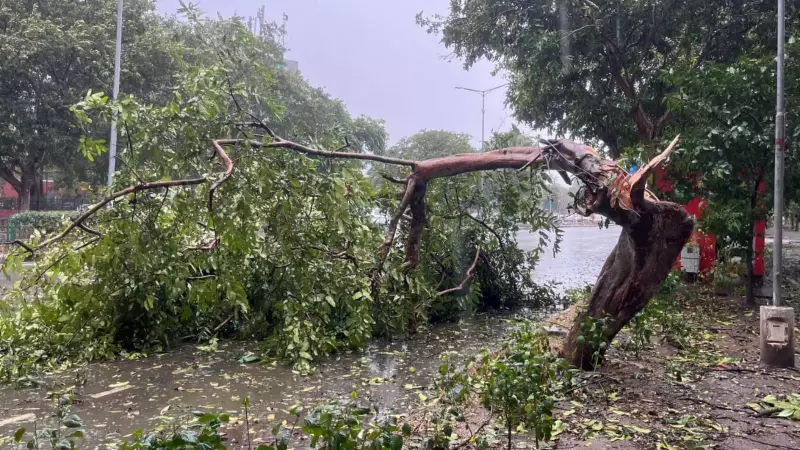
Overnight Thunderstorm Triggers Red Alert and Dramatic Rainfall Shift in Northern India
The India Meteorological Department has issued a red alert for thunderstorms, hail, and lightning across several districts of Punjab, Haryana, and the Union Territory of Chandigarh following an intense overnight weather event that has fundamentally transformed the seasonal rainfall scenario in these regions.
IMD Issues Severe Weather Warnings Across Multiple Districts
The Meteorological Department has placed Fatehgarh Sahib, Patiala, Rajpura, and Bassi Pathana in Punjab under a red alert, indicating severe weather conditions. Additionally, an orange alert has been issued for Anandpur Sahib, Rupnagar, and Samana districts. For Chandigarh and several parts of Haryana, the Met department has similarly placed a red alert, while Kalka, Panchkula, Naraingarh, Barara, Shahbad, Nilokheri, Indri, Kaithal, and Karnal regions are under an orange alert for Friday.
According to weather advisories, moderate thunderstorms accompanied by lightning and hail, with wind speeds reaching 40-60 kmph, are very likely over parts of Patiala, Samana, Nabha, Rajpura, Dera Bassi, Fatehgarh Sahib, Amloh, Mohali, Khanna, Kharar, Khamanon, and Chamkaur Sahib. The thunderstorm warning remains valid until 6:25 PM on Friday, with residents advised to stay updated and avoid open areas during lightning activity.

Punjab Transitions from Deficit to Surplus in Under 24 Hours
In a remarkable meteorological turnaround, Punjab has shifted from rainfall deficit to surplus category within less than 24 hours. Cumulative rainfall data reveals that Punjab recorded 14.5 mm of rainfall, with 13 mm occurring in just the past day. This exceeds the normal January requirement of 12.3 mm, registering a seasonal surplus of +18 percent.
The impact has been particularly pronounced in several districts where heavy rainfall was reported:
- Gurdaspur recorded 43.3 mm against a normal of 20.7 mm (+109 percent)
- Pathankot received 33.3 mm of rainfall
- Jalandhar saw 32.6 mm (+83 percent)
- Sangrur registered 21.5 mm (+168 percent)
- Mansa received 14.5 mm against a normal of 5.1 mm (+184 percent)
- Barnala recorded 16.8 mm with a massive +150 percent departure
Other districts including Amritsar (19.8 mm), Ludhiana (16.2 mm), and Tarn Taran (15.8 mm) also reported substantial rainfall. However, some districts including Moga (–100 percent), Fazilka (–85 percent), Ferozepur (–81 percent), and Muktsar (–63 percent) continue to face significant rainfall deficiencies.
Haryana Shows Sharp Improvement Despite Overall Deficit
In Haryana, the overnight rain caused a substantial jump in cumulative rainfall, though the state as a whole remains deficient. Cumulative rainfall now stands at 6.2 mm against a normal of 9.3 mm, translating to a –33 percent departure—a significant improvement from previously extreme deficient conditions.
Several districts recorded impressive rainfall figures:
- Bhiwani received 18 mm against a normal of 5.2 mm (+246 percent)
- Fatehabad recorded 12 mm (+71 percent)
- Hisar saw 7.4 mm (+28 percent)
- Kaithal recorded 10.1 mm—slightly above normal
- Charkhi Dadri registered 9.9 mm (+33 percent)
Simultaneously, large parts of southern and eastern Haryana continue to face severe rainfall shortages. Palwal, Rewari, and Nuh remain at –100 percent deficiency, while Faridabad records –94 percent, Gurgaon at –88 percent, and Yamunanagar at –90 percent. The subdivision as a whole recorded 6.3 mm against a normal of 9.4 mm, narrowing the deficit to –33 percent.

Chandigarh Witnesses Major Rainfall Recovery
The Union Territory of Chandigarh experienced a sharp rise in seasonal rainfall due to the overnight showers. Cumulative rainfall has increased to 17.7 mm compared to a normal of 27.5 mm, reducing the deficit to –36 percent from a much steeper shortfall earlier. The city recorded one of the highest single-day contributions, reflecting the intensity of the rain spell.
Single-Day Event Creates Lasting Meteorological Impact
Meteorologists emphasize that this event demonstrates how a single day of widespread rain can dramatically reshape seasonal statistics, particularly during otherwise dry periods. While Punjab has emerged into the surplus category, Haryana and Chandigarh have seen substantial recovery, though additional rainfall will be necessary to eliminate deficits in several districts.
The rainfall has provided agricultural relief, but officials note that distribution remains uneven, with some areas still confronting acute shortages. The weather department has cautioned residents across multiple districts to remain vigilant and follow safety protocols during the ongoing severe weather conditions.