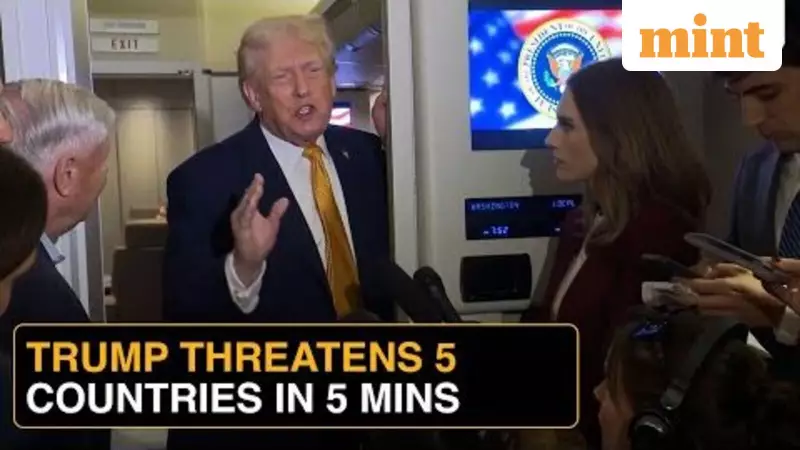
In a sweeping series of aggressive statements, former US President Donald Trump targeted multiple nations, including India, with threats of tariffs and military action, all within a brief five-minute address centered on the Venezuela crisis.
A Cascade of Threats in Minutes
Trump's remarks, which have drawn sharp international criticism, covered a wide geopolitical front. He specifically singled out India, hinting at the imposition of punitive tariffs. The threat was linked directly to New Delhi's continued purchases of Russian oil, a key energy strategy for India since the Ukraine conflict. Trump declared that the US could "raise them quickly," signaling a potential sharp turn in trade relations should he return to power.
Beyond India, the former president issued warnings to an array of countries. He suggested that Cuba was on the brink of collapse without Venezuelan oil support, warned Mexico that it must stop drug trafficking or face the deployment of US troops, and reiterated his controversial interest in purchasing Greenland for US security, citing growing Russian and Chinese presence in the Arctic.

Venezuela Arrests and Global Backlash
The catalyst for this outburst was the recent US-led capture of Venezuelan President Nicolás Maduro and his wife on drug charges. Trump defended this action, but it has been met with immediate and severe condemnation from a coalition of nations. Brazil, Chile, Colombia, Mexico, Uruguay, and Spain have collectively slammed the move as setting a dangerous international precedent. They argue that such extraterritorial arrests undermine national sovereignty and diplomatic norms.
Implications for India and World Order
The direct threat to India over its Russian oil imports places New Delhi in a precarious position. India has deftly balanced its long-standing relationship with Russia and its growing strategic partnership with the West, prioritizing its energy security and economic interests. Trump's rhetoric threatens to destabilize this balance, potentially forcing a difficult recalculation of one of India's most critical foreign policy and economic strategies.
Analysts view this episode as more than just campaign rhetoric. It highlights a potential return to a transactional and confrontational style of US foreign policy that could have significant ripple effects. The unified criticism from both traditional allies and regional powers indicates deep concern over the erosion of established international rules. For India, the message is clear: its multi-alignment diplomacy could face its sternest test if such threats materialize into policy, impacting trade, energy costs, and geopolitical stability.