

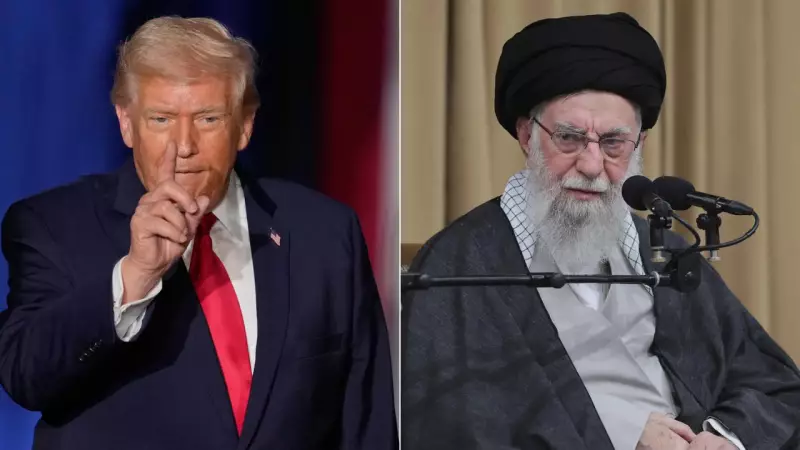
US President Donald Trump has once again issued a stern warning to Iran, urging the nation to "come to the table" and negotiate what he described as an "equitable" deal that explicitly prohibits nuclear weapons. In a clear ultimatum, Trump stated that failure to comply would result in a military attack far "worse" than the previously executed Operation Midnight Hammer.
Tehran's Firm Rejection of Negotiations Under Duress
In response to Trump's demands, Tehran has categorically rejected the possibility of engaging in talks with the United States. Iranian officials emphasized that negotiations cannot proceed in what they termed an "atmosphere of threats." This stance underscores the deepening diplomatic rift between the two nations, with Iran maintaining that productive dialogue cannot occur under coercive conditions.
Trump's "Armada" Fleet Claims and Military Posturing
Reiterating his earlier assertions about a formidable naval presence, Trump claimed that a massive "Armada" fleet is currently en route to Iran. He described this fleet as "ready, willing, and able to rapidly fulfill its mission, with speed and violence, if necessary." In a detailed post on Truth Social this Wednesday, Trump elaborated on the composition and capabilities of this naval force.

"A massive Armada is heading to Iran. It is moving quickly, with great power, enthusiasm, and purpose. It is a larger fleet, headed by the great Aircraft Carrier Abraham Lincoln, than that sent to Venezuela. Like with Venezuela, it is, ready, willing, and able to rapidly fulfill its mission, with speed and violence, if necessary," Trump declared. This statement highlights the administration's continued emphasis on military readiness as a tool of diplomatic pressure.
Iran's Diplomatic Counter: Rejecting Military Threats
Iranian Foreign Minister Abbas Araghchi responded firmly to Trump's threats, asserting that "diplomacy through military threat cannot be effective or useful." In comments reported by AFP, Araghchi stressed that genuine talks are impossible when conducted under the shadow of intimidation. "One cannot speak of talks in an atmosphere of threats," he reiterated, reinforcing Iran's position that any negotiations must be free from external pressure.
Trump's Call for a Comprehensive and Fair Agreement
Trump further elaborated on his vision for a potential deal, emphasizing that it should be "good for all parties" and must unequivocally exclude nuclear weapons. He warned that Iran's refusal to engage could lead to severe consequences. "Hopefully Iran will quickly 'Come to the Table' and negotiate a fair and equitable deal - NO NUCLEAR WEAPONS - one that is good for all parties. Time is running out, it is truly of the essence!" Trump stated.
He also referenced past events, noting, "As I told Iran once before, MAKE A DEAL! They didn’t, and there was 'Operation Midnight Hammer,' a major destruction of Iran. The next attack will be far worse! Don’t make that happen again." This reminder of previous military actions serves as a stark warning of the potential escalation if diplomatic efforts fail.
Iran's Conditions for Future Dialogue
Meanwhile, Araghchi outlined specific preconditions for any future negotiations with the United States. He insisted that if the US genuinely desires talks, it must abandon "excessive demands" and "illogical issues." "If they want negotiations to take shape, they must certainly set aside threats, excessive demands and raising illogical issues," Araghchi asserted. He added, "Iran has not sought negotiations," indicating that the impetus for dialogue lies squarely with Washington.
Regional Security Concerns and Warnings
The escalating tensions have also prompted reactions from regional actors. An IRGC commander issued a warning that neighboring countries would be considered hostile if their "soil, sky, or waters are used against Iran." However, the commander clarified that these nations are otherwise regarded as "our friends," highlighting the nuanced geopolitical landscape.
In a related development, Saudi Arabia has publicly stated that it will not permit its territory or airspace to be utilized for any attack on Iran. This declaration adds another layer of complexity to the regional dynamics, as countries navigate their alliances and security interests amidst the rising US-Iran confrontation.

The ongoing standoff between the United States and Iran continues to unfold, with both sides entrenched in their positions. Trump's combination of diplomatic overtures and military threats contrasts sharply with Iran's insistence on threat-free negotiations, setting the stage for a potentially volatile period in international relations.





