

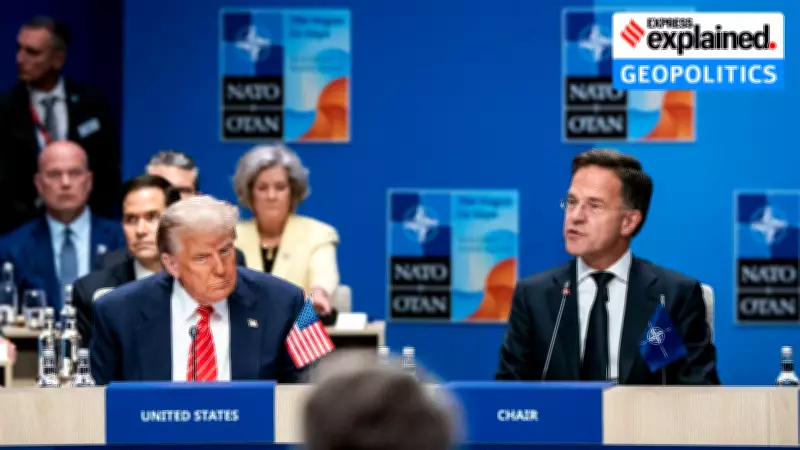
Trump's America First Approach Fractures Transatlantic Unity: An Expert Analysis
Eight years since his first term, President Donald Trump has significantly impacted global geopolitics, particularly by fracturing transatlantic unity. His America First approach has forced NATO members to increase their military spending while casting doubt on the United States' commitment to securing European allies against threats like Russia.
The Erosion of NATO and Security Guarantees
Transatlantic unity is experiencing unprecedented strain under Trump's second term. Historically, the US and Europe have maintained a strong bond on security and territorial sovereignty, despite differences on issues like climate change and trade. However, President Trump's reluctance to steadfastly support Ukraine and Europe against Russia, coupled with his public desire to acquire Greenland, a Danish territory, has deeply alarmed European nations.
This concern extends to his comments about Canada, which he has referred to as the 51st state of the US in a threatening manner, further undermining trust. NATO, established post-World War II to keep Russia out, the US in, and Germany down, now faces a crisis. Its core principle, Article 5, which affirms collective self-defense, is being challenged by Trump's rechristened "Donroe" doctrine, focusing US interests primarily on the Americas.

Military Dependence and the Push for Détente
Europe's military dependence on the US is a key factor in this fracture. With a combined GDP of USD 28 trillion and a population of 600 million, Europe possesses significant economic might. Yet, it struggles to independently counter Russian aggression, largely due to lower military spending compared to the US. In NATO, the US accounts for over half of the estimated USD 1.6 trillion annual defense expenditure, spending around USD 980 billion, with over 65,000 US troops still stationed in Europe.
This disparity has led to perceptions of Europe free-riding on US security. In his first term, Trump demanded European nations increase defense spending to 2% of GDP. Now, in his second term, he has forced NATO members to up this to 5%, a tough financial and political move driven by fears that the US may not back them against Russia.
Trump's push for détente with Russia contrasts with Europe's heightened fears, stemming from events like Russia's annexation of Crimea in 2014 and the 2022 conflict. While Europe benefited from cheap oil and trade with Russia post-Soviet Union, NATO's eastward expansion has fueled tensions.
Territorial Ambitions and Global Realignments
Trump's America First policy is fueled by nativist tendencies, restrictive immigration, and unbridled capitalism. He seeks deals with major competitors like China and Russia, as seen in their support for UNSC Resolution 2803, which created a Board of Peace chaired by Donald Trump, not the US President. This move, ostensibly for Gaza, is viewed by many as a model for global intervention replacing the UN.
Europeans, seen as obstructionists promoting a rule-based order, have largely eschewed membership in this board. Trump's territorial ambitions, including acquiring Greenland and eyeing Canada, aim to cement his legacy as a consequential US president. Despite Greenland being a Danish NATO member open to US military presence, Trump's focus on sovereignty raises concerns about control over mineral-rich regions like Venezuela.
However, domestic support for such acquisitions is low, with polls showing only a quarter of Americans approve of acquiring Greenland.
Implications for Global Geopolitics and India
A major rupture in transatlantic unity could weaken the combined influence of the West, which still accounts for about 45% of global GDP, and create openings for Chinese hegemony. This realization persists within the US and Trump administration, but Europeans are increasingly recognizing the need to develop independent security strategies and multi-alignments.
For India and the global south, transatlantic divergences have historically provided space for multi-alignment. India is pursuing détente with China, rekindling ties with Russia, and securing trade deals with the EU, UK, and EFTA, reflecting a similar European interest in diversified partnerships.

As Europe hopes Trump's policies will pass, there is a growing understanding that they must stand up for their security and build resilient alliances in an evolving global landscape.





