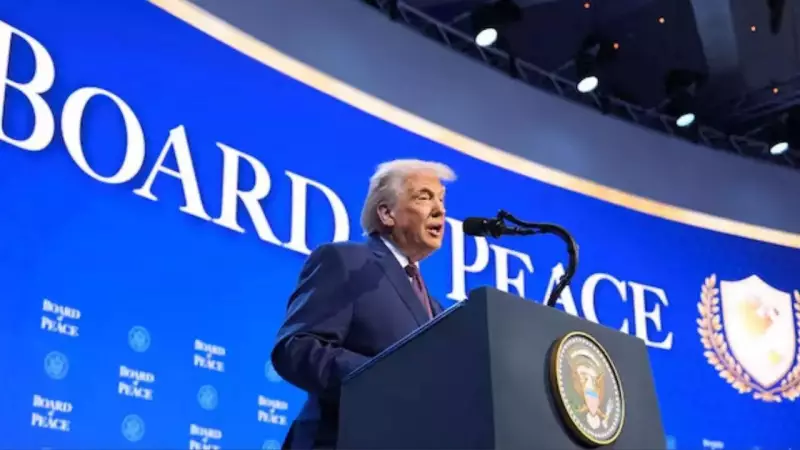
Trump Unveils 'Board of Peace' at Davos with Controversial $1 Billion Membership Fee
In a significant diplomatic move, former US President Donald Trump officially launched his much-discussed Board of Peace during a signing ceremony at the World Economic Forum in Davos on Thursday. The initiative, initially conceived to help stabilize Gaza's fragile ceasefire, has been positioned by Trump as a potential broader mechanism for addressing international conflicts beyond existing multilateral institutions.
Controversial Financial Structure and Membership Model
The Board of Peace introduces a controversial financial model that has already sparked debate among international observers. Under the proposed structure:
- Countries may join the board free of charge for an initial three-year period
- After this introductory phase, the board's chairman retains discretion to renew a country's membership
- Nations seeking permanent membership must pay a substantial $1 billion fee within their first year of participation
This financial requirement represents one of the most distinctive and contentious aspects of the new peace initiative.

Logo Design Sparks Widespread Social Media Criticism
While the board's purpose and structure generated discussion, it was the organization's official logo that quickly captured global attention, triggering sharp reactions across social media platforms. The design combines several symbolic elements:
- A protective shield representing defense and security
- A laurel wreath historically associated with victory and authority
- A globe prominently centered on the Americas
The dominant gold color palette emphasizes prestige and permanence, while the symbolic elements collectively suggest that peace requires protection and enforcement rather than mere negotiation. However, the globe's specific focus on North and South America has drawn criticism for reflecting a distinctly US-led worldview rather than promoting genuine multilateral consensus.
Social Media Reactions Highlight Design Flaws
The logo immediately became a subject of mockery and analysis across digital platforms. One user commented, "Trump's 'Board of Peace' logo is basically the UN logo, except dipped in gold and edited so the world only includes America." Another offered more direct criticism: "That logo is objectively terrible."
A particularly pointed observation highlighted what many see as a glaring omission: "Hilarious that it doesn't even include the part of the Middle East it's supposed to be focused on." These reactions underscore broader skepticism about the board's credibility and its perceived American-centric presentation.
International Participation: Who's In, Who's Out
The Trump administration has extended invitations to more than 50 countries worldwide. While the White House hasn't released a complete list, several nations have already committed to participation. The charter document presented on January 22 included signatures from:
- Saudi Arabia, United Arab Emirates, Bahrain, Jordan, Qatar
- Turkey, Hungary, Bulgaria, Argentina, Mongolia
- Morocco, Pakistan, Indonesia, Kosovo, Uzbekistan
- Kazakhstan, Paraguay, Armenia, and Azerbaijan
Additional countries including Israel, Egypt, Belarus, Albania, and Vietnam have also agreed to join. Trump has claimed Russian acceptance of an invitation, though the Kremlin has not officially confirmed this statement.
Countries Still Considering or Declining Participation
Several major global powers remain undecided about joining the initiative. China, Canada, Britain, Germany, and Japan are reportedly still evaluating the proposal. Meanwhile, Sweden, Norway, and France have already declined participation.
Ukraine has adopted a cautious stance, indicating it will wait for clarity on Russia's position, noting the difficulty of joining a peace body alongside a country with which it remains at war. The Vatican has confirmed that Pope Leo, the first American pontiff, has received an invitation, though no decision has been announced.

Broader Implications for Global Conflict Resolution
The Board of Peace represents Trump's attempt to establish an alternative mechanism for international conflict resolution that operates outside traditional multilateral frameworks. By combining symbolic elements suggesting strength and authority with a controversial financial model, the initiative reflects a distinctive approach to global peacekeeping that emphasizes American leadership and direct financial commitment from participating nations.
As the international community continues to react to both the board's structure and its symbolic presentation, questions remain about how this new entity will function alongside existing peacekeeping institutions and whether its US-centric approach will gain broader global acceptance.