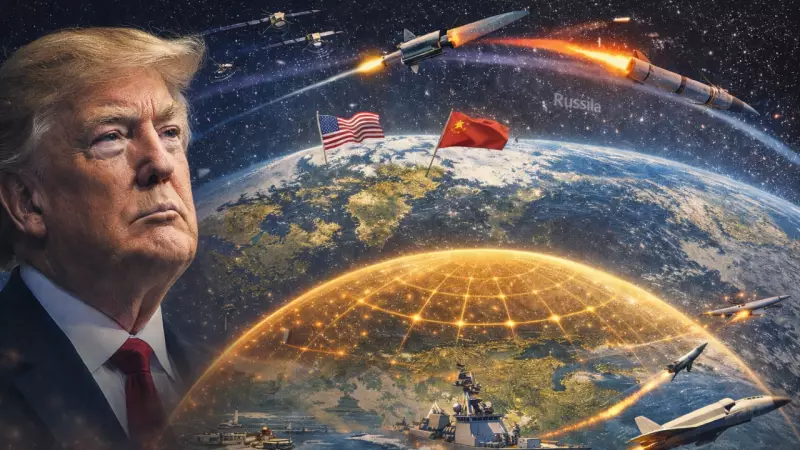
Trump Revives Greenland Ambition for Missile Defense Shield
Former President Donald Trump has reignited his interest in Greenland, framing it as essential for national security. He explicitly connected this Arctic territory to his proposed Golden Dome missile defense system in a recent social media post. Trump declared that the United States needs Greenland to make NATO more formidable and effective.
His statement has generated significant reactions from Moscow and Beijing. Both nations view Greenland not as a simple real estate opportunity but as a potential strategic asset that could shift global power dynamics.
Geographic Advantage of Greenland
Greenland's value lies primarily in its location rather than its natural resources. Positioned between North America and Eurasia, it sits along the shortest ballistic missile paths between Russia and the United States. This makes early detection of missile launches crucial for defense systems.

The United States already operates the Pituffik Space Base in northern Greenland under a defense agreement with Denmark. This facility houses advanced radar systems that provide critical early warning capabilities. These systems detect missile launches within seconds and track objects in space.
Trump argues that tighter control over Greenland prevents adversaries from exploiting these strategic advantages. He has expressed concerns about Russian and Chinese military presence near Greenland, including destroyers and submarines.
The Golden Dome Concept
The Golden Dome represents Trump's vision for a comprehensive, layered missile defense architecture. Unlike existing systems designed for limited threats, this proposal aims to protect against a wide range of advanced weapons.
Key features of the Golden Dome concept include:
- Space-based sensors for global missile launch detection
- Advanced tracking systems across multiple domains
- Multiple interception layers including potential space-based interceptors
- Capability against ballistic, hypersonic, and cruise missiles
This ambitious project carries an estimated cost of around $175 billion, though analysts suggest the actual figure could be much higher. The Golden Dome seeks to achieve near-invulnerability for the US homeland, a goal that arms control experts view with skepticism.
Distinction from Iron Dome
Many people confuse the Golden Dome with Israel's Iron Dome system due to similar naming. However, these systems serve completely different purposes.
Iron Dome is a tactical air defense system that counters short-range rockets and artillery shells. It protects specific areas within Israel and operates with selective interception logic. The system only engages threats likely to hit populated areas, conserving interceptors for genuine dangers.
In contrast, the Golden Dome would address strategic threats from major powers. It would need to intercept nuclear-capable ballistic missiles traveling at hypersonic speeds. This requires near-perfect performance since even a single successful penetration could cause catastrophic damage.
Global Reactions and Strategic Implications
Russian officials have expressed serious concerns about the Golden Dome proposal. They argue that such a comprehensive missile defense system could destabilize global strategic balance. Russian analysts specifically worry about Greenland's role in enabling Arctic-focused defense layers.
China has responded more cautiously but shares similar concerns. Chinese officials suggest the Golden Dome could violate international space treaties and accelerate militarization of space.
Both nations fear that a successful Golden Dome could weaken their nuclear deterrent capabilities. This might prompt them to expand their arsenals or develop more sophisticated delivery systems.
India's Missile Defense Approach
India maintains a different missile defense posture compared to the Golden Dome concept. New Delhi has developed a Ballistic Missile Defence programme focused on regional protection against limited threats.
India's systems include:

- Prithvi Air Defence interceptors
- Advanced Air Defence interceptors
- PDV interceptors for longer-range threats
Unlike the Golden Dome's ambition of national invulnerability, India's approach remains deterrence-based and regionally focused. It does not seek to neutralize the strategic deterrents of major powers.
Arctic Competition Intensifies
The Arctic region has transformed into a zone of strategic competition. Melting ice has opened new maritime routes and increased access to undersea resources. Russia has expanded its military presence in the Arctic, while China has declared itself a "near-Arctic state" despite geographical distance.
Trump's worldview favors territorial control over alliance management. Where previous administrations relied on treaties and agreements, Trump prefers direct control that cannot be reversed by political changes. In this context, Greenland represents permanent strategic advantage.
Whether the Golden Dome moves beyond rhetoric remains uncertain. What is clear is that Greenland has become a focal point of great-power rivalry once again. Its value lies not in what it produces but in what it enables nations to monitor and potentially counter.
In the evolving Arctic landscape, geography continues to shape strategic destiny. For Trump's vision of missile defense, Greenland may indeed serve as the keystone holding the Golden Dome in place.