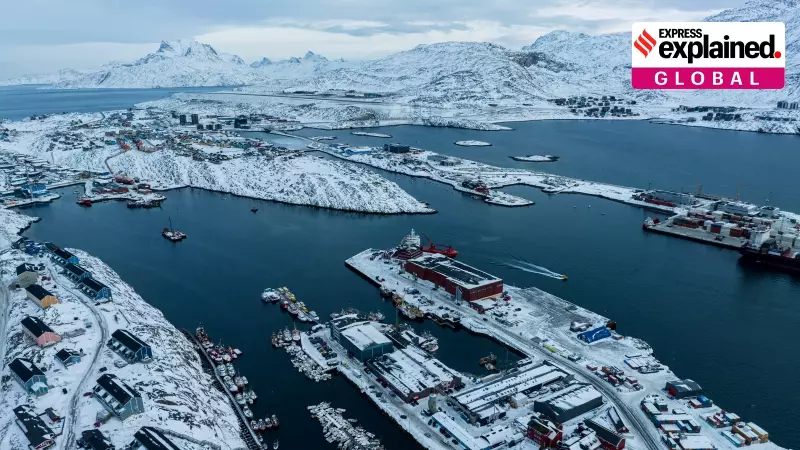
Trump's Greenland Assertion: A Historical Misrepresentation Amidst Arctic Geopolitics
At the World Economic Forum in Switzerland, US President Donald Trump sparked controversy by claiming that the United States "gave Greenland back to Denmark" after World War II. This statement, made during a 70-minute speech, has been widely debunked by historical experts and official records. In reality, the US never held sovereignty over Greenland, and Denmark has consistently maintained control over the territory, with a Cold War-era defense agreement granting the US extensive military privileges without ownership.
The Historical Context: World War II and the Defense Agreement
To understand the current situation, one must revisit the events of World War II. In April 1940, Nazi Germany invaded Denmark, leading to a swift occupation. By August 1943, the German Army had disarmed Danish forces and taken administrative control. At that time, Greenland was a Danish colony, and its strategic location in the Arctic caught the attention of the United States.
In 1941, with Denmark under occupation, the Danish ambassador to Washington signed a treaty allowing the US to protect Greenland. This agreement, as noted by Ulrik Pram Gad, a Senior Researcher at the Danish Institute for International Studies, was made in exchange for a reaffirmation of Danish sovereignty. It granted the US rights to establish military bases on the island, but crucially, it did not transfer ownership.

Post-War Developments and the Cold War Era
After the war ended in 1945, the US interest in Greenland persisted. In 1946, President Harry Truman even offered to buy Greenland for $100 million in gold, a proposal that Denmark rejected. This offer itself underscores that the US recognized Denmark as the rightful sovereign at the time.
By 1951, with the Cold War intensifying and the Soviet Union emerging as a key threat, the US formalized its military presence through the Defense of Greenland agreement. This pact led to the establishment of the Thule Air Base, now known as the Pituffik Space Base, which remains America's sole base on the island. The agreement explicitly acknowledges "the sovereignty of the Kingdom of Denmark," ensuring that US military activities do not challenge Danish control.
Greenland's Evolving Status and US Military Rights
Over the decades, Greenland's relationship with Denmark has evolved significantly. In 1953, its colonial status ended, and it became an integral part of the Kingdom of Denmark, with representation in parliament. Autonomy increased over time, culminating in the Self-Government Act of 2009, which grants Greenland's population of around 57,000 the right to hold a referendum on independence.
The Defense of Greenland agreement was updated in 2004, with the US expressly noting Greenland's status as an "equal part of the Kingdom of Denmark." This update, as highlighted by Professor Marc Weller in an article for Chatham House, precludes any US challenge to Danish sovereignty.
Today, the US enjoys sweeping military rights in Greenland under this agreement, including the ability to:
- Construct, install, maintain, and operate facilities and equipment.
- Station and house personnel for defense purposes.
- Control landings, takeoffs, and movements of ships and aircraft.
These rights allow the US to ramp up its military presence in the Arctic region at will, all while respecting Danish sovereignty.
Trump's Recent Announcements and Future Implications
During his speech, Trump announced that a framework had been reached for a deal with NATO regarding Greenland's future. Media reports suggest this could involve building more military bases and potentially mining rare earth minerals without Danish permission. However, it remains unclear what additional benefits this framework offers beyond existing US rights.
Experts argue that Trump's threats to buy or annex Greenland were unnecessary, given the extensive military access already granted. The framework, as announced, does not suggest US ownership, and more details will emerge as negotiations progress. For now, European allies may find relief in the fact that Danish sovereignty remains intact, despite heightened geopolitical tensions in the Arctic.