One Year of Trump's Return: How US Policies Reshaped India's Trade and Immigration
Donald Trump returned to the White House in January 2025. His second term as US president quickly upended global dynamics. India felt the impact directly. The relationship between the two nations faced new challenges in trade and migration.
Steep Tariffs Hit Indian Exports
Trump wielded tariffs as a powerful tool. On August 27, 2025, the US imposed a 50% tariff on many Indian goods. This included an additional 25% penalty for purchasing Russian oil. These measures put India at a disadvantage compared to other emerging markets.
China faced around 32% tariffs. Vietnam and Bangladesh dealt with 20% rates. Indian exporters, especially in labor-intensive sectors, suffered sharp declines. Gems and jewelry exports fell by 60%. Plastic and linoleum dropped 44.3%. Glassware saw a 44% decrease. Fertilizer exports declined by 33.3%.

Despite these pressures, overall exports to the US showed resilience. From September to December 2025, exports dipped only marginally by 1% to $25.57 billion. India diversified its markets. Shipments to China, Spain, Vietnam, and Hong Kong increased. Overall exports actually rose by 3% during this period.
Shifting Oil Imports Amid Tensions
India's oil trade became a focal point. After Russia invaded Ukraine, India bought discounted Russian oil. Before the war, Russian oil made up just 2% of India's imports. By fiscal year 2025, this share zoomed to 35%. India became the second-largest consumer of Russian oil after China.
The US response targeted India but not China. Trump's administration imposed additional tariffs on India for buying Russian oil. This forced India to adjust its strategy. The share of Russian oil imports declined to 32% in fiscal year 2026. India slipped to the third-largest buyer of Russian oil by December 2025.
Simultaneously, India increased oil purchases from the United States. The US share in India's oil imports nearly doubled. It rose from 4.6% last fiscal year to 8.1% in fiscal year 2026. This shift aimed to ease trade tensions with the Trump administration.
Immigration Crackdowns and Deportations
Immigration policies created another flashpoint. Trump signed an executive order hours after taking office. It fast-tracked deportations of illegal immigrants in the US. This move had direct consequences for India.
Over 200,000 unauthorized Indian immigrants lived in the US until 2022. Many faced quick deportation. In February 2025, over 200 illegal Indian immigrants were deported in handcuffs and chains. This incident stirred controversy in India.
Data from India's external affairs ministry revealed the scale. By November 28, 2025, the US had deported 3,250 Indians. This number far exceeded deportations in previous years, including Trump's first term.
Visa Changes Hit Indian Professionals
The Trump administration announced a crackdown on high-skilled immigration. It introduced tighter and costlier visa processes. The most significant change was a steep one-time fee of $100,000 for new H-1B visa petitions. This sharply raised costs for employers hiring foreign workers.
A new wage-based weighted lottery system for H-1B visas is also nearing approval. This system would prioritize applicants with higher salaries over the current random selection process. Indians, who receive about 74% of H-1B visas, face the hardest impact.
Visa processing delays and heightened uncertainty became common. An analysis by the National Foundation for American Policy showed a 19% year-over-year decline in H-1B visa approvals for initial employment at top companies in fiscal year 2025.
Indian-based IT firms suffered particularly. The top seven Indian companies saw only 4,573 H-1B visas approved. This represented a 37% year-on-year decline. Tata Consultancy Services witnessed a drop of 41.7%.
Diplomatic Twists and Future Challenges
The relationship took awkward turns on other fronts. Trump claimed he mediated a ceasefire between India and Pakistan. He listed this as one of eight wars he ended. This assertion added complexity to diplomatic exchanges.

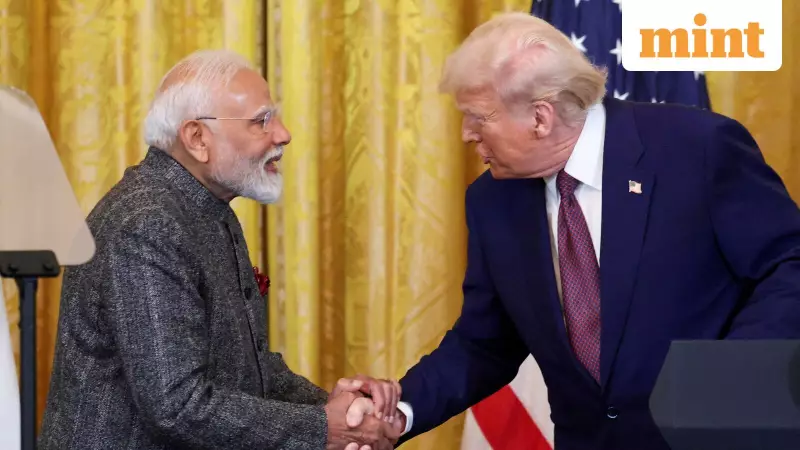
Trump's second term has moved with full force on multiple fronts. His administration pushed tariffs, tightened immigration, and asserted American power globally. India found itself navigating these changes while seeking to protect its interests.
The country must continue finding alternative markets to reduce risks from overdependence on the US. Trade diversification and immigration policy adjustments remain critical challenges. One year into Trump's return, India-US relations stand at a crossroads, shaped by economic pressures and policy shifts.