

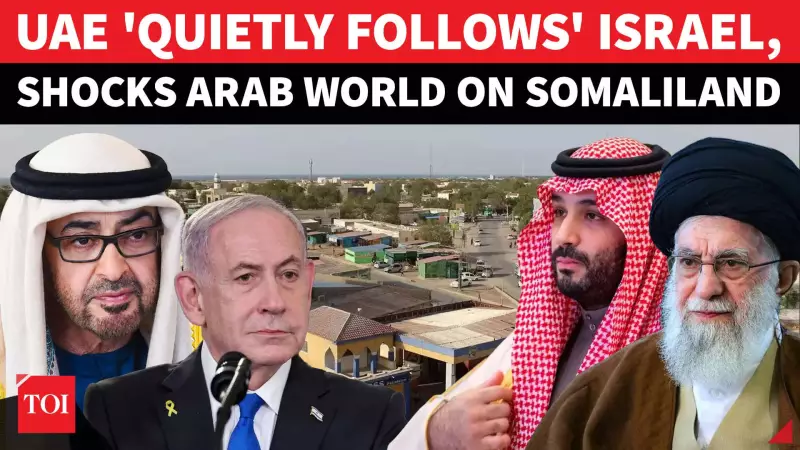
In a development that is sending ripples across the Muslim world, the United Arab Emirates (UAE) has seemingly executed a major, unannounced foreign policy shift. Evidence strongly suggests the Gulf nation has extended de facto recognition to the breakaway region of Somaliland, a move that directly challenges the sovereignty of the Federal Republic of Somalia and places the UAE at odds with most Arab and Islamic nations.
The Silent Signals: Passports and Political Absence
The recognition, while not declared publicly, is being communicated through clear administrative and diplomatic actions. The most tangible proof is found on the UAE's official visa application platform. Travellers holding a Somaliland passport can now apply for entry, while those with a Somali passport are systematically blocked. This practical distinction is a powerful indicator of state-level acceptance.
Simultaneously, Abu Dhabi chose to distance itself from a collective regional stance. When a joint Arab-Islamic statement was issued condemning Israel's earlier recognition of Somaliland, the UAE notably declined to add its signature. This deliberate absence speaks volumes, setting the Emirates apart from the consensus of its neighbours and partners in the region.

Strategic Interests and the Berbera Base
Analysts point out that this 'silent recognition' is not a sudden impulse but aligns with the UAE's long-term strategic and military investments in Somaliland. For years, the Emirates has cultivated deep ties, with the crown jewel being its military base in the port city of Berbera. This facility overlooks the critical Bab el-Mandeb Strait, a chokepoint for global shipping and energy routes into the Red Sea and Suez Canal.
By solidifying its partnership with Somaliland, the UAE secures a stable foothold on the Horn of Africa, enhancing its maritime security influence and economic reach. This move is seen as part of a broader competition for influence in the region, where powers like Turkey and Qatar have invested heavily in the federal government in Mogadishu.
Potential Fallout and Reshaping Alliances
The implications of this quiet manoeuvre are profound. Firstly, it deals a significant blow to the Somali government's longstanding efforts to reunify the country. Somaliland, which declared independence in 1991, has sought international recognition for decades. The tacit backing of a powerful Arab state like the UAE lends it unprecedented legitimacy.
Secondly, it risks sparking new diplomatic tensions within the Arab and Islamic bloc. The UAE's divergence from the collective position on Somalia's unity could lead to friction with other Gulf Cooperation Council (GCC) members and African Union states that firmly support Mogadishu. The situation creates a complex web where geopolitical interests are trumping traditional diplomatic solidarity.
As of now, the UAE's strategy of 'recognition by action, not announcement' allows it to advance its interests while maintaining a degree of plausible deniability. However, as the practical consequences of accepting Somaliland passports become clear, this silent shift is poised to become a loud and contentious issue in international diplomacy, potentially reshaping alliances in one of the world's most strategically volatile regions.






