

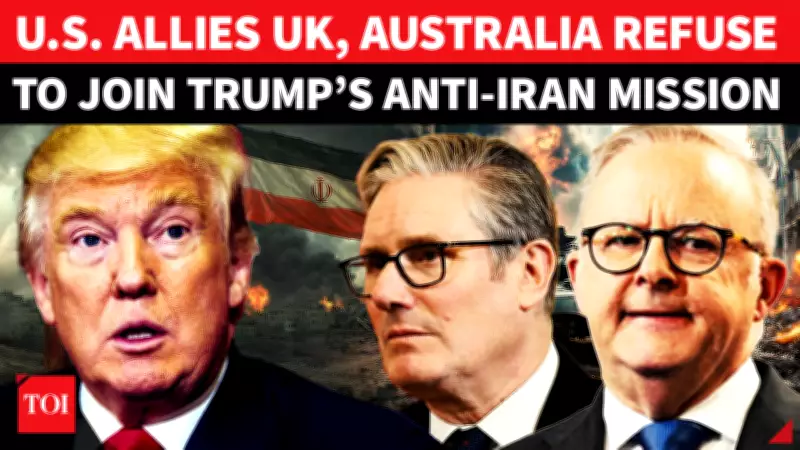
US Allies Distance Themselves from Trump's Hormuz Naval Blockade
In a significant diplomatic development, key allies of the United States have openly refused to support President Donald Trump's controversial naval blockade on Iran, following the collapse of recent negotiations. This move has created a notable rift within the international coalition, highlighting divergent approaches to the escalating tensions in the Middle East.
Australia and UK Advocate for Open Navigation
Australia and the United Kingdom have taken a firm stance, explicitly calling for the Strait of Hormuz to remain open to maritime traffic. Both nations have emphasized their commitment to the principle of freedom of navigation, a cornerstone of international maritime law. By distancing themselves from the blockade, these allies are signaling a cautious approach to the conflict, prioritizing stability in the vital energy corridor over aggressive military measures.
This public rejection underscores the growing international concern over the potential for a broader geopolitical crisis. The Strait of Hormuz is a critical chokepoint for global oil shipments, and any disruption carries severe implications for energy security worldwide.

US Proceeds with Blockade Despite Opposition
Concurrently, the United States Central Command has officially confirmed that the naval blockade will proceed as planned. This decision has already triggered an immediate halt in shipping traffic through the strait, effectively cutting off a major artery for crude oil exports from the Persian Gulf region.
The implementation of the blockade marks a significant escalation in the standoff between the US and Iran, raising the stakes for all parties involved. It represents a hardline strategy by the Trump administration, which has rejected further diplomatic talks with Tehran, asserting a position of total dominance in the region.
Global Markets React with Sharp Volatility
The geopolitical turmoil has sent shockwaves through global financial markets. Oil prices have surged dramatically in response to the supply disruption, while equity markets have experienced significant declines. Investors are grappling with fears of a prolonged economic crisis, driven by the uncertainty surrounding energy supplies and the potential for wider military conflict.
The market reaction highlights the interconnected nature of global security and economic stability. Analysts warn that continued instability in the Strait of Hormuz could lead to sustained high oil prices, inflationary pressures, and reduced economic growth worldwide.
Broader Context and Regional Implications
This development occurs against a backdrop of heightened regional tensions. Recent events, including missile strikes and diplomatic failures, have exacerbated the situation. Iran has issued warnings and ridiculed US efforts, while other actors in the region have become involved, further complicating the security landscape.
The refusal of allies like Australia and the UK to endorse the blockade may influence other nations' positions, potentially isolating the US strategy. It raises questions about the cohesion of international responses to Iranian actions and the long-term viability of unilateral measures in such a sensitive geopolitical arena.
As the situation evolves, the world watches closely, aware that the stakes extend far beyond the waters of the Strait of Hormuz to encompass global energy markets, diplomatic alliances, and the specter of a larger conflict.






