

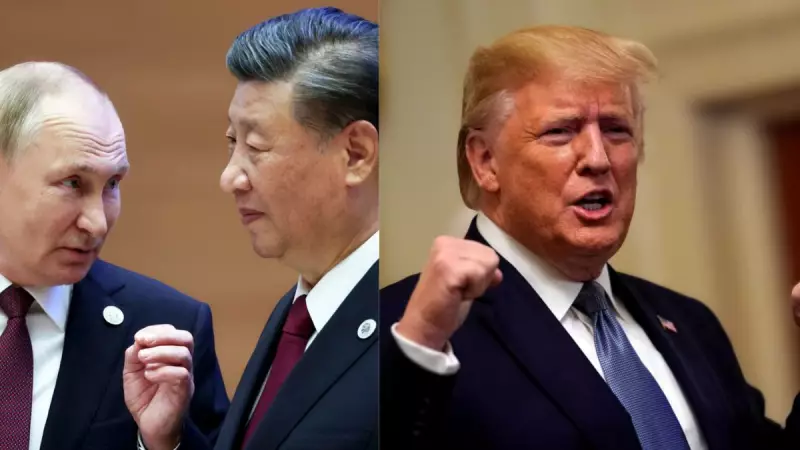
In a stunning development with far-reaching geopolitical implications, reports have emerged detailing a bold operation by the United States to capture Venezuelan President Nicolás Maduro. This dramatic event, if confirmed, is not merely a regional shockwave but a potential catalyst for major global conflicts, including Russia's ongoing war in Ukraine and China's strategic designs on Taiwan.
The Operation and Its Immediate Aftermath
According to the source report, the United States successfully apprehended President Nicolás Maduro of Venezuela. The operation, executed with precision, marks a significant escalation in the long-standing tensions between Washington and the Caracas regime. For years, the US has levied severe sanctions against Maduro's government, labeling him a dictator and recognizing opposition figure Juan Guaidó as the legitimate interim president. This move, however, transitions from economic and diplomatic pressure to direct, physical intervention.
The immediate consequences within Venezuela are expected to be chaotic. The nation, already grappling with profound economic hardship and political division, now faces a leadership vacuum and the potential for severe internal unrest. The capture of a sitting head of state by a foreign power is an act of immense gravity, likely to provoke strong reactions from Maduro's loyalists within the military and his political base.

Global Ripples: Fuel for Putin's War Machine?
The geopolitical ramifications extend far beyond Latin America. Analysts are closely watching how Russia will respond. Venezuela has been a key strategic and economic partner for Moscow in the Western Hemisphere. Russia has provided military support, investment, and diplomatic cover for Maduro's government. The removal of a major ally is a direct blow to Russian influence.
More critically, there is a palpable fear that this action could inadvertently provide new impetus to President Vladimir Putin's war in Ukraine. Faced with a significant loss in one theatre, Russia might be compelled to double down in another to demonstrate strength and deter further Western interventions against its allies. Alternatively, it could seek new, asymmetric ways to retaliate against US interests globally, further complicating an already volatile international security landscape.
The Taiwan Strait Dimension: A Signal to Beijing?
Perhaps the most delicate global trigger lies in the Asia-Pacific. The United States' decisive action against Maduro will be scrutinized in Beijing. China, which has steadily increased military pressure on Taiwan, views the island as a breakaway province to be reunited with the mainland, by force if necessary.
The precedent of US-led regime change, even against a leader as controversial as Maduro, could be interpreted by China's leadership as a demonstration of Washington's willingness to use extreme measures. This perception might accelerate China's timeline regarding Taiwan, pushing it to act more swiftly to secure its core interests before the US can apply similar tactics or strengthen its alliances in the Indo-Pacific region. It serves as a live-action case study in US interventionism, one that Xi Jinping's government is certain to analyze for its own strategic calculations.
A New Phase of Unpredictable Power Politics
The reported capture of Nicolás Maduro signifies a potential pivot point in international relations. It moves great power competition into a more overt and unpredictable phase. The event underscores a shift towards more direct action in the US foreign policy playbook, moving beyond sanctions and proxy conflicts.
The world now watches for the domino effect. Will this empower hawks in Moscow and Beijing, or will it serve as a deterrent? The answers will unfold in the battlefields of Ukraine, the tense waters of the Taiwan Strait, and in capitals around the world. One thing is clear: the rules of engagement in 21st-century geopolitics are being rewritten in real-time, with consequences that are impossible to fully foresee but are undoubtedly profound.






