

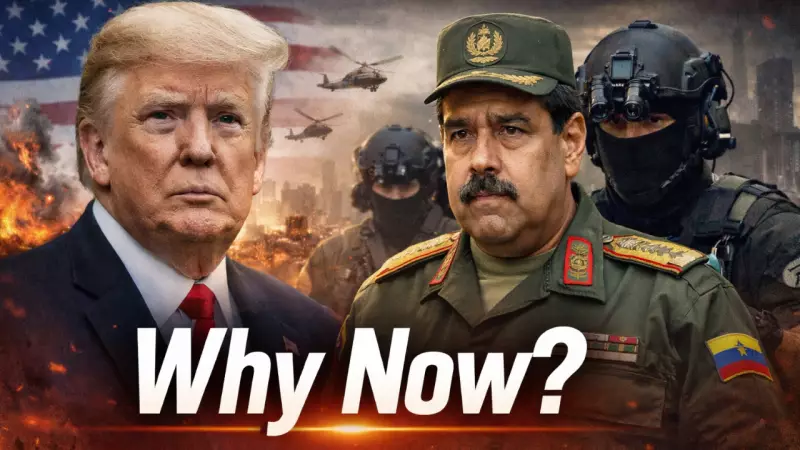
In a stunning escalation that has reshaped geopolitics in the Western Hemisphere, United States forces executed a large-scale military operation on Saturday, capturing Venezuela's sitting President, Nicolás Maduro, and flying him out of the country. This bold move marks the first time in over three decades, since the Panama intervention, that a US administration has physically seized the leader of a sovereign nation.
The Operation and Its Immediate Justification
The capture, authorised by President Donald Trump at 10:46 PM EST on Friday, followed months of visible military buildup and covert pressure. The White House has framed the strike as a decisive action in the war on drugs, labelling Maduro a "narco-terrorist" who presided over a criminal state flooding the US with cocaine. Trump, in a briefing, called Maduro the "kingpin of a vast criminal network" responsible for countless American deaths.
This narrative was built over time. In July 2025, the US doubled the bounty on Maduro to $50 million. The military presence near Venezuela grew to include the powerful USS Gerald R. Ford carrier strike group and roughly 18 warships by late 2025. General Dan Caine, Chairman of the Joint Chiefs, stated the operation proceeded once skies "broke just enough" for a narrow window.

Beyond Drugs: The Strategic Drivers
However, experts argue the operation's motives run deeper than law enforcement. Dr. Melanie Garson of University College London told The Times of India that the timing reflects strategic opportunity and political calculation. With key Venezuelan allies like Russia and Iran preoccupied with their own challenges, and a global context of rivalry, the US saw a window to act.
Oil is a central prize. Venezuela holds the world's largest proven oil reserves, about 17% of the global total, though production has crashed to near 1 million barrels per day. Trump has openly stated that US "oil majors" would move in to rebuild the industry, implying a formal role. This aligns with a grander strategy articulated by the Trump administration: an updated "Donroe Doctrine" asserting unchallenged US dominance in the Americas and guaranteeing access to resources.
The action also serves as a warning to rivals. Venezuela had cultivated deep ties with US adversaries—Russia for military support, China for oil-backed loans (estimated at $60 billion since 2007), and Iran for technical aid. By removing Maduro, the US sends a clear signal against such alliances in its backyard.
Domestic Politics and Regional Fallout
Domestic US politics played a role. As Trump's administration approaches significant anniversaries, demonstrating delivered promises—especially on immigration and restoring US influence—was crucial. The White House links instability in Venezuela to migration pressures at the US border.
The intervention has sparked sharp regional and global divisions. While Argentina's Javier Milei praised it, leaders of Mexico, Brazil, and others condemned it as a dangerous precedent. China and Russia denounced it as a violation of sovereignty. Inside Venezuela, a power vacuum exists, with Vice-President Delcy Rodríguez declared interim leader and opposition figure María Corina Machado seeing an opening for democratic restoration.
The path forward is fraught. Rebuilding Venezuela's shattered economy and ensuring stability will require careful management of sanctions and incentives. As Dr. Garson cautioned, the US must balance pressure with phased sanction reduction and investment that rewards progress toward stability. The capture of Maduro is not an end, but the beginning of a complex new chapter for Venezuela and US influence in Latin America.






