

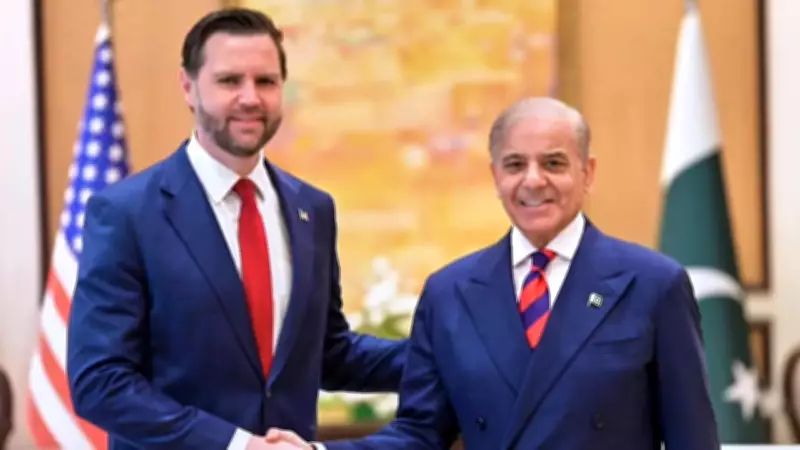
US and Iranian Delegations Converge in Islamabad for Critical Ceasefire Talks
A high-level US delegation, headed by Vice President JD Vance, arrived in Pakistan on Saturday for pivotal discussions with Iranian officials. The talks aim to bolster a fragile ceasefire and explore avenues for a permanent resolution to the ongoing conflict. This meeting represents the first direct engagement between the two sides since hostilities erupted over a month ago.
Ceasefire Challenges and Iranian Preconditions
The ceasefire, mediated by Pakistan, remains tenuous as Israel and Hezbollah continue to exchange fire along the southern Lebanon border. Iran has laid out strict conditions before formal negotiations can proceed. An Iranian delegation, led by parliament speaker Mohammad Bagher Qalibaf, arrived in Islamabad early Saturday. Qalibaf stated on social media that discussions would only occur if Israel implements a ceasefire in Lebanon and Iran's blocked assets are released.
"We'll find out what's going on. They're militarily defeated," US President Donald Trump remarked hours before the talks. Iran's red lines, as reported by state TV, include control over the Strait of Hormuz, payment of war reparations, the release of frozen assets, and a comprehensive regional ceasefire.

Lebanon: A Central Stumbling Block
Tehran insists that formal talks can only begin after Washington commits to a ceasefire in Lebanon and lifts sanctions on Iran. The Lebanon issue is particularly contentious, with Israeli strikes on Iran-backed Hezbollah militants reportedly killing nearly 2,000 people since March. While Israel and the US view the Lebanon campaign as separate, Iran maintains it is directly linked to the broader ceasefire.
Israeli Prime Minister Benjamin Netanyahu has declared there is "no ceasefire" regarding Hezbollah. Despite repeated warnings for residents of Beirut's southern suburbs to evacuate, further military action has not yet materialized. President Trump noted that Israel's operations in Lebanon would become "a little more low key," and the US State Department announced direct Israel-Lebanon talks scheduled for Washington next week.
Iran's President Masoud Pezeshkian warned on social media that continued actions against Hezbollah could render negotiations meaningless, asserting, "Our fingers remain on the trigger. Iran will never abandon its Lebanese sisters and brothers."
Strait of Hormuz: A Geopolitical Flashpoint
Another major complication is the Strait of Hormuz, a critical global oil shipping route. Iran seeks acknowledgment of its authority over the strait, including the ability to collect transit fees and control access—a move that would significantly alter regional power dynamics. The US, however, insists the waterway must remain open without restrictions or tolls.
Trump criticized Iran for "doing a very poor job" of allowing ship passage, despite prior assurances. He accused Iran of being "dishonourable" in a social media post, stating, "This is not the agreement we have!" Currently, few vessels are transiting the strait, with hundreds of ships and an estimated 20,000 seafarers stranded in the Gulf. Iran recently announced new transit routes north of existing channels, citing the need to avoid "anti-ship mines in the main traffic zone," a statement that heightened concerns among shipping companies.
Nuclear Program and Missile Capabilities
Iran's nuclear program remains one of the most contentious and long-standing issues. Tehran demands permission to continue enriching uranium, a condition Washington has ruled out as non-negotiable. Trump emphasized that Operation Epic Fury was launched partly to ensure Iran "can never have a nuclear weapon." US Defence Secretary Pete Hegseth reiterated that Iran would "never have a nuclear weapon or the capability to get a path to one."
Additionally, Israel and the US seek significant curtailment of Iran's missile capabilities, but Tehran declares its arsenal non-negotiable.

Sanctions Relief and Asset Unfreezing
Iran is pressing for the unfreezing of its assets and the lifting of sanctions that have crippled its economy for years. Washington has indicated potential sanctions relief in exchange for concessions on nuclear and missile programs. The White House dismissed a Reuters report claiming the US had agreed to release Iran's frozen assets held in foreign banks, estimated at about $6 billion. The report suggested this unfreezing was "directly linked to ensuring safe passage through the Strait of Hormuz."
Troop Withdrawal and Regional Security
Iran demands the withdrawal of US combat forces from the region, an end to all hostilities, and a commitment to non-aggression as part of any peace agreement. Trump, however, has vowed to maintain American military assets in the Middle East until a final deal is secured, warning of escalated fighting if Iran fails to comply.
The talks in Islamabad are poised at a critical juncture, with multiple complex issues threatening to derail efforts toward a lasting peace. The outcome will hinge on whether both sides can navigate these deep-seated disagreements and find common ground.





