

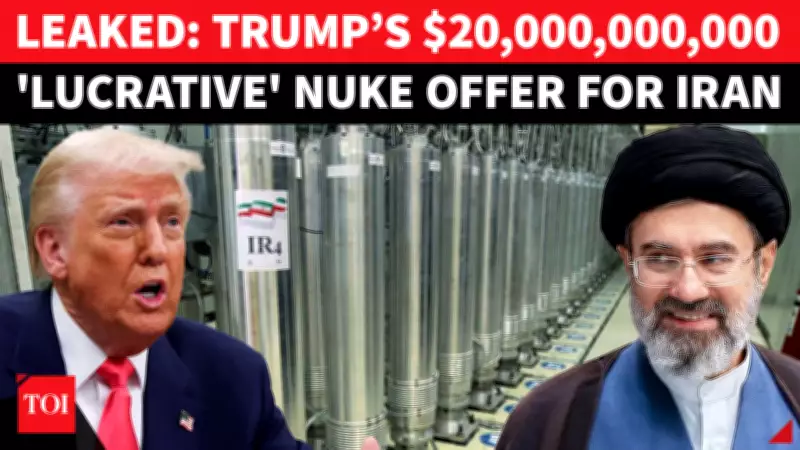
US Proposes $20 Billion Agreement for Iran's Enriched Uranium Stockpile
In a development that could dramatically reshape Middle Eastern geopolitics, reports have emerged detailing a potential $20 billion agreement between the United States and Iran. According to sources, the proposed deal would involve Washington releasing billions in frozen Iranian funds in direct exchange for Tehran's substantial stockpile of enriched uranium, often referred to in diplomatic circles as 'nuclear dust.'
High-Stakes Negotiations Under Global Scrutiny
The negotiations, occurring against a backdrop of heightened regional tensions, have drawn intense international attention. With former President Donald Trump reportedly facing significant political pressure and global powers monitoring developments closely, the potential agreement represents one of the most consequential diplomatic initiatives in recent Middle Eastern history.
Critics of the proposed arrangement argue that such a deal might signal a fundamental shift in American foreign policy strategy toward Iran, potentially setting concerning precedents for future nuclear negotiations. They express concerns that exchanging substantial financial resources for nuclear materials could be interpreted as rewarding behavior that the international community has historically sought to curb through sanctions and diplomatic pressure.

Supporters Highlight Conflict Prevention Potential
Conversely, supporters of the potential agreement contend that this bold diplomatic move could serve crucial strategic purposes:
- Directly reducing Iran's capacity for nuclear escalation by physically removing enriched uranium from the country
- Creating tangible mechanisms for conflict de-escalation in a volatile region
- Establishing a framework for future diplomatic engagement between longstanding adversaries
- Potentially preventing broader regional conflict that could involve multiple state and non-state actors
Geopolitical Implications and Regional Dynamics
The proposed $20 billion exchange occurs within a complex geopolitical landscape where multiple Middle Eastern conflicts intersect with great power competition. The outcome of these negotiations could influence:
- Regional power balances between Iran and its neighbors
- Future nuclear non-proliferation efforts worldwide
- American diplomatic credibility and leverage in the Middle East
- Global energy security and market stability
As diplomatic teams work through the intricate details of this potential agreement, the international community remains divided on whether this represents a genuine breakthrough in nuclear diplomacy or constitutes a dangerous compromise that might embolden other nations pursuing nuclear capabilities. The substantial financial component—$20 billion in released funds—adds significant economic dimensions to what is fundamentally a security negotiation.
The coming weeks will likely determine whether this proposed exchange moves forward, stalls in diplomatic channels, or becomes renegotiated with different terms. What remains clear is that any agreement of this magnitude would have ripple effects across global diplomacy, nuclear non-proliferation efforts, and Middle Eastern stability for years to come.






