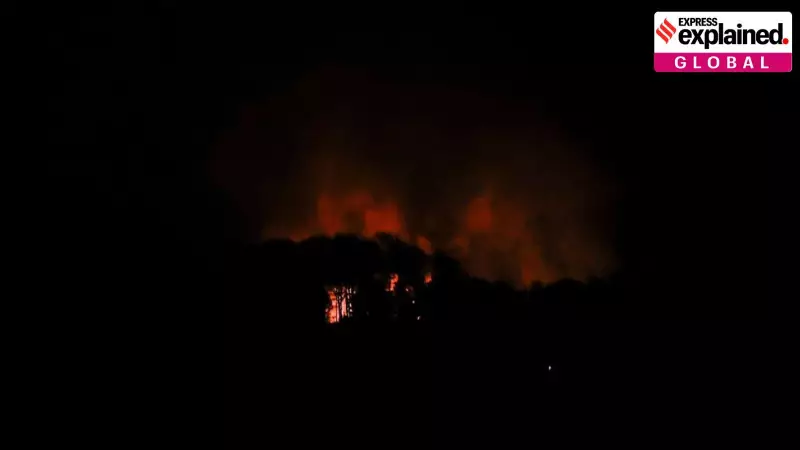
Caracas, the capital of Venezuela, was rocked by at least seven explosions on Saturday, with smoke seen billowing from a military base hangar. This direct military action, ordered by United States President Donald Trump, targeted sites including military facilities inside the South American nation.
A Long-Brewing Confrontation Comes to a Head
The strikes did not occur in a vacuum. They are the culmination of months of military build-up in the region by the US, involving the deployment of troops, aircraft, and warships. The official justification from Washington points to narcotics. The US government has long accused Venezuela's socialist leader, Nicolás Maduro, of drug trafficking and collaborating with gangs designated as terrorist organisations. Maduro has consistently denied these allegations.
However, many experts and Venezuelan officials see a more familiar pattern. David Smilde, a Venezuela expert at Tulane University, described the strategy to Reuters as "gunboat diplomacy," aimed at applying "maximum pressure…on the regime to see if they can get it to break." The underlying goal, they argue, is regime change—to force Maduro from power.

The Historical Backdrop: The US and Latin America
To understand Caracas's fears, one must look at history. The United States has a long and chequered history of intervention in Latin America, often to install regimes friendly to its interests. This policy has roots in the 19th-century Monroe Doctrine, which declared the Western Hemisphere as a US zone of influence.
As author Stephen Kinzer detailed in his book Overthrow, the US has repeatedly used its power to topple governments perceived as threats to American interests, often cloaking interventions in the language of liberation or national security while acting largely for economic reasons. During the Cold War, this was framed through the Truman Doctrine of containing communism. The list of countries where the US has installed or attempted to install friendly regimes is long, including Chile, Guatemala, Nicaragua, and Cuba.
Trump's Actions and the Unspoken Oil Motive
President Trump's recent actions against Maduro's government have been strikingly overt. In January 2019, he officially recognized opposition figure Juan Guaidó as Venezuela's legitimate president, handing him control of Venezuelan state assets in the US. This followed crippling sanctions on Venezuela's crucial oil exports. Secret meetings between the Trump administration and rebellious Venezuelan military officers to discuss a coup were also reported ahead of the 2018 elections.
Upon returning to power in January 2025, Trump resumed pressure, now explicitly framing it as a war on drug cartels, labeling Maduro a cartel leader. Draft legislation circulating in Washington seeks to grant the President broad powers to wage war against cartels and nations that harbor them.
Yet, analysts point to a resource far more tangible than drugs: oil. Venezuela sits on the largest proven oil reserves in the world. The US struggle for influence dates back to the 1999 election of anti-Washington socialist Hugo Chávez. Washington backed a failed coup against Chávez in 2002, and oil remains the bedrock of US interest today.
Former US undersecretary Tom Shannon told Newsweek that controlling licenses for the oil and gas sector through sanctions allows the US to decide which companies—and by extension, which global powers like China and Russia—can operate there. Notably, after US sanctions in 2019, China became the largest buyer of Venezuelan oil. In early 2025, Trump sent envoy Richard Grenell to Caracas to negotiate a deal for US oil giant Chevron to resume operations.
Skepticism and Fear Inside Venezuela
While Maduro is deeply unpopular due to economic collapse, corruption, and alleged electoral fraud in the 2024 elections, there is significant skepticism about US-led regime change. Many Venezuelans, including some in the opposition, fear the catastrophic instability that could follow. They point to the violent history of US interventions and doubt Washington's commitment to a genuine democratic recovery.

As one opposition politician posed to The New York Times, "And the cost for us Venezuelans, what will it be? What guarantee do we have that this will translate into a recovery of our democracy?" The explosions in Caracas have opened a new, dangerous chapter, but the fundamental questions about sovereignty, resources, and power remain unresolved.