Trump Administration Intensifies Push for Political Transition in Cuba
The Donald Trump administration is reportedly engaged in an active search for government insiders within Cuba who could facilitate a political agreement aimed at removing the island's long-standing Communist leadership by year's end. According to a detailed Wall Street Journal report published on January 21, this initiative represents a strategic extension of US policy following recent developments in Venezuela, framing Cuba as the next critical geopolitical battleground.
Washington Sees Cuba as Vulnerable After Venezuela Ouster
Senior US officials have indicated to The Wall Street Journal that, emboldened by the successful ouster of Nicolás Maduro in Venezuela, the administration now perceives Cuba's Communist regime as more vulnerable than at any point in recent decades. They believe the political landscape may be ripe for significant transformation. Officials cited in the report have assessed that the collapse of Venezuela, Cuba's primary economic partner, has left Havana exceptionally exposed, placing unprecedented stress on its already fragile economy.
Although no detailed blueprint for ending Communist rule currently exists, the US strategy involves meticulously identifying potential reform-minded figures within the Cuban governmental structure who might be willing to negotiate a peaceful transfer of power. This approach underscores a calculated effort to instigate change from within the existing power framework.

Trump's Public Pressure and Economic Squeeze
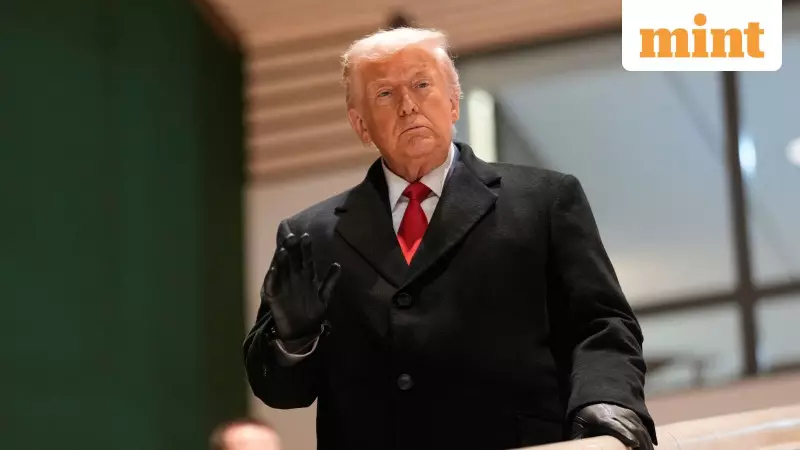
In a social media post dated January 11, President Trump appeared to publicly underscore this strategic direction, directly exhorting Cuban leaders to seek an agreement with the United States. "I strongly suggest they make a deal. BEFORE IT IS TOO LATE," Trump declared, adding a stark warning that there would be "NO MORE OIL OR MONEY" channelled to Cuba. This hard-line public stance complements a broader tightening of economic and diplomatic pressure on the island nation.
Recent measures include stringent curbs on overseas medical missions, which represent a critical source of hard currency for Havana, and the imposition of visa bans on officials linked to those programmes. These actions form part of a concerted campaign to amplify economic strain on the Cuban government.
Leveraging Lessons from the Venezuela Operation
US officials have told The Wall Street Journal that the January 3 operation in Venezuela, which resulted in the capture of Maduro and the death of allied Cuban security personnel, illustrates the perceived effectiveness of engaging with insiders to achieve regime change. In Venezuela's case, the raid was reportedly aided by an asset within the former president's inner circle, reinforcing the administration's belief in leveraging internal dissent or pragmatism as a catalyst for political transition.
In meetings with Cuban exile groups and civic leaders in Miami and Washington DC, US officials have reportedly concentrated on identifying individuals within Havana's ruling establishment who might "see the writing on the wall" and be willing to negotiate a deal rather than cling to power amidst mounting economic difficulties.
Havana's Economic Strain and Defiant Resistance
The Trump administration's calculations are grounded in stark assessments of the Cuban economy, which has suffered from chronic shortages, frequent power blackouts, and a significant decline in oil supply following reduced exports from Caracas and tightened US sanctions. Analysts and residents alike have warned of deepening hardship, raising serious questions about the island government's long-term resilience.
However, Cuban leaders have publicly and forcefully rejected US pressure. Tens of thousands of Cubans recently participated in a mass demonstration in Havana to denounce US actions in Venezuela and protest Washington's tightening sanctions. President Miguel Díaz‑Canel has affirmed the government's unwavering resolve, stating, "There is no surrender or capitulation possible nor any kind of understanding based on coercion or intimidation." He made these remarks while speaking in military fatigues at a memorial for Cuban security personnel killed in Caracas.

Internationally, responses have begun to emerge. On January 15, Reuters reported that Russia criticized what it described as "blackmail and threats" against Cuba, asserting such approaches are unacceptable and reaffirming Moscow's steadfast support for Havana.
Cuba's Political Structure and History of Control
Cuba's power structure remains dominated by Raúl Castro, 94, the younger brother of revolutionary leader Fidel Castro, while President Miguel Díaz-Canel, 65, manages day-to-day governance. The Cuban state has historically proven adept at suppressing dissent despite widespread poverty, having faced only two major protest movements in recent history: in Havana in 1994 and nationwide demonstrations in 2021. Human rights groups estimate that more than 1,000 political prisoners remain in detention.
As tensions with the US escalate, Cuba recently held a national day of defense, where citizens practiced for a "war of all the people" to repel potential invaders, highlighting preparations for sustained resistance.
The Strategic Value of Cuba's Natural Resources
Beyond immediate political objectives, the island sits atop significant untapped reserves of nickel and cobalt—critical minerals essential for manufacturing electric vehicle batteries, aerospace components, and advanced defence systems. These are resources the United States increasingly seeks to secure outside of Chinese-dominated supply chains.
Cuba is already one of the world's largest producers of nickel, but decades of US sanctions and chronic underinvestment have limited large-scale extraction capabilities. Furthermore, its offshore waters are believed to hold substantial oil and gas potential. From a geographic perspective, Cuba's position astride key Caribbean sea lanes, particularly adjacent to the vital Windward Passage, grants it enduring strategic value. This passage is a crucial corridor linking the Atlantic approaches to the Caribbean and onward to the Panama Canal, one of the world's most important arteries for global trade.
Intelligence assessments from agencies like the CIA also indicate that Cuba possesses a wider range of strategic resources, including iron ore, chromium, copper, salt, timber, silica, and petroleum. This natural wealth adds a significant economic dimension to the geopolitical struggle unfolding between Washington and Havana.