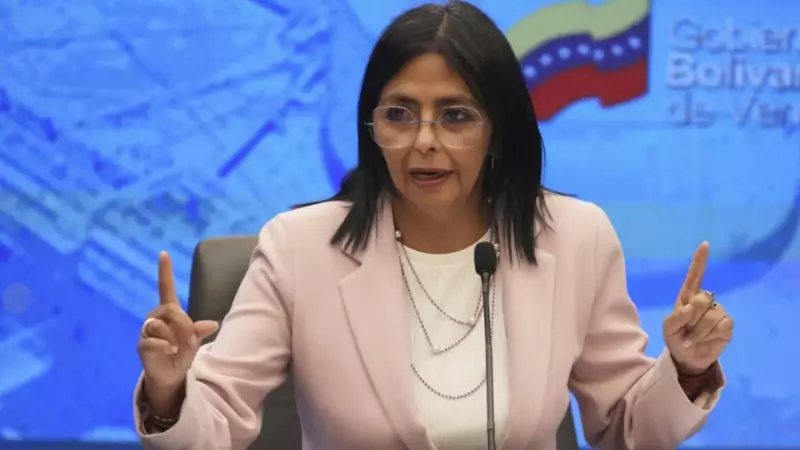
In a sharp and direct rebuke, Venezuelan Interim President Delcy Rodriguez has launched a scathing attack on former United States President Donald Trump. Rodriguez has accused the ex-US leader of being singularly motivated by a desire to control Venezuela's vast petroleum reserves, framing years of aggressive American policy as a crude resource grab.
A Blunt Accusation from Caracas
Rodriguez did not mince her words when addressing the legacy of the Trump administration's approach to her country. She stated that the true nature of Washington's hostility under Trump's leadership was now laid bare. "It was always about oil," Rodriguez declared, summarising what she sees as the core driver behind the economic sanctions and political pressure levied against the South American nation.
The Venezuelan leader made these pointed remarks recently, casting a long shadow over the already fractured relationship between the two countries. Her comments underscore the deep-seated belief within the government of President Nicolás Maduro that the United States' primary objective has been regime change to gain unfettered access to Venezuela's energy resources, which are the largest in the world.

The Context of Sanctions and Strife
The administration of Donald Trump significantly escalated tensions with Venezuela, recognising opposition figure Juan Guaidó as the country's legitimate interim president in January 2019. This move effectively sought to delegitimise the elected government of Nicolás Maduro. Alongside this political manoeuvre, the US imposed a stringent series of economic sanctions, most crucially an embargo on Venezuelan oil exports.
These sanctions crippled Venezuela's primary source of foreign revenue, exacerbating a profound economic and humanitarian crisis. Rodriguez's latest statement frames these punitive measures not as tools for promoting democracy or human rights, as often stated by US officials, but as instruments of economic warfare designed to weaken the state and seize control of its natural wealth.
The oil sector, the lifeblood of the Venezuelan economy, was brought to its knees, with production plummeting to historic lows. For the Maduro government, this sequence of events confirms a long-held narrative of imperialist intervention.
Implications for Future Relations
Rodriguez's forceful condemnation signals that diplomatic reconciliation between Venezuela and the United States remains a distant prospect. By publicly attributing Trump's policies to a naked desire for oil, she is reinforcing a powerful ideological stance for both domestic and international audiences.
Domestically, it serves to rally support by presenting the government as a defender of national sovereignty against a predatory foreign power. Internationally, it aims to shape the narrative, particularly among other nations wary of Western intervention, portraying the US actions as fundamentally exploitative rather than principled.
While the Biden administration has shown some slight variations in approach, the core sanctions regime remains largely in place. The accusation from Caracas highlights the enduring bitterness and the significant obstacles to any future normalisation of ties. The foundational issue of control over Venezuela's immense oil reserves continues to be the central, unyielding point of contention.
As global energy dynamics shift and geopolitical alliances evolve, this stark accusation from a top Venezuelan leader ensures that the question of resource sovereignty will remain at the forefront of any discussion concerning Venezuela's future and its place on the world stage.