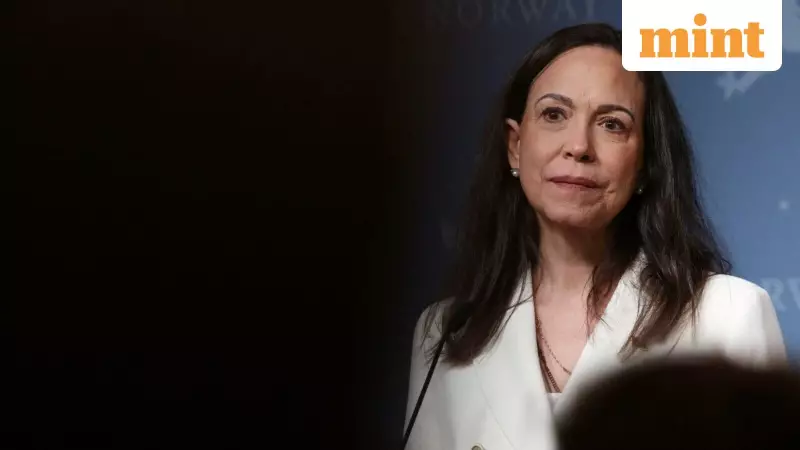
Venezuela's political opposition experienced a dramatic rollercoaster of emotions over the weekend, moving from euphoria to deep dismay as the United States' stance on the country's future shifted decisively. The initial elation came on Saturday, January 3, 2026, when news broke that the US had forcefully ousted the authoritarian President Nicolás Maduro. This action seemed to pave the way for Nobel Peace Prize laureate and opposition leader María Corina Machado to assume power.
A Swift Reversal of Fortunes
However, within hours, President Donald Trump delivered a stunning blow to those aspirations. He publicly stated that Machado lacked sufficient respect and support within Venezuela to lead the nation. Instead, in a move that shocked observers, Trump turned to one of Maduro's top lieutenants, Delcy Rodríguez, to head a transitional government. The US President also vowed to take control of Venezuela's crucial oil industry.
"I have never seen a speech destroy the image of a movement more quickly than that," said Javier Corrales, a Venezuela scholar at Amherst College. "It's a catastrophe." This development presents one of the most significant challenges in the opposition's 25-year struggle against Chavismo, the far-left movement founded by Hugo Chávez and led by Maduro.

Machado's Struggle for Relevance
María Corina Machado, who captured global attention with her daring escape from Venezuela in December 2025 to receive the Nobel Peace Prize in Oslo, now finds herself sidelined. The opposition must now contend not only with a repressive regime at home but also with a US administration seemingly more focused on securing Venezuela's oil wealth and cementing Washington's influence in the hemisphere than on restoring democracy through elections.
"Machado doesn't have any chance to get into the government soon, unless there will be a free and fair election, and that is not on the agenda right now," said Imdat Oner, a former Turkish diplomat to Venezuela now with the Jack D. Gordon Institute for Public Policy. "The window is closing for them, and there is not much they can do."
Publicly, Machado and her allies continue to praise Trump and express hope that Maduro's downfall will ultimately lead to democracy. She called the capture of the strongman, known for cracking down on dissent and aligning with US adversaries, a "huge step for humanity, for freedom." She told Fox News on Monday that January 3 would be remembered as "the day justice defeated tyranny."
However, Machado has been sharply critical of Delcy Rodríguez, calling her "one of the main architects of torture, persecution, corruption, narco trafficking" and a key liaison with Russia, China, and Iran. Machado, who spent months in hiding before traveling to Norway, stated her intention to return to Venezuela as soon as possible.
Practical Politics and Perilous Paths
Analysts suggest Trump's preference for Rodríguez is based on practical considerations. A Central Intelligence Agency analysis indicated that as a regime stalwart, Rodríguez is best positioned to maintain short-term stability and lead a temporary government. Machado's uncompromising stance, including her criticism of business elites operating in Venezuela and her support for US sanctions, has alienated some segments of the population.
US Secretary of State Marco Rubio echoed the call for realism, stating on CBS News that while the US desires a complete transformation for Venezuela, it was not expected to happen "in the next 15 hours." Rodríguez, after initially lashing out at the US action, adopted a conciliatory tone on Sunday, inviting the US government "to work together on a cooperative agenda."
Former US officials note that Trump's wariness of the Venezuelan opposition stems from its failure to take power during his first term, despite US backing for a parallel government. Now, Machado's coalition will likely rely on Republican lawmakers in South Florida to lobby the White House, though this is seen as unlikely to change Trump's mind.

"Trump is convinced that ceding this position to the opposition would not be smart," Oner said. "There would be a power vacuum, and the Venezuelan opposition might not manage it so well."
Despite the setback, opposition figures like Freddy Guevara, a former political prisoner, remain hopeful. He stated priorities now include securing the release of hundreds of political prisoners and re-establishing the rule of law. "Maduro being out opens a path to a real transition in Venezuela," said Guevara, now at Harvard University. "But we know that the job is not done."
Some within the opposition believe Maduro's capture may reveal cracks in the regime. From exile, former presidential candidate Edmundo González, whom the US recognized as the rightful winner of the 2024 election, called on the armed forces to honor the constitution. Economists like Ricardo Hausmann argue that rebuilding Venezuela's oil industry, which requires tens of billions in investment, will necessitate a return to democracy to provide legal security for investors.
For María Corina Machado, the most perilous path may now be the most viable: returning to Venezuela to mobilize public pressure and demonstrate her popular support. "It could be the kind of shock to the system that is needed at this point," Corrales said. "So that whatever plan Trump and Delcy Rodríguez have concocted, if they want to derail that, the only way to do it is from within." He added a sobering caveat: "It's incredibly risky."