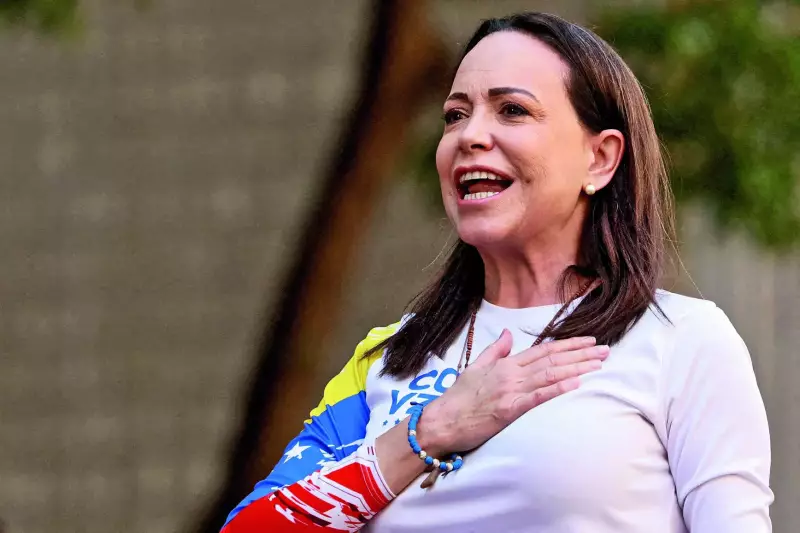
The political landscape of Venezuela has been thrown into sharp focus once again, with opposition figure and 2025 Nobel Peace Prize winner Maria Corina Machado finding herself at the heart of a major international development. This follows a bold claim by US President Donald Trump on Saturday that Venezuela's long-standing leader, Nicolas Maduro, has been "captured" amid large-scale American military strikes on the South American nation.
Machado's Defiance and Dramatic Escape
While Machado has not yet publicly commented on Trump's announcement, her position as the leading voice against the Maduro regime makes her a central figure in this rapidly evolving crisis. Her rise to global prominence was cemented by winning the Nobel Peace Prize last year, an honour that reportedly Trump himself had sought. Her journey to Oslo to receive the prize was itself a tale of high-stakes evasion.
Machado had been in hiding inside Venezuela for over a year, under constant threat from state authorities. Her daring escape, detailed by US special forces veteran Bryan Stern, involved a disguise complete with a wig. She travelled from a remote Venezuelan fishing village by wooden boat to Curaçao in the Caribbean, braving treacherous seas, before finally boarding a private jet to Norway.

Stern, who led the mission dubbed "Operation Golden Dynamite" for the Grey Bull Rescue Foundation, described the perilous night-time boat journey to the BBC. "The seas are very rough. It's pitch black. We're using flashlights to communicate. This is very scary; lots of things can go wrong," he said, praising Machado's "formidable" composure throughout the ordeal. She arrived too late for the official ceremony, and her daughter accepted the Nobel on her behalf.
Alignment with Trump's Aggressive Stance
Machado has been an open and ardent supporter of President Trump's hardline approach towards the government in Caracas. In a December interview with CBS News, she expressed unequivocal backing for his strategy, which has included a US military buildup in the Caribbean, strikes on suspected drug-smuggling vessels, and an oil tanker blockade.
"We, the Venezuelan people, are very grateful to him and to his administration, because I believe he is a champion of freedom in this hemisphere," Machado stated. She has consistently argued that sustained external pressure, potentially including military intervention, is the only way to end what she calls the communist rule of Maduro.
Trump's recent claim of Maduro's capture, if verified, would represent a seismic shift in Venezuelan power dynamics, dramatically weakening the regime and validating Machado's long-held position. Earlier, after her first public appearance in 11 months in Oslo, she told reporters, "I think that the actions of President Trump have been decisive to reach where we are now, where the regime is significantly weaker."
Uncertain Future and Political Calculations
Despite her strong rhetoric, Machado has been cautious about explicitly endorsing a full-scale US military invasion to oust Maduro. On the critical question of her return to Venezuela, she has indicated that timing would hinge on security conditions rather than any specific political outcome.
"I would return to Venezuela when we believe the security conditions are right, and it won't depend on whether or not the regime leaves," she declared last year. As Washington intensifies its pressure and Trump projects an image of decisive action, Machado stands to gain the most politically from any collapse or significant weakening of the Maduro government.
For now, the Nobel laureate remains silent on the explosive claim of Maduro's capture. Yet, as the world's attention turns back to Venezuela, Maria Corina Machado is once again in the global spotlight, widely seen as the nation's most prominent opposition figure awaiting a potential historic transition.