

Massive Voter List Revision in West Bengal Sees Thousands Deleted
The Election Commission's Special Intensive Revision (SIR) of electoral rolls in West Bengal continues to make headlines. Officials have now deleted more than 11,500 names from the voter list. This action follows an earlier draft roll that removed over 58 lakh names last month.
Mapping Exercise Targets Logical Discrepancies
The Commission conducted a detailed mapping exercise. This process matched current elector names with the SIR 2002 list. Authorities then issued summons to voters showing logical discrepancies.
These discrepancies included cases where the age difference between voters and their parents was less than 16 years. Other cases involved voters having more than six children. According to sources, approximately 31 lakh voters were not mapped with the 2002 list initially.

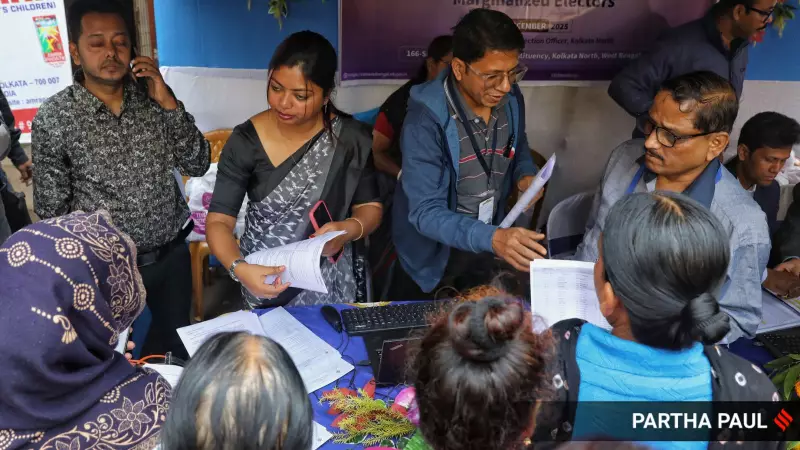
These individuals received hearing notices. Out of them, around 11,500 voters could not produce necessary documents during hearings. They failed to prove they were genuine voters of the state.
Nadia District Bears the Brunt
Most deletions occurred in Nadia district. This region has a significant Matua community population. Many Matua community members migrated from Bangladesh in waves starting from 1947.
The Election Commission has generated 65,78,058 notices so far. Officials have served 32,49,091 of these notices to electors. However, the number might increase further.
An EC official stated that notices could reach 74,19,356 electors soon. The Commission plans to address all logical discrepancy cases in the coming week.
State CEO Proposes Humanitarian Relief
Meanwhile, the state Chief Electoral Officer (CEO) has submitted two proposals to the Election Commission. These proposals aim to prevent disenfranchisement of genuine voters who lack proper documents.
One proposal focuses on married women without the eleven prescribed SIR documents. Many such women also lacked listings in the 2002 voter list. However, their husbands served as state or central government employees.
Some women now receive regular government pensions after their husbands' deaths. The CEO's office argues that pension documents provide credible proof. They recommend including these women in the final voter list based on pension records.
The second proposal addresses families where children possess Scheduled Caste or Scheduled Tribe (SC/ST) certificates, but parents do not. Historically, many parents did not obtain such certificates due to limited necessity.
Excluding parents from voter lists merely due to certificate absence seems illogical. The CEO recommends special concessions. Parents should gain inclusion in the final voter list based on their children's certificates.
An official explained that these proposals consider humanitarian grounds and practical situations. They aim to protect voting rights while maintaining electoral integrity.






