

The State Election Commission in Maharashtra is considering conducting the long-delayed zilla parishad and panchayat samiti elections in multiple phases, creating a distinction between local bodies that have maintained the 50% reservation ceiling and those that have exceeded it.
Election Statistics and Reservation Status
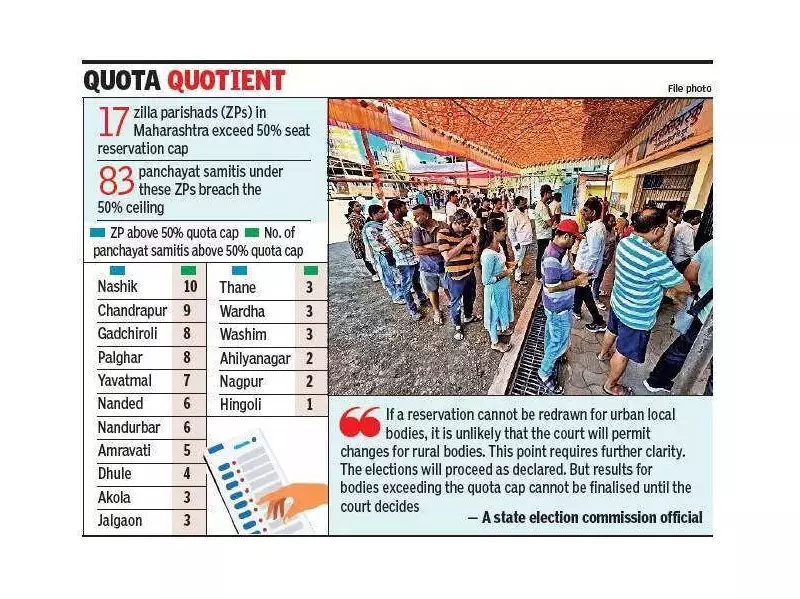
Elections are currently pending for 32 zilla parishads (ZPs) and 336 panchayat samitis across Maharashtra. According to the latest assessment by the State Election Commission, a significant number of these local bodies have crossed the legally mandated reservation limit. Specifically, 17 zilla parishads and 83 panchayat samitis have exceeded the 50% reservation cap for various categories.
An official from the State Election Commission explained that the Supreme Court's recent order has provided clarity for conducting elections in compliant bodies while creating uncertainty for those that have breached the reservation limit. The court directive stated that elections should proceed "as per previous orders" for local bodies that have maintained the reservation ceiling.

Supreme Court Directives and Legal Framework
The Supreme Court, in its Friday ruling, explicitly addressed the situation regarding urban local bodies that have crossed the reservation cap, stating that their election results would remain subject to the outcome of ongoing judicial proceedings. However, the court did not provide specific guidance on how to handle zilla parishads and panchayat samitis that have already exceeded the 50% limit.
The court order specifically directed that "in respect of 32 ZPs and 336 panchayat samitis, it is directed that wherever the reservation does not exceed the 50% mark, let the elections be held in accordance with our previous orders."
Importantly, the Supreme Court has not permitted any restructuring or redrawing of reservations for local bodies that have crossed the threshold. SEC officials confirmed that this restriction applies equally to both urban and rural local bodies, meaning the commission cannot modify reservation structures until the court issues further rulings.
District-wise Breakdown of Reservation Violations
The data reveals significant variation in reservation cap violations across different districts. Nashik district leads with 10 panchayat samitis exceeding the 50% reservation limit, followed closely by Chandrapur with 9 and Gadchiroli with 8. Palghar also has 8 panchayat samitis above the cap, while Yavatmal has 7.
Other districts with substantial violations include Nanded and Nandurbar (6 each), Amravati (5), Dhule (4), with Akola, Jalgaon, and Thane having 3 panchayat samitis each above the reservation limit. Wardha and Washim also have 3 violations each, while Ahilyanagar and Nagpur have 2 each, and Hingoli has 1.
SEC officials emphasized that the same legal framework currently governing municipal council and nagar panchayat elections would apply to the upcoming rural local body elections. The Supreme Court has allowed these urban polls to continue while specifying that results for 40 municipal councils and 17 nagar panchayats with reservations above 50% would remain subject to judicial outcome.
With the matter now referred to a three-judge bench and scheduled for hearing on January 21, SEC officials confirmed that the notified election schedule would remain unchanged. However, results for bodies exceeding the quota cap cannot be finalized until the court reaches a decision.
The sequencing of rural and urban elections, including the possibility of corporation polls preceding zilla parishad and panchayat samiti elections, will depend on obtaining further legal clarity in the coming weeks.






