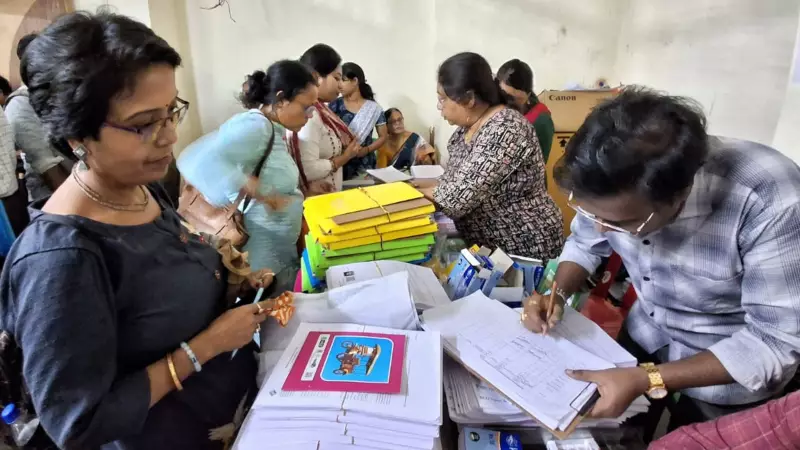
The Election Commission of India (ECI) is set to launch the crucial hearing phase for the second round of the Special Intensive Revision (SIR) of electoral rolls in West Bengal starting December 27. This extensive exercise will scrutinize the documents of more than one crore voters across the state, with the Commission issuing a significant clarification: an Aadhaar card will not be accepted as the only proof of identity for these proceedings.
Massive Scale and Stringent Oversight for Hearings
Preparations are in full swing for what is likely one of the largest electoral verification drives in the state. To ensure strict adherence to guidelines, the ECI has commenced training a small army of micro-observers. These officials will be stationed at hearing tables to monitor the process conducted by Electoral Registration Officers (EROs) and Assistant EROs (AEROs). Their mandate is clear: record any deviations and, if issues persist, report directly to the ECI.
The scale is immense. Officials plan to set up a minimum of 11 hearing tables in each of West Bengal's 294 Assembly constituencies, bringing the total to at least 3,234 tables statewide. The deployment of micro-observers is expected to exceed 4,000 individuals, with numbers flexible to increase based on demand.

Detailed Document Verification Protocol
The ECI has laid out a meticulous, multi-layered procedure for verifying the documents submitted by voters summoned for hearings. In a directive issued recently, the Commission stated that electors who receive notices may need to submit prescribed documents proving their eligibility, including proof of mapping in the last SIR. These documents will be uploaded via the Booth Level Officer (BLO) App for examination by the ERO.
The verification chain is designed for efficiency and cross-checking. Once uploaded to the ECINet platform, the submitted documents will be sent for authentication to their original issuing authorities. District Election Officers (DEOs) have been given a five-day window to complete this task. For documents issued in another district within West Bengal, the DEO will forward the request via ECINet. For documents from authorities outside the state, the request will be routed through the state's Chief Electoral Officer (CEO) to the CEO of the concerned state.
Scope of Scrutiny and Correcting the Rolls
The hearings will address a massive pool of 1.67 crore electors flagged during the revision process. This group comprises 1.36 crore voters with logical discrepancies in their records and another 31 lakh voters whose entries have no mapping. The process will begin with this latter group of 31 lakh electors.
This second SIR phase follows the draft roll publication on December 16, which revealed a significant cleanup in the first phase. The total number of voters in West Bengal dropped from 7.66 crore to 7.08 crore after the deletion of over 58 lakh names. Official data shows that 58,08,232 enumeration forms were not uploaded, including records of deceased, untraceable, and duplicate voters.
Concurrently, Booth Level Officers have begun the task of correcting spelling and typographical errors in existing voter records by calling voters with supporting documents.
Accepted Documents and Key Clarification
The ECI has provided a list of acceptable documents for the hearings. Voters may submit items such as government employee identity cards, pre-1987 documents from post offices or banks, birth certificates, passports, educational certificates, residential or caste certificates, and government-issued land documents.
The Commission has explicitly stated that an Aadhaar card will not be accepted as the sole identity document for this process, emphasizing the need for other prescribed proofs. To streamline operations, the ECI has also developed dedicated software where each elector will have a separate account containing stored information and scanned documents from the hearing.
The Chief Electoral Officer of West Bengal has been instructed to ensure all district and roll officials strictly comply with these directives, setting the stage for a transparent and rigorous revision of the state's voter list.