

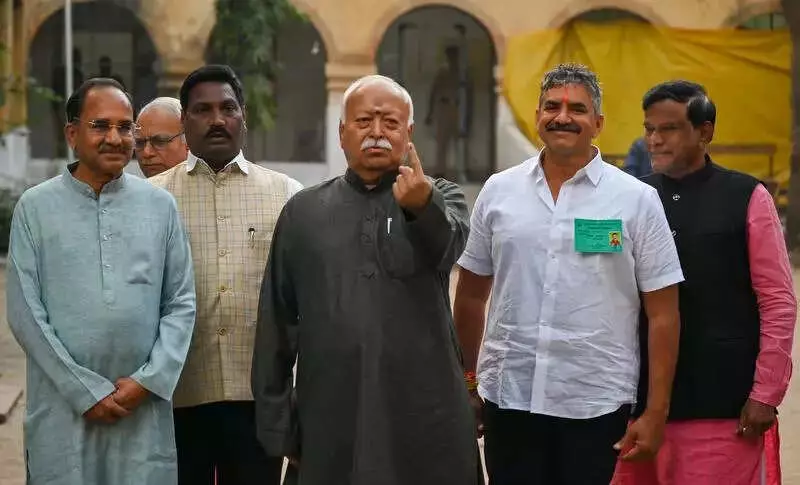
RSS Chief Mohan Bhagwat Issues Strong Warning Against NOTA Option
Rashtriya Swayamsevak Sangh chief Mohan Bhagwat delivered a clear message to voters on Thursday. He cautioned them against using the None of the Above (NOTA) option in elections. Bhagwat cast his vote in the Nagpur Municipal Corporation elections and shared his thoughts immediately afterward.
Bhagwat Casts His Vote in Nagpur
Mohan Bhagwat voted early in the morning at the polling booth located at Nagpur Night High School in the Mahal area. Former RSS Sarkaryavah and executive committee member Bhaiyyaji Joshi accompanied him. The RSS chief used this occasion to address a critical issue facing Indian democracy.
Bhagwat focused his remarks squarely on the NOTA option. He explained that NOTA symbolizes the rejection of all candidates. However, he argued this rejection fails to produce any constructive outcome for the electoral process.

"NOTA means we reject everyone. But we must choose the best among the available options," Bhagwat stated firmly. He warned that simply disengaging from the process does not lead to genuine reform or improvement in the political system.
The Philosophical and Historical Dangers of Political Vacuum
Drawing from deep philosophical and historical references, Bhagwat underlined the inherent dangers of creating a political vacuum. He spoke about the concept of 'Arajakta' or anarchy.
"Arajakta means a situation where there is no ruler, and that is the worst condition. Even the Mahabharata speaks about this," Bhagwat noted. He emphasized that the absence of a clear authority often results in instability and chaos rather than the positive change some voters might hope for.
The RSS chief further elaborated that indiscriminate rejection through NOTA could have unintended consequences. He suggested this action might inadvertently aid forces that voters actually oppose.
"When we use NOTA, we end up helping those we do not want," Bhagwat argued. He called for greater discernment among voters instead of resorting to protest voting that lacks strategic purpose.
Voting as a Foundational Democratic Duty
Bhagwat described voting as a foundational element of any functioning democracy. He framed it not just as a right but as a core duty of every responsible citizen.
"In a democratic system, voting is extremely important. It is the duty of all citizens," he asserted. The RSS chief urged people to make informed choices guided by public interest rather than personal frustration.
"It is important to vote for the candidate who appears right to you, keeping the larger good of society in mind," Bhagwat advised. He stressed that citizens should evaluate available options carefully and select the most suitable candidate.
Election Commission Appeals and Citizen Responsibility
Bhagwat acknowledged that the Election Commission regularly appeals to citizens to participate in voting. He noted that various social organizations echo this same message about civic participation.
"The impact of these appeals may be seen over time, but the responsibility to vote ultimately rests with the citizen," Bhagwat concluded. He emphasized that while institutions can encourage voting, the final decision and action belong to each individual voter.
The RSS chief's comments come during significant civic elections in Nagpur. His warning against NOTA adds to an ongoing national conversation about voter engagement and electoral reform in India.






