

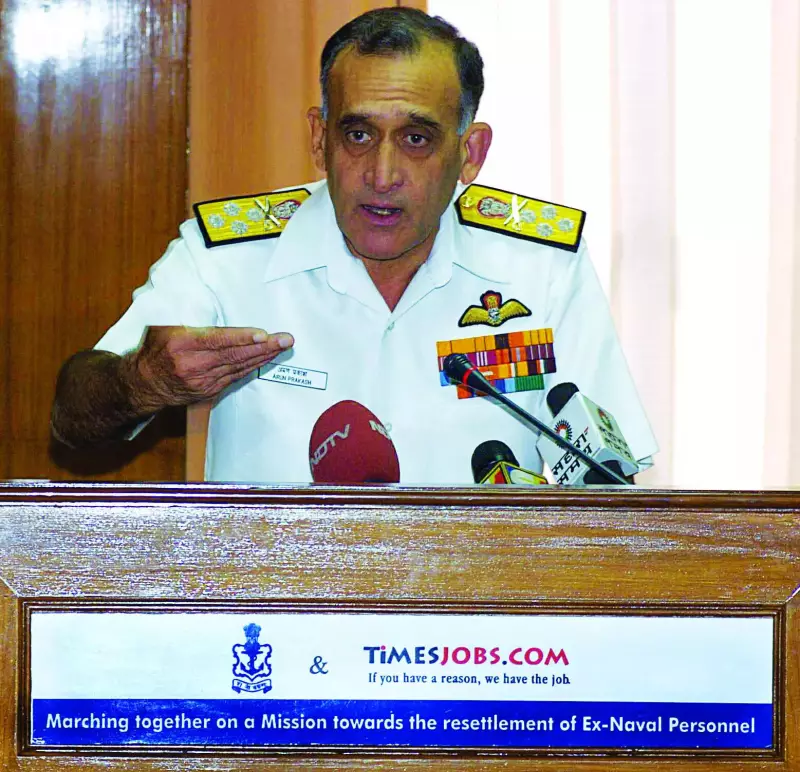
The Election Commission of India on Monday moved to clarify the circumstances that led to a verification notice being issued to decorated former Navy chief Admiral Arun Prakash (retired) during Goa's ongoing Special Intensive Revision (SIR) of electoral rolls. The Commission attributed the incident to a combination of an automated system procedure and incomplete details in the Admiral's previous enumeration form.
What Triggered the Notice?
The controversy began when the 81-year-old Vir Chakra awardee and 1971 war hero received a notice requiring him to appear in person to prove his identity. This sparked significant outcry on social media, with veterans and citizens alike questioning why a figure of his stature was subjected to such a requirement. Officials have since confirmed that after the form was duly completed, Admiral Prakash is no longer required to appear.
In an official clarification, Electoral Registration Officer (ERO) for Cortalim, Dr. Medora Ermomilla D'Costa, explained the sequence of events. She stated that the Booth Level Officer (BLO) for the constituency had collected the naval veteran's form but found it lacked mandatory particulars from previous electoral roll revisions.

The System-Driven Procedure Explained
The core issue was the absence of specific historical data. Dr. D'Costa detailed that Admiral Prakash's form did not contain mandatory particulars from the previous SIR. These missing fields included the elector's name, EPIC number, relative's name, and the assembly constituency's name and number, along with the part number and serial number in the existing electoral roll.
"In the absence of these details, the Booth Level Officer application could not establish an automatic linkage with the existing electoral roll database," the ERO stated. She further noted, "As all the fields pertaining to the previous SIR were left blank, the system categorised the enumeration form under the 'unmapped' category."
Following this automated classification, a standard procedure was triggered. "As per the standard, system-driven procedure, a hearing notice was automatically generated and issued to enable verification of the elector’s details and ensure due opportunity for confirmation of eligibility," the clarification added.
Admiral's Perspective and Broader Implications
Admiral Arun Prakash, who has resided in Goa since his retirement in 2006, took to social media to highlight the practical challenges such processes pose for elderly citizens. While asserting that he neither needs nor seeks special privileges, he pointed out a procedural gap. He mentioned that the BLO had visited his home three times and could have requested the missing documents during those visits.
He also suggested a review of the process itself, stating, "...if the SIR forms are not evoking required info, they should be revised." His comments have ignited a wider conversation about the accessibility and user-friendliness of government procedures for senior citizens and veterans.
The swift resolution of the case—where the form was completed and the notice requirement withdrawn—highlights the system's capacity for correction. However, the incident underscores the potential for friction when rigid, automated systems interact with complex individual histories, especially of long-serving public figures. The Election Commission's clarification aims to separate a procedural anomaly from any notion of deliberate oversight.






