In the bustling urban sprawl of Ahmedabad, a meticulous exercise is underway to bridge a two-decade-old gap in democracy's foundational document – the electoral roll. At the heart of this effort in Gujarat's largest assembly constituency, Ghatlodiya, are Booth Level Officers (BLOs) who are solving complex puzzles, including cases of voters with identical full names and historical addresses, as part of the Special Intensive Revision (SIR).
The Arduous Task of Reconciling 2002 with 2026
The scale of the challenge is immense. Ghatlodiya is an urban assembly constituency with 463 polling booths covering over 3.65 lakh voters according to the 2026 draft roll. Represented by Chief Minister Bhupendra Patel and previously by former CM Anandiben Patel, it falls under the Gandhinagar Lok Sabha seat of Union Home Minister Amit Shah. The core issue? A direct comparison of the current voter list with the one from 2002, leading to a massive reconciliation project for thousands of voters who have migrated, primarily from walled city areas.
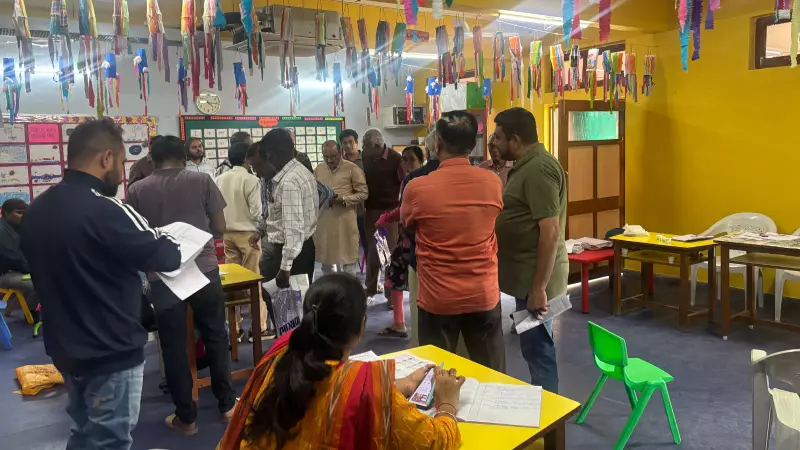
Ankita Sahibrao Balpande, a 34-year-old government school teacher and BLO for six years, embodies this on-ground effort. Assigned a target of 1258 voters, she recently signed off a camp at JG International School with a "zero-zero" report, indicating no voter left to be mapped from her list. Her work, however, was far from simple. She cites a revealing case: two male voters, both named Kiritkumar, sharing the same middle name (father's name) and surname, who were residents of the same pol neighbourhood in Kalupur in 2002 and had both moved to Ghatlodiya.

"Their age became an identifier for me, as one Kiritkumar was 10 years younger than the other. It would have been tough had the age gap been lesser," Balpande explained. From her assigned target, her findings were stark: 110 had shifted, 26 had died, 20 were duplicate entries, and 9 were absent.
On-Ground Challenges: From New Societies to NRI Outreach
The BLOs faced a multitude of unique scenarios. A common problem was entire housing societies that did not exist in 2002, requiring fresh documentation for all residents. Balpande handled two such societies – Mirant Co-operative and Sudarshan Towers. The human stories behind the data forms were poignant. Jyotiben Trivedi, 72, attended a camp with her daughter-in-law Khushboo to submit documents for including four family members and delete her deceased husband's name after shifting from Ranip to Thaltej.
Some voters, like Prahladbhai Patel (70) and his wife Vasanti Patel (63), were in Hyderabad for six months. Their BLO contacted them, shared screenshots of the 2002 list for verification, and with consent, their neighbours used a spare key to access documents from their home to submit on their behalf. For consultant Haresh Khatwani, the issue was his children, who were not 18 in 2002 and thus missing from the base list despite having voted in later elections. He submitted passports and birth certificates to secure their franchise.
Perhaps the most innovative outreach was for Non-Resident Indians (NRIs). BLOs sent SIR forms virtually to voters abroad, particularly to 8-9 voters in the US from Upendra Park society. Contact was established through society secretaries and "society dictionaries." By January 4, at one booth with 7100 voters, only four pending cases were NRIs.
Political Oversight and Public Sentiment
The exercise, which saw Gujarat's deadline extended, was closely watched by political parties. Parag Panchal, spokesperson for the Gujarat Pradesh Congress Committee (GPCC), who assisted at camps, noted initial public hesitation turned to frustration and anger when voters couldn't find their names in the 2002 list. "Most were left angry too but those who waited patiently to use their right to vote submitted the required documents," he said.
Hitendra Thakkar, BJP's Thaltej ward vice president, acknowledged the cleaning of rolls that contained names of the deceased or permanently shifted for 15-20 years, including duplications from village-to-city migration. He praised the BLOs' hard work, detailing how party workers collaborated by sharing pending lists with society chairmen and relentlessly following up via WhatsApp groups and calls.

An official from the Chief Electoral Office (CEO) stated that while unmapped voters would be called for hearings as per ECI guidelines, the process might be reconsidered based on documents already received. For BLOs like Ankita Balpande, the satisfaction lies in a job meticulously done, having tracked down voters within Gujarat, across India, and beyond its shores, ensuring the electoral roll is a true reflection of the people it serves.