In Prashant Kishor's Village, a Debate on Political Influence and Missed Opportunities
Nestled within Bihar's rice belt in Rohtas district, the village of Konar is home to a weathered, two-storey building from the 1970s. Its paint is peeling, but its significance has never been greater, for this is the ancestral house of political strategist-turned-activist Prashant Kishor. As the Bihar Assembly elections unfold, the village that knows him best is abuzz with discussions about his movement, Jan Suraaj, and the narrative he has set for the state's political future.
The Caretaker's Perspective: Energy and a Missing Candidature
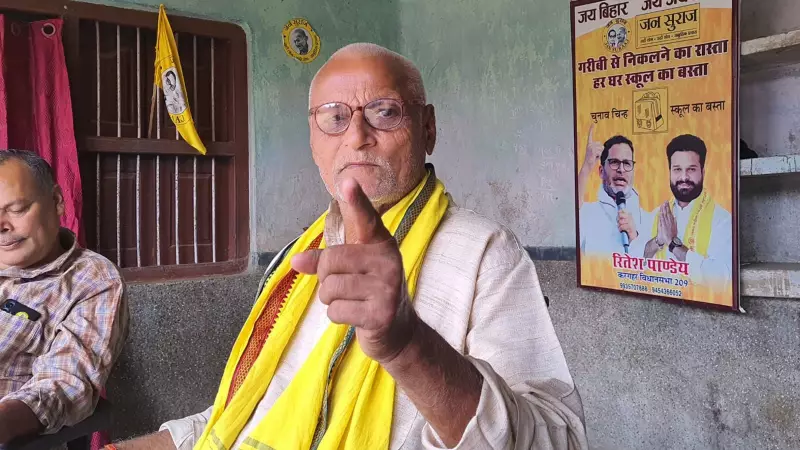
Seventy-two-year-old Kedar Pandey, the house's caretaker since 1970, sits in the courtyard. He is joined by fellow villager Ramesh Pandey, and their conversation is animated. While they dismiss theories of an easy NDA victory, they find common ground on one crucial point: Prashant Kishor himself should have contested the polls.
"Kishor's candidature from any seat across the state or even from Karaghar would have instilled more energy into the Jan Suraaj cadre," Kedar states. He believes that while the media struggles to gauge Kishor's true influence, the strategist has successfully set the election's narrative. The proof, he suggests, will be in the results.

Kedar, a former active member of the CPI(M-L)L, reminisces about Kishor's formative years, highlighting how the value of social service was ingrained in him by his father, Dr. Shrikant Pandey, who provided free medical treatment to hundreds in the village. He recalls Kishor as an obstinate child, a trait that perhaps foreshadowed his foray into politics against his family's initial wishes.
Konar's Political Landscape: Friendly Fights and Caste Realities
Konar village, with its middle school and banks, falls under the Karaghar Assembly seat, which went to the polls on November 11, 2025. Here, Jan Suraaj's candidate, Bhojpuri singer Ritesh Pandey, faces a multi-cornered contest against the Congress's sitting MLA Santosh Mishra, as well as candidates from the RJD and the CPI(M-L)L, making it one of the state's 'friendly fight' seats.
As the discussion turns to the allegations of Jan Suraaj being the BJP's 'B-team,' Kedar Pandey is dismissive. He points to Kishor's direct confrontations with the BJP in states like West Bengal and the fact that his party is challenging numerous BJP candidates in Bihar.
However, not all in the village share this unwavering support. Vinod Pandey, a relative and rice mill owner, offers a more pragmatic view. "Kishor has been talking sense but he talks in an idealistic manner. It is very difficult to break the caste shackles of Bihar politics," he says, emphasizing that kinship does not blind them to political realities. An anonymous resident echoes this, noting that the village does not blindly follow Kishor and that the main political battle remains between the NDA and the Mahagathbandhan.
The House as a Metaphor: Grand Plans and Practical Hurdles
The state of Kishor's ancestral home serves as a potent metaphor for his political journey. Kedar Pandey gives a tour of the 24-room house, where 22 rooms remain locked. He speaks of the difficulties in its upkeep and a renovation plan that was shelved due to Kishor's busy schedule, a project that a contractor now says would require a full reconstruction.
Yet, outside on the house lawns, the younger generation embodies the hope that Jan Suraaj represents. When asked about Kishor, a young girl immediately replies, "Jan Suraaj." Her friend, Ragini, a Class 2 student, then breaks into a song: "Jan Suraaj aayega, garibi mitayega, sundar raj laayega (Jan Suraaj will come to power, it will alleviate poverty and bring in good governance)." This simple, hopeful chant captures the essence of the promise that Prashant Kishor has brought to his home state, even as his own village remains thoughtfully divided on its immediate impact.