

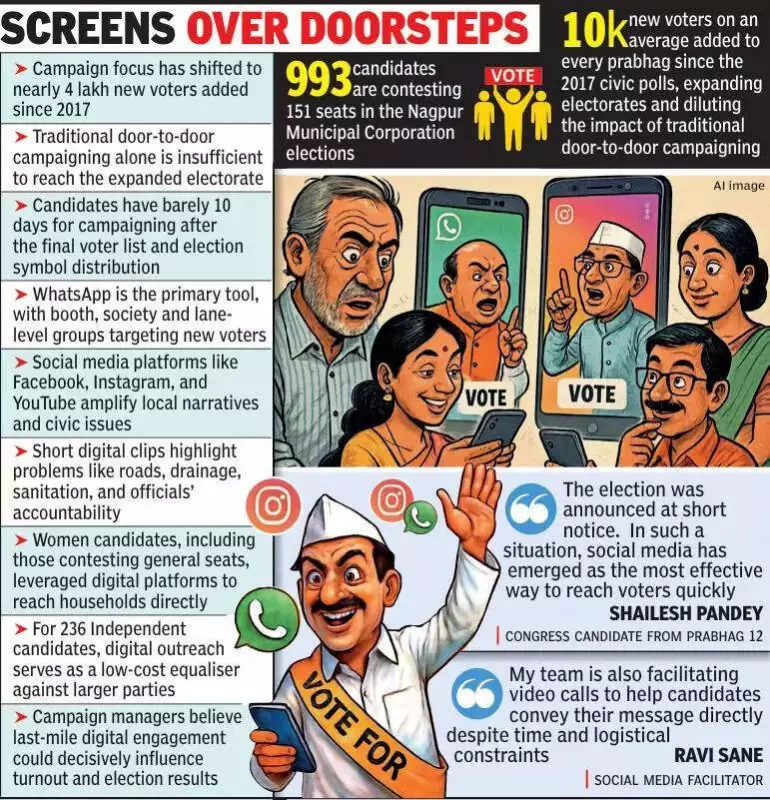
The electoral battlefield in Nagpur has transformed dramatically for the upcoming Municipal Corporation polls. With a staggering 993 candidates vying for just 151 seats, the political focus has intensely shifted towards a massive block of nearly 4 lakh new voters. This unprecedented expansion of the electorate has forced candidates to abandon traditional campaign playbooks and embrace a hyper-local digital strategy.
The Digital Imperative in a Compressed Timeline
The challenge for candidates was twofold: a vastly enlarged voter base and a severely compressed campaign period. While elections were announced on December 15, the real campaign sprint began only after the final candidate list and symbols were published on January 2. This left contenders with barely 10 days for outreach. With every prabhag (ward) gaining at least 10,000 new voters since the 2017 polls, conventional door-to-door canvassing became logistically impossible.
Candidates openly admitted that physically reaching this surge of first-time and newly enrolled voters was an unfeasible task. The geographical growth of wards, both vertically and horizontally, further complicated traditional methods. This gap created a critical window for digital tools to become the primary conduit for voter connection.

WhatsApp: The Engine of Hyper-Local Campaigning
Emerging as the undisputed champion of this digital push, WhatsApp became the central nervous system for campaign communication. Candidates and their teams created a labyrinth of targeted groups—booth-wise, society-wise, and even lane-level—to deliver tailored messages.
The content strategy was sharply focused on local civic issues that resonate in daily life:
- Road conditions and repairs
- Water supply reliability
- Drainage and sanitation problems
- General civic neglect
Beyond issue-based messaging, these groups are being used aggressively to circulate poll reminders, booth locations, and direct voting appeals. The target: the 4 lakh new voters perceived as politically fluid and less tied to established party loyalties, making them a decisive demographic.
Social Media Amplifies the Local Narrative
Platforms like Facebook, Instagram, and YouTube served as force multipliers. To capture the attention of a voter base that consumes information online, campaigns deployed short, compelling videos. These clips often highlighted local failures—such as candidates walking through waterlogged streets—or showed direct confrontations with officials, aiming to build a narrative of proactive leadership.
Campaign managers emphasized that in this short race, digital engagement was crucial for shaping first impressions, especially among voters unfamiliar with local political faces.
Digital Tools as a Great Equalizer
This shift to online campaigning had two significant democratizing effects. First, it provided a powerful platform for women candidates. Of the 76 seats reserved for women, and with 14 more contesting in general seats, many used women-centric WhatsApp groups and social media videos to reach households directly, often bypassing male-dominated traditional political networks.
Second, for the 236 Independent candidates in the fray, digital platforms became a great equalizer. Lacking the organizational machinery of major parties, these independents relied on low-cost, high-frequency online outreach to introduce themselves to the expanded voter base, leveling the playing field somewhat.
As campaigning officially concluded at 5 pm on January 13, the consensus among candidates is clear. In an election defined by rapid voter expansion and extreme time constraints, the ability to secure last-minute digital recall with the new voters could be the deciding factor. The outcome of this digital versus traditional battle will be revealed when Nagpur casts its vote on January 15.






