

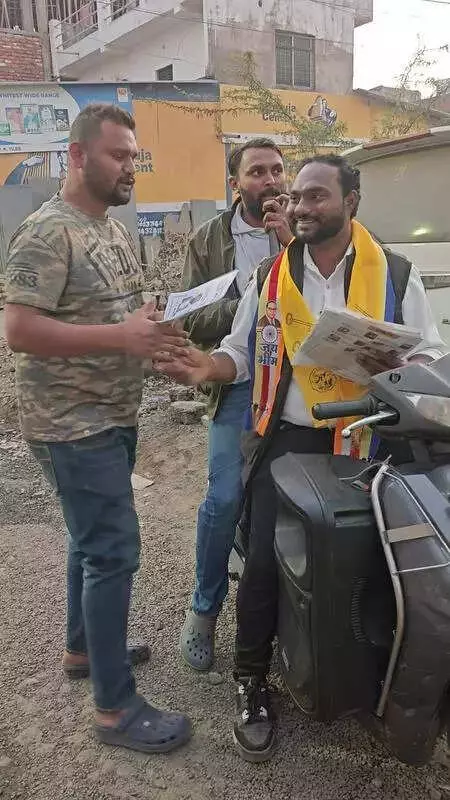
With the Nagpur Municipal Corporation (NMC) elections just days away, the city's campaign landscape is a study in contrasts. Two distinct political realities are unfolding simultaneously on the streets of Nagpur.
The Glitz of Major Parties vs. The Grit of Grassroots
On one side, established political giants like the Bharatiya Janata Party (BJP), the Nationalist Congress Party (NCP), and the Congress dominate the visual and auditory space. Their campaigns are characterized by massive rallies, convoys of vehicles, overpowering loudspeakers, and larger-than-life banners, showcasing their substantial organizational strength and financial muscle.
Running parallel, often in the shadows of these spectacles, is a quieter, more personal campaign led by independent candidates and those from smaller political outfits. This campaign is defined not by resources but by relentless personal effort and a direct connection with the electorate.

The Doorstep Warriors of Nagpur
Lacking the funds for fleets and fanfare, these candidates are betting on one-on-one interactions. Their strategy is simple: walk the wards, knock on every door, and speak to voters personally.
In Ward 1D, Nikhilesh Meshram of the Jan Badlao Party (JBP) embodies this approach. His entire campaign arsenal consists of a microphone and a small speaker fixed to his moped. "I go from lane to lane on my own," Meshram said, adding that he sometimes campaigns completely alone. A resident of Samta Nagar himself, he believes his local understanding of issues gives him an edge over parachuted candidates from big parties.
The story is similar in Ward 9A, where JBP's Deepak Sane is conducting a solitary door-to-door campaign with a stack of posters and brochures. "I am running my campaign using donated funds," he revealed, highlighting the financial constraints that shape his methods.
Overcoming Unique Challenges
For some candidates, the challenges are even more pronounced. Asawari Kotiwan, the People's Party of India candidate from Ward 35C, pointed out the physical difficulty of covering 500 to 600 homes alone. "That is why my relatives and my husband accompany me," she said. She also organized a modest rally of 15-20 people. Kotiwan acknowledged that campaigning as a woman presents additional hurdles but affirmed that the door-to-door model fosters a direct and trusted connection with voters.
In Ward 10D, independent candidate Mangesh Khandalkar has turned his limited budget into a strategy. He consciously chose house-to-house outreach because he lacks the funds for large-scale advertising. "Going house-to-house allows me to understand people's problems directly and discuss solutions face to face. That builds trust," Khandalkar explained.
His rival in the same ward, independent Ajay Mohbe, relies on a legacy of local service. With a local office and a record of assisting residents with schemes like the Ladki Bahin Yojana, Mohbe's candidacy is fueled by personal recognition. "People know me personally and encouraged me to contest the elections," he stated.
The Core Contrast: Resources vs. Relationships
The final days of the NMC campaign thus highlight a fundamental divide in Indian urban politics. The major parties leverage money, power, and organizational networks to create a wave of visibility. In contrast, the independents and small-party candidates are investing in the slow, painstaking work of building relationships one voter at a time.
As Nagpur voters prepare to cast their ballots, the question remains: Will the high-decibel, high-budget campaign prove decisive, or will the quiet conversations on the doorstep resonate more powerfully in the polling booths? The outcome will reveal which campaign style truly connected with the citizens of Nagpur.






