

Namesake Candidates Flood Tamil Nadu Assembly Polls in Strategic Move
The 2026 Tamil Nadu assembly elections have witnessed a remarkable and deliberate proliferation of namesake candidates across more than 100 constituencies, creating significant confusion among voters. This tactic involves fielding independent candidates with names identical or strikingly similar to those of prominent contenders from major political parties.
Multiple Identities in Key Constituencies
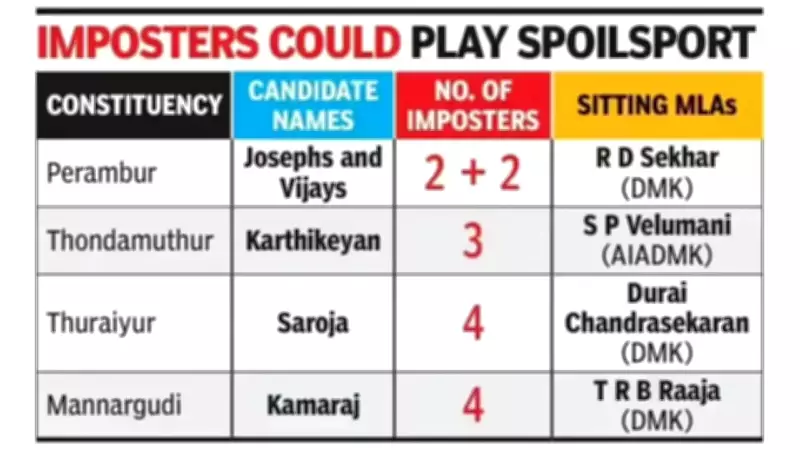
In Coimbatore South assembly constituency, where former DMK minister V Senthil Balaji is contesting, voters face an unusual dilemma: there are five candidates named Senthil Kumar in the fray. While one represents the official TVK candidate, the remaining four are independents. Similarly, in Perambur, where TVK president Vijay is contesting, the ballot includes two additional Vijays and two Josephs, further complicating the electoral landscape.
The pattern repeats in Thondamuthur, where AIADMK's S P Velumani faces competition that includes three candidates named Karthikeyan, mirroring the name of DMK's official candidate N Karthikeyan. In Thurayur assembly segment in Trichy district, AIADMK candidate Saroja finds herself competing against three namesakes, while Mannargudi features four candidates named Kamaraj, potentially confusing NDA voters.

Deliberate Strategy with Electoral Consequences
Political insiders confirm this is not coincidental but a calculated strategy. Opposition parties systematically field namesakes of popular candidates to sow confusion among voters, particularly in tight races where every vote counts. The impact of this tactic became evident in the 2021 elections in Katpadi, where DMK's Duraimurugan won by a mere 700 votes. In that contest, three namesakes of AIADMK candidate Ramu—independent candidates K Ramu and D Ramu, along with Raman—collectively secured 593 votes, potentially altering the outcome in a closely fought battle.
Election Commission's Countermeasures
In response to this growing concern, the Election Commission has implemented a significant change for the current elections: candidate photographs now appear on Electronic Voting Machines alongside party symbols. This measure aims to help voters distinguish between genuine candidates and their namesakes, reducing the likelihood of mistaken identity at the polling booth.
Expert Analysis and Legal Perspectives
Psephologist R Chandrasekaran highlights the legal dimensions of this practice, noting that courts have recognized its problematic nature. The Kerala High Court has described the fielding of namesake candidates as a 'massacre of democracy', warning that such tactics are designed to deceive voters. However, Chandrasekaran points out that enforcement remains weak, with limited intervention to curb this form of electoral manipulation despite judicial observations.
TVK functionary T Selvakumaran acknowledges that photographs on EVMs may provide some assistance but argues they are insufficient. "For newer parties like TVK with many unfamiliar faces, voters primarily rely on party symbols," he explains. "But even symbols can create confusion—free symbols like hand rollers can resemble our whistle symbol. The Election Commission needs to take stronger action against these deceptive tactics."
Broader Implications for Democratic Processes
The widespread use of namesake candidates raises serious questions about electoral integrity and voter autonomy. As Tamil Nadu heads to the polls, this phenomenon underscores the challenges in maintaining transparent and fair elections. While technological interventions like photographs on EVMs represent a step forward, experts emphasize that comprehensive regulatory measures and stricter enforcement are necessary to protect the democratic process from such manipulative strategies.






