

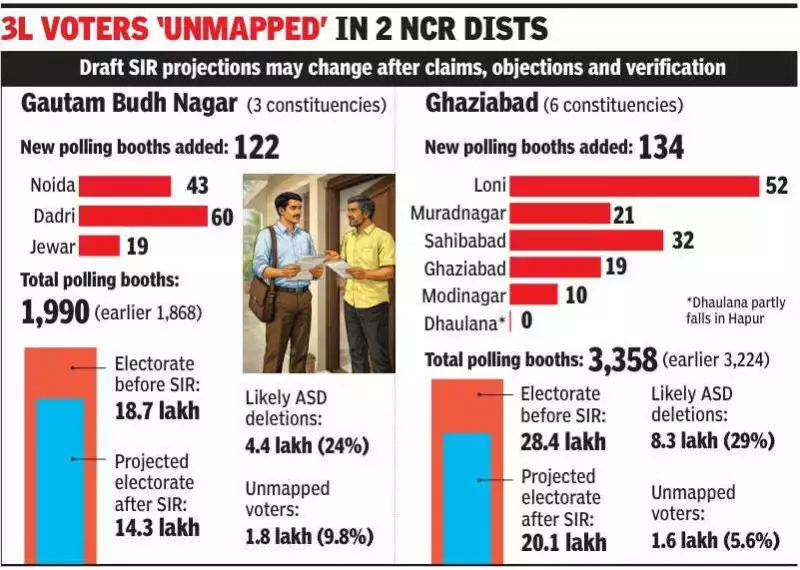
Voters in Gautam Budh Nagar (Noida) and Ghaziabad districts should brace for significant changes when they check the latest draft electoral roll. A large-scale rationalisation exercise, part of the ongoing Special Intensive Revision (SIR), has led to the creation of hundreds of new polling booths and a major remapping of voters. The draft roll is set for publication on Tuesday, January 6.
Massive Restructuring to Ease Voter Load
Election officials in both National Capital Region (NCR) districts undertook an extensive restructuring drive after identifying numerous polling booths where the number of electors had surpassed the prescribed limit of 1,200 voters per booth. This rationalisation was deemed unavoidable, especially in fast-growing residential areas where voter numbers have swelled.
In Gautam Budh Nagar, the district has added 122 new polling booths, taking its total from 1,868 to 1,990. The three assembly constituencies of Noida, Dadri, and Jewar, which together had 642 polling centres, will now have 644. Two new polling centres have been added in Dadri alone. To redistribute the voter load, officials added 43 new booths in Noida, 60 in Dadri, and 19 in Jewar.

Ghaziabad district witnessed an even larger expansion, adding 134 new polling booths. Its total count has risen from 3,224 to 3,358 booths. The district also added seven new polling centres: one each in Sahibabad and Dhaulana, and five in Ghaziabad. The booth increases were spread across five of the district's six assembly constituencies.
Booth-Level Officers Drive Ground Verification
The rationalisation was carried out in tandem with the core SIR task of identifying and removing Absent, Shifted, and Dead (ASD) voters from the rolls. Booth-Level Officers (BLOs) were instructed to physically verify electors, delete ineligible names, and flag voters who could not be mapped to existing booths.
In Ghaziabad, Additional DEO Saurabh Bhatt stated that fresh BLOs were appointed for all newly created booths. Each BLO prepared a new electoral roll for their respective booth, removing ASD voters and categorising previously unmapped electors.
In GB Nagar, Additional District Election Officer Atul Kumar detailed the meticulous process. The groundwork involved physical verification of locations and identification of suitable buildings between October 29 and November 4. A draft list of booths was published on November 10 for objections, followed by a meeting with MPs, MLAs, and political party representatives on November 18 to finalise the list. The final proposal was sent to the UP Chief Electoral Officer between November 19-21 and forwarded to the Election Commission of India for approval on November 24.
Over 12 Lakh Voters Face Deletion as ASD
The revision exercise is set to have a massive impact on the voter lists, leaving more than three lakh voters "unmapped" and leading to the potential deletion of over 12 lakh names across the two districts classified as ASD.
In GB Nagar, which has a total of about 18.7 lakh voters, nearly 4.4 lakh names (24%) may be deleted. The Noida constituency has the highest proportion of ASD voters at 27%, followed by Dadri at 22% and Jewar at 20%.
The situation is more pronounced in Ghaziabad. With an electorate of roughly 28.4 lakh, the district may see around 8.3 lakh names (29%) removed from the rolls. Sahibabad is set to top the list with a staggering 38% ASD voters, followed by Loni at 26%, Ghaziabad at 24.4%, Muradnagar at 24.3%, and Modinagar at 15%.
The draft electoral rolls for each newly created booth will be published on January 6 and made available locally for public scrutiny. Voters are advised to check their details promptly to ensure their names are correctly listed in the appropriate polling booth following this large-scale reshuffle.






