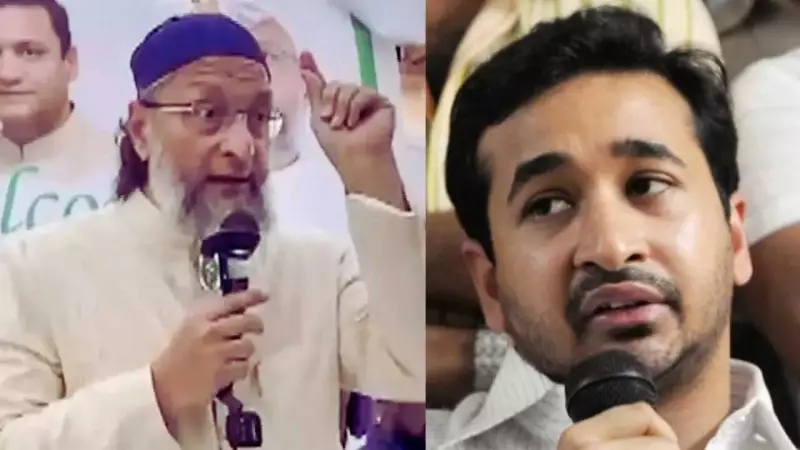
In a fiery exchange that has reignited debates on secularism and religious identity, AIMIM president Asaduddin Owaisi and Maharashtra minister Nitish Rane clashed over the inclusivity of the Indian Constitution and the possibility of a hijab-clad woman leading the nation.
Owaisi's Constitutional Contrast in Solapur
Addressing an election gathering in Solapur, Maharashtra, on Friday, Asaduddin Owaisi drew a sharp comparison between the constitutions of India and Pakistan. He pointed out that while Pakistan's Constitution reserves the posts of President and Prime Minister for followers of a specific religion, India's foundational document, framed by Babasaheb Ambedkar, imposes no such religious restrictions.
"The Constitution of India allows any citizen to become the Prime Minister, President, chief minister, or mayor," Owaisi stated, underscoring its secular character. He invoked Ambedkar's vision, saying, "His dream was that a day would come when a Hijab-clad woman would rise to become the Prime Minister of India. The day will come in future."

Rane's Forceful Rebuttal: "This is Our Hindu Nation"
The remarks prompted an immediate and aggressive response from Maharashtra's Minister for Industries, Nitish Rane. Dismissing Owaisi's statement, Rane asserted, "Asaduddin Owaisi does not dare to make such statements in our Hindu nation. This is our Hindu nation, where 90% of the population is Hindu."
Rane went further to explicitly reject the possibility Owaisi envisioned. "Women who wear hijab or burqa will not become the Prime Minister or the Mayor of Mumbai," he declared. He suggested that those aspiring for such positions should go to "their own Islamic countries, like Karachi. Here, they have no place."
Political Fallout and the Core Debate
This public spat highlights the deepening political and ideological fault lines in the country, especially in the context of electoral campaigning. The core of the debate revolves around two contrasting interpretations:
- Constitutional Inclusivity: Owaisi's argument rests on the letter and spirit of the Indian Constitution, which guarantees equality and does not bar any citizen from the highest offices based on religion or attire.
- Majoritarian Assertion: Rane's counter is rooted in a majoritarian perspective, emphasizing the demographic majority and defining the nation's character in religious terms.
The incident in Solapur has set the stage for a renewed discussion on secularism, representation, and the boundaries of political discourse in India. It underscores how symbols like the hijab have become potent flashpoints in the nation's ongoing cultural and political battles.